
Seasonal and Spatial Patterns in Water Quality and in Situ Responses of Daphnia Magna along River Kaduna, Nigeria
DOI:
https://doi.org/10.33003/fjs-2026-1022-6116Keywords:
Daphnia Magna, in Situ Bioassay, Water Quality, Dissolved Oxygen, SeasonalityAbstract
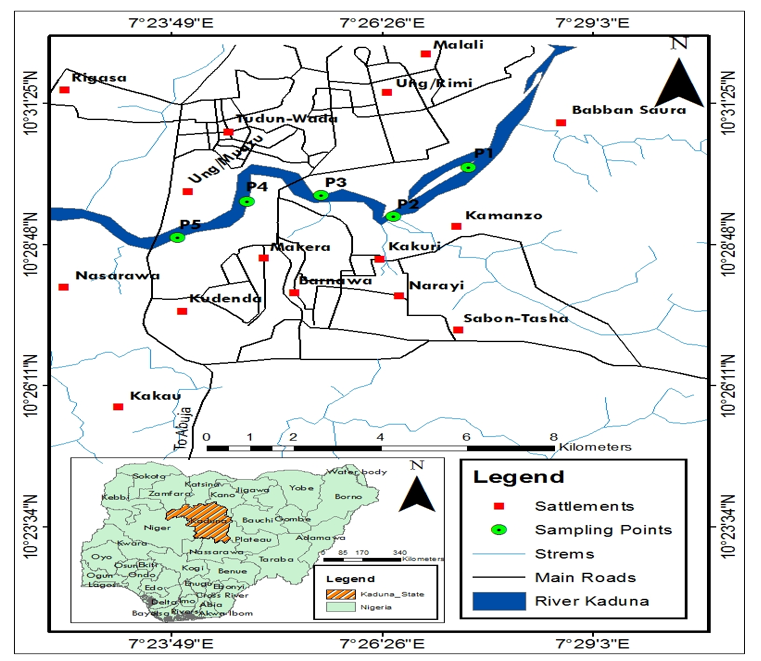
Variations in biochemical oxygen demand and dissolve oxygen affect aquatic organisms and have the potential to disrupt the ecological equilibrium of aquatic ecosystems. This study examined the effects of these environmental factors on the growth, reproduction and survival response of Daphnia magna at various sampling sites with differing levels of pollution in the River Kaduna, Nigeria, during both the dry and wet seasons. The physicochemical changes and the structure and dynamics of the D. magna community were monitored bi-monthly. In situ bioassays involving D. magna were conducted twice at five sampling locations in River Kaduna, Nigeria. Exposure was followed by reported measurements of growth, survival, and reproduction at 7 and 14 days. Mean station dissolved oxygen ranged from 2.75 to 4.15 mg/L, while biochemical oxygen demand ranged from 1.47 to 2.13 mg/L. Growth values were higher in wet season than dry season values at Stations 1 – 4; reproductive values were higher in dry season values at Stations 1 and 3, higher in the wet season values at Station 2, and equal at Station 4. This study assessed field bioassay screen of organism responses associated with ambient water conditions. The findings show that in stations with low pollution levels in the River Kaduna, Nigeria, higher DO levels promote improved D. Magna growth and reproductive function.
References
Ahmed S (2023) Applications of Daphnia magna in ecotoxicological studies: a review. J Adv Res Biology, 6(2), 16-35
Alexander S, Aronson J, Whaley O, Lamb D. 2016. The relationship between ecological restoration and the ecosystem services concept. Ecol Soc 21(1).
Baas J, Willems J, Jager T, Kraak MHS, Vandenbrouck T, Kooijman SALM (2009) Prediction of daphnid survival after in situ exposure to complex mixtures. Environ. Sci. Technol. 43, 6064-6069
Barata C, Damasio JB, Lopez MA, Kuster M, Lopez de Alda M, Barcelo D, Riva MC, Raldua D (2007) Combined use of biomarkers and in situ bioassays in Daphnia magna to monitor environmental hazards of pesticides in the field. Environmental Toxicology and Chemistry, 26: 370–379
Carlos Z, Bello-Mendoza R, Figueroa MS, Sokolov MY (2005) Chlorothalonil degradation under anaerobic conditions in an agricultural tropical soil. Water, Air, and Soil Pollution, 151: 397-409
Chen M, Kim S, Park J, Kim HS, Hur J (2016) Effects of dissolved organic matter (DOM) sources and nature of solid extraction sorbent on recoverable DOM composition: implication into potential lability of different compound groups. Anal. Bioanal. Chem. 408, 4809–4819
Ieromina O, Peijnenburg W, De Snoo G, Vijver M (2014) Population responses of Daphnia magna, Chydorus sphaericus and Asellus aquaticus in pesticide contaminated ditches around bulb fields. Environmental Pollution, 192, 196-203
Karaouzas I, Smeti E, Vourka A, Vardakas L, Mentzafou A, Tornés E, Kalogianni E (2017) Assessing the ecological effects of water stress and pollution in a temporary river-Implications for water management. Science of the Total Environment, 618: 1591–1604
Katrennada Ankous H (2024) Testing resistance of Daphnia magna in various environments
KEPA: Kaduna State Environmental Protection Authority (1998): revised in 1998
Lai Y, Jia Z, Xie Z, Li S, Hu J (2022) Water quality changes and shift in mechanisms controlling hypoxia in response to pollutant load reductions: A case study for Shiziyang Bay, Southern China. Science of The Total Environment, 842, 156774
Lushchak VI, Barata T, Sharma AA (2011). Environmentally induced oxidative stress in aquatic animals. Aquatic Toxicology, 11: 13-30
Majeed OS, Nashaat MR, Al-Azawi AJ (2022) Physicochemical parameters of river water and their relation to zooplankton: A review. In IOP Conference Series: Earth and Environmental Science (Vol. 1120, No. 1, p. 012040). IOP Publishing
Medupe M, Letshwenyo MW (2025) Investigation of self-purification and water quality index during dry and rainy seasons in the Khurumela Stream (Botswana). Journal of Ecohydraulics, 10(1), 1-18
McWilliam RA Baird DJ (2002) Application of post exposure feeding depression bioassays with Daphnia magna for assessment of toxic effluents in rivers. Environmental toxicology and chemistry, 21(7): 1462-1468
Moro, H., Vaya, R., Casado, M., Piña, B., Domínguez-García, P., Gómez-Canela, C., & Barata, C. (2024). Biomonitoring emerging hazards of pharmaceuticals in river water using gut microbiome and behavioural Daphnia magna responses. Chemosphere, 143612. https://doi.org/10.1016/j.chemosphere.2024.143612
Moulinec, A., Arle, J., Hollert, H., Hörchner, S., Johann, S., Kienle, C., Oetken, M., & Sundermann, A. (2025). Assessing chemical pollution with biomonitoring approaches in streams and rivers: a critical review. Environmental Sciences Europe, 37. https://doi.org/10.1186/s12302-025-01110-z
OECD (2004) OECD Guideline for Testing of Chemicals 202- Daphnia Sp., AcuteImmobilisation Test Organization for the Economic Cooperation and Development. OECD, Paris.
Ogbozige, F., Adie, D. B., & Abubakar, U. (2018). Water quality assessment and mapping using inverse distance weighted interpolation: a case of River Kaduna, Nigeria. In Nigerian Journal of Technology (Vol. 37, pp. 249–261). https://doi.org/10.4314/NJT.V37I1.33
Prommi T, Payakka A (2015) Aquatic Insect Biodiversity and Water Quality Parameters of Streams in Northern Thailand. Sains Malaysiana. 4(5): 707–717
Romero-Alfano, I., Prats, E., Raldúa, D., Blázquez, M., Tauler, R., Piña, B., Gómez-Canela, C., & Barata, C. (2025). Assessing neurological and cardiovascular effects caused by pharmaceuticals in river water: Insights from Daphnia magna and Danio rerio embryos. Chemosphere, 385, 144541. https://doi.org/10.1016/j.chemosphere.2025.144541
Romero-Alfano, I., Prats, E., Raldúa, D., Gómez-Canela, C., & Barata, C. (2026). Neurotoxic effects of representative pharmaceutical mixtures from Mediterranean rivers impacted by waste water treated effluents. The Science of the Total Environment, 1039, 181901. https://doi.org/10.1016/j.scitotenv.2026.181901
Sadiq, Q., Ezeamaka, C. K., Daful, M., & Mustafa, I. (2022). Evaluation of the Water Quality of River Kaduna, Nigeria Using Water Quality Index. In Environmental Technology and Science Journal. https://doi.org/10.4314/etsj.v13i1.3
Shalaby AM, Khattab YA, Abdel rahman AM (2006) Effects of garlic (Allium sativum) and chloramphenicol on the growth performance of physiological parameter and survival of wile Tilapia (O. niloticus). Journal of Venomous Animal and Toxins Including Tropical Diseases, 12(2): 365-378
Singh SP, Sharma J, Ahmad T, Chakrabarti R (2016) Oxygen stress: impact on innate immune system, antioxidant defence system and expression of HIF-1α and ATPase 6 genes in Catla. Fish Physiol. Biochem. 42: 673–688
Solomon CT, Jones SE, Weidel BC, Buffam I, Fork ML, Karlsson J, Larsen S, Lennon JT, Read JS, Sadro S, (2015) Ecosystem consequences of changing inputs of terrestrial dissolved organic matter to lakes: current knowledge and future challenges. Ecosystems 18, 376–389
Tepe Y, Mutlu E (2005) Physico-chemical characteristics of Hatay Harbiye spring water, Turkey. Journal of the Institute of Science and Technology of Dumlupinar University, 6: 77-88
USEPA (1993) Methods for Measuring the Acute Toxicity of Effluents and Receiving Waters to Freshwater and Marine organisms, fourth ed. USEPA/600/4-90/027F
Vale G, Mehennaoui K, Cambier S, Libralato G, Jomini S, Domingos RF (2016) Manufactured nanoparticles in the aquatic environment-biochemical responses on freshwater organisms: a critical overview. Aquat. Toxicol. 170: 162–174
Downloads
Published
Issue
Section
Categories
License
Copyright (c) 2026 Idris Shaaba Ramatu, Bala Alhassan Abdullahi, Ahii Chia Mathias, Adamu Wada Yunusa, Yusuf Abdullateef, John Ameh Adakole, Danladi Balarabe Dangora, Madu Katsallah Gadzama Ibrahim

This work is licensed under a Creative Commons Attribution 4.0 International License.