
Poverty Status among Cassava (Manihot esculenta Crantz) Farmers in Bekwarra Local Government Area of Cross River State, Nigeria
DOI:
https://doi.org/10.33003/fjs-2026-1018-6101Keywords:
Cassava Farmers, Manihot esculenta Crantz, Poverty Status, Determinants, ConstraintsAbstract
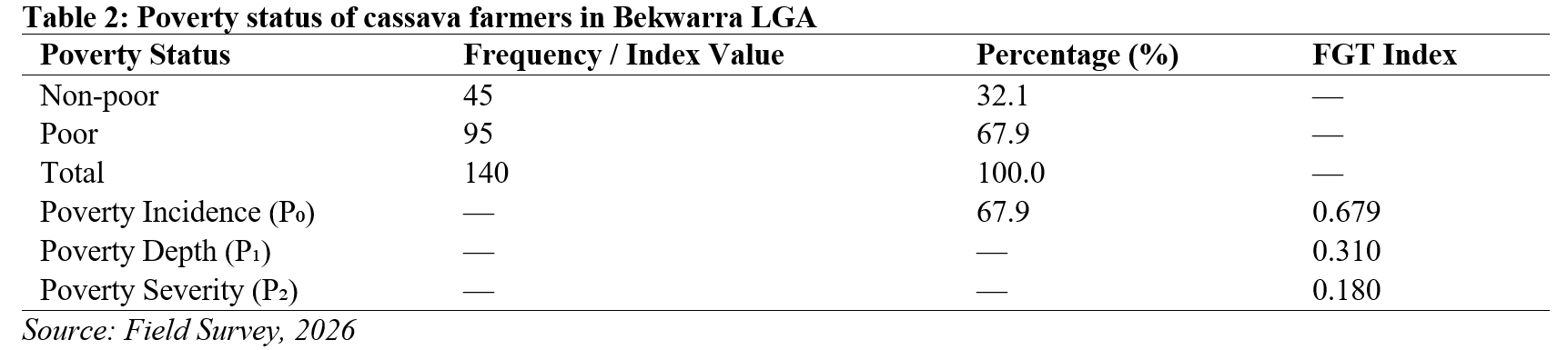
Poverty among smallholder cassava farmers remains a critical development challenge in rural Nigeria despite the country’s status as the world’s largest cassava producer. This study assessed the poverty status of cassava (Manihot esculenta Crantz) farmers in Bekwarra area of Cross River State, Nigeria. A multistage sampling procedure was used to select 140 respondents from four randomly selected wards. Primary data were collected through structured questionnaires administered via personal interview and analyzed using descriptive statistics, the Foster-Greer-Thorbecke (FGT) poverty index, and binary logit regression. Results revealed that 67.9% of sampled cassava farmers were classified as poor, falling below the poverty line, while 32.1% were non-poor. The poverty depth index (P1= 0.31) and severity index (P2= 0.18) further confirmed the depth and intensity of poverty in the study area. Logit regression results showed that farming experience (p = 0.000), farm income (p = 0.003), and farm size (p = 0.003) were significant at the 1% level, while years of schooling (p = 0.080) and age (p = 0.096) were significant at the 10% level. Major constraints included insecurity (90.7%), adverse climate conditions (89.3%), and financial exclusion (89.3%). The study concludes that Poverty among cassava farmers is multidimensional and driven by interconnected socio-economic and institutional constraints, and recommends targeted policy interventions addressing security, credit access, extension services, land consolidation, and rural infrastructure to improve farmers’ welfare.
References
Aboajah, F. N., Onjewu, S. S., Chia, J. I., & Okeme, S. (2018). Socio-economic determinants of cassava production in Benue State, Nigeria. International Journal of Environment, Agriculture and Biotechnology, 3(2), 550–557. https://doi.org/10.22161/ijeab/3.2.32
African Development Bank. (2023). Feed Africa: Strategy for agricultural transformation in Africa 2022–2025. AfDB Group.
Agunbiade, M. O., & Oke, J. T. O. (2019). Poverty analysis of cassava farming households in Osun State. Journal of Development and Agricultural Economics, 11(1), 9–14. https://doi.org/10.5897/JDAE2017.0867
Akoji, S. J., & Abaji, A. S. (2025). The 2022 multidimensional poverty index of Nigeria: A sociological review. PanAfrican Journal of Governance and Development, 6(1), 141–168. https://doi.org/10.46404/panjogov.v6i1.6192
Akpaeti, A., Okon, U., & Archibong, D. (2024). Determinants of poverty severity among cassava farmers in Uyo Agricultural Zone, Akwa Ibom State, Nigeria. Nigerian Agricultural Journal, 54(2), 452–459. https://www.ajol.info/index.php/naj/article/view/267778
Anderson, J. R., & Feder, G. (2004). Agricultural extension: Good intentions and hard realities. World Bank Research Observer, 19(1), 41–60. https://doi.org/10.1093/wbro/lkh013
Babatunde, R., Salami, M., & Adeboje, A. (2016). Poverty among cassava farmers in Oyo State, Nigeria: Characteristics and drivers. Journal of Agribusiness and Rural Development, 41(3), 249–254. https://doi.org/10.17306/JARD.2016.51
Christiaensen, L., Demery, L., & Kuhl, J. (2011). The (evolving) role of agriculture in poverty reduction. Journal of Development Economics, 96(2), 239–254. https://doi.org/10.1016/j.jdeveco.2010.10.006
Doss, C., Meinzen-Dick, R., Quisumbing, A., & Theis, S. (2018). Women in agriculture: Four myths. Global Food Security, 16, 69–74. https://doi.org/10.1016/j.gfs.2017.10.001
Edaba, M. I., Onoja, A. O., & Elum, Z. A. (2025). Analysis of farm credit access among cassava-based farmers in South-South Nigeria. International Journal of Agriculture and Environmental Research, 11(2), 510–530. https://doi.org/10.51193/IJAER.2025.11213
Edike, C. E., Kainga, P. E., & Ekiyor, A. T. (2025). Constraints of cassava farming in South-South Nigeria: A case of cassava cooperative farmers. Journal of Agripreneurship and Sustainable Development, 8(1), 68–74. http://www.jasd.daee.atbu.edu.ng
Food and Agriculture Organization. (2023). FAOSTAT: Crops and livestock products. FAO. https://www.fao.org/faostat
Foster, J., Greer, J., & Thorbecke, E. (1984). A class of decomposable poverty measures. Econometrica, 52(3), 761–766. https://doi.org/10.2307/1913475
Hossain, M., Bose, M. L., & Mustafi, B. A. A. (2006). Adoption and productivity impact of modern rice varieties in Bangladesh. The Developing Economies, 44(2), 149–166.
Ikuemonisan, E. S., Mafimisebi, T. E., Ajibefun, I., & Adenegan, K. (2020). Cassava production in Nigeria: Trends, instability and decomposition analysis. Heliyon, 6(10), e05196. https://doi.org/10.1016/j.heliyon.2020.e05089
Larson, D. F., Otsuka, K., Matsumoto, T., & Kilic, T. (2014). Should African rural development strategies depend on smallholder farms? World Development, 53, 152–164. https://doi.org/10.1111/agec.12070
National Bureau of Statistics. (2022). Nigeria multidimensional poverty index. https://www.nigerianstat.gov.ng
Olayiwola, S. A., Odo, D. O., & Olayiwola, M. O. (2025). Adoption of vitamin A-fortified cassava technology and its effect on poverty status in Benue State, Nigeria. Sule Lamido University Journal of Science & Technology, 10(1), 74–81. https://doi.org/10.56471/
Osuji, M. N. (2019). Determinants of poverty status of cassava-based farmers in Imo State, Nigeria. Advances in Research, 20(1), 1–8. https://doi.org/10.9734/AIR/2019/v19i630145
World Bank. (2022). World development indicators. https://databank.worldbank.org/
Yuguda, R. M., Girei, A. A., Dire, B., & Salihu, M. (2013). Socio-economic factors and constraints influencing productivity among cassava farmers in Taraba State, Nigeria. International Journal of Advances in Agricultural Science and Technology, 1(1), 1–15.
Downloads
Published
Issue
Section
Categories
License
Copyright (c) 2026 Sikiru Adekunle Olayiwola, Veronica Adah-Oshi Aganyi, Salamotu Waniyo Umaru, Abali Ousmanou

This work is licensed under a Creative Commons Attribution 4.0 International License.


