Comparative Performance of Random Forest and Multilayer Perceptron Models for Diabetes Classification using the Pima Indian Diabetes Dataset
DOI:
https://doi.org/10.33003/fjs-2026-1020-6088Keywords:
Diabetes prediction, Random Forest, MLP Neural Network, machine learning, Clinical decision supportAbstract
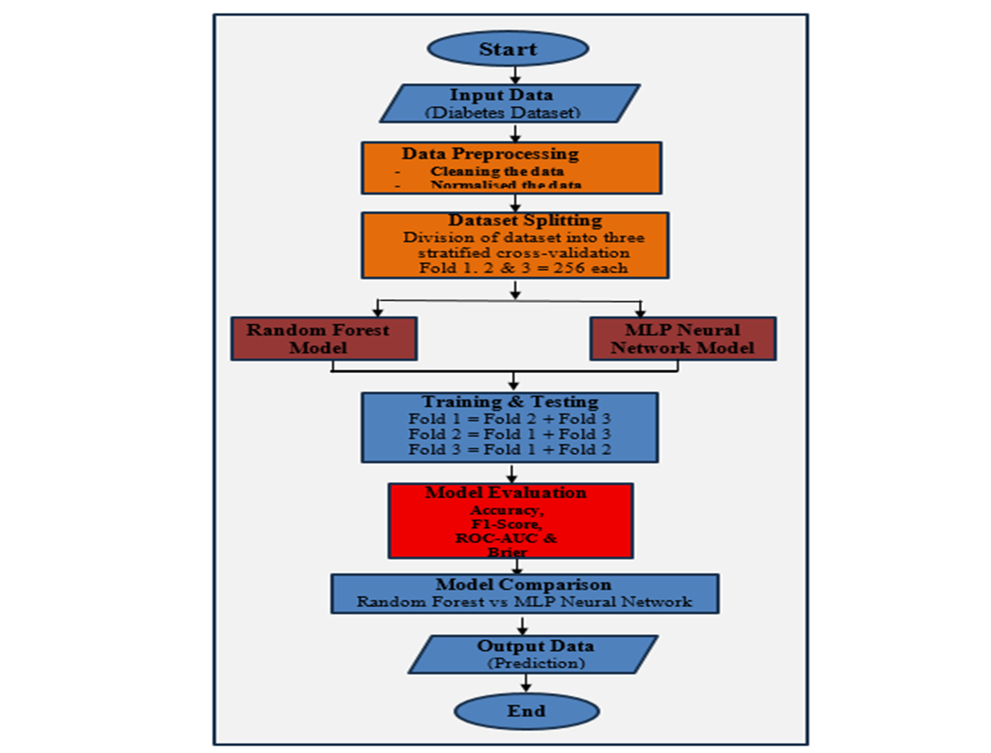
Diabetes has become one of the most severe public health issues around the globe and is especially severe in developing nations. Aging leads to an increase in population, as well as impact rate. If timely diagnosis is not achieved, diabetes can significantly increase the prevalence of microvascular and macrovascular complications that can lead to increased costs of care and mortality. Commonly believed, none of these tests, namely Hemoglobin A1c (HbA1c), the Oral Glucose Tolerance Test (OGTT) or the Fasting Plasma Glucose (FPG) is a predictive or predisposing test. Making a model that can foresee these potentially fatal diseases is crucial for identifying those at risk before they become very sick. Using the Pima Indians Diabetes Dataset of 768 with 9 variables, this research assesses diabetes prediction using MLP Neural Network (MLP-NN) and Random Forest (RF) models. Several methods for feature engineering and data preparation were used to improve the model's performance. We validated our model using a three-fold stratified cross validation technique. This study uses ROC-AUC, F1-Score, Accuracy, and Brier for evaluating the performance of the model. With an accuracy of 76.43%, F1-Score of 63.28%, Brier 15.62% and ROC-AUC of 83.86%. However, after the simulation of this model if design and implemented accordingly, it will predict accurately and be reliable based on the results.
References
Afsaneh E., A. Sharifdini, H. Ghazzaghi, and M. Zarei Ghobadi, (2022) "Recent applications of machine learning and deep learning models in the prediction, diagnosis, and management of diabetes: A comprehensive review," Diabetology & Metabolic Syndrome, vol. 14, no. 1, p. 196, https://doi.org10.1186/s13098-022-00969-9
Alghamdi T., (2023) "Prediction of diabetes complications using computational intelligence techniques," Applied Sciences, vol. 13, no. 5, p. 3030, https://doi.org10.3390/app13053030
American Diabetes Association Professional Practice Committee, (2024) "Introduction and methodology: Standards of Care in Diabetes," Diabetes Care, vol. 47, no. 1, pp. S1–S4, 2023. https://doi.org10.2337/dc24-SINT
Chukwuebuka Joseph Ejiyi , Zhen Qin a, Joan Amos, Makuachukwu Bennedith Ejiyi, Ann Nnani, Thomas Ugochukwu Ejiyi, Victor Kwaku Agbesi, Chidimma Diokpo, Chidinma Okpara (2023) "A robust predictive diagnosis model for diabetes mellitus using Shapley-incorporated machine learning algorithms," Healthcare Analytics, vol. 3, p. 100166,. https://doi.org10.1016/j.health.2023.100166
El-Sofany H, S. A. El-Seoud, O. H. Karam, Y. M. Abd El-Latif, and I. A. T. F. Taj-Eddin, (2024) "A proposed technique using machine learning for the prediction of diabetes disease through a mobile app," International Journal of Intelligent Systems, vol., Art. no. 6688934, 2024. https://doi.org10.1155/2024/6688934
Ganie S. M., P. K. D. Pramanik, M. Bashir Malik, S. Mallik, and H. Qin, (2023) "An ensemble learning approach for diabetes prediction using boosting techniques," Frontiers in Genetics, vol. 14,. https://doi.org10.3389/fgene.2023.1252159
Gupta N., B. Kaushik, M.-K.-I. Rahmani, and S.-A. Lashari, (2023) "Performance evaluation of deep dense layer MLP Neural Network for diabetes prediction," Computers, Materials & Continua, vol. 76, no. 1, pp. 347–366, https://doi.org10.32604/cmc.2023.038864
Hanif K. H. and R. W. Dwinanto, (2023) "Comparison of random forest algorithm, support vector machine, and k-nearest neighbor for diabetes disease classification,”
Kaur S, D. Kaur, M. Mayank, and N. T. Singh, (2023) "Diabetes detection using random forest classifier and risk score calculation using random forest regressor,".
Mohsen F., H. R. H. Al-Absi, N. A. Yousri, N. El Hajj, and Z. Shah, "Artificial intelligence-based methods for precision medicine: Diabetes risk prediction," arXiv:2305.16346.
Sun Q, X. Cheng et al., (2024) "Machine learning-based assessment of diabetes risk," Applied Intelligence, https://doi.org10.1007/s10489-024-05912-1
Su Y., C. Huang, W. Zhu, X. Lyu, and F. Ji, (2023) "Multi-party diabetes mellitus risk prediction based on secure federated learning," Biomedical Signal Processing and Control, vol. 85, p. 104881. https://doi.org/10.1016/j.bspc.2023.104881
Paucar I. R., C. Yactayo-Arias, and L. Andrade-Arenas, (2025). "Random Forest model based on machine learning for early detection of diabetes," International Journal of Advanced Computer Science and Applications.
Pratama R., A. M. Siregar, S. A. P. Lestari, and S. Faisal, (2024). "Implementation of diabetes prediction model using random forest algorithm, k-nearest neighbor, and logistic regression," Jurnal Teknik Informatika (JUTIF), vol. 5, no. 4, pp. 1165–1174.
Downloads
Published
Issue
Section
Categories
License
Copyright (c) 2026 Adama Asmau Sani, Olawale Mustapha Isah, Adekunle Olorukooba Abdullateef, Abubakar Ndagi Muhammad, Abdulmuqtadir Yunus, Bello-Sulayman Omotosho Yusuf

This work is licensed under a Creative Commons Attribution 4.0 International License.