
Survey and Identification of Biological Contaminants in Sources of Drinking Water in Biu Metropolis, Biu Local Government Area, Borno State, Nigeria
DOI:
https://doi.org/10.33003/fjs-2026-1020-6064Keywords:
Drinking water, Bacterial contaminants, Fungal contaminants, Water quality, BiuAbstract
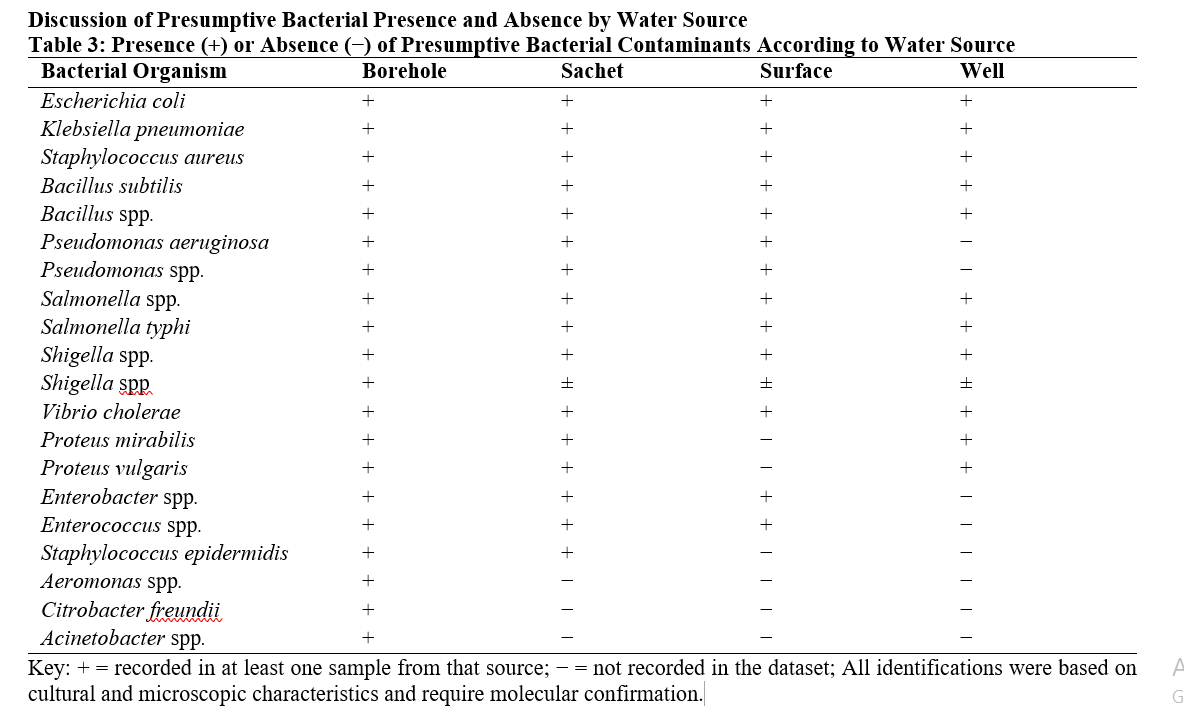
Safe drinking water remains a public health priority in developing nations where untreated sources are commonly used. This study assessed the physicochemical and biological quality of drinking water from borehole, sachet, surface, and well water sources in Biu Local Government Area, Borno State. A total of 120 water samples were collected between April and September 2026 and analysed using standard methods. Physicochemical parameters differed significantly among sources (p < 0.05), with sachet water recording the lowest conductivity (278.48 μS/cm) and TDS (195.43 mg/L), while surface water had the highest (731.04 μS/cm and 469.76 mg/L, respectively). Bacterial and fungal contaminants were detected across all sources. Borehole water contained the greatest number of presumptively identified bacterial types (20), while well water contained the fewest (14). Fungal genera including Aspergillus, Penicillium, Fusarium, Candida, Rhizopus, and Cryptococcus were detected, with sachet water containing the highest number of fungal types (13). Identifications were presumptive; confirmatory molecular methods and quantitative microbial enumeration were not performed. The findings indicate that water sources in the study area harbour bacterial and fungal contaminants of potential public health concern. Routine monitoring of physicochemical, bacteriological, and fungal parameters is recommended for all drinking-water sources in the study area.
References
Abd-El-Haleem, D., Kheiralla, Z. H., Zaki, S., Rushdy, A. A., & Abd-El-Rahiem, W. (2003). Multiplex-PCR and PCR-RFLP assays to monitor water quality against pathogenic bacteria. Journal of Environmental Monitoring, 5(6), 865–870.
Alawi, M., Smyth, C., Drissner, D., Zimmerer, A., Leupold, D., Müller, D., Do, T. T., Velasco-Torrijos, T., & Walsh, F. (2024). Private and well drinking water are reservoirs for antimicrobial resistant bacteria. npj Antimicrobials and Resistance, 2, Article 7.
American Public Health Association. (2017). Standard methods for the examination of water and wastewater (23rd ed.). American Public Health Association.
Chukwuka, G. E., Akpan, E. K., Oshilonyah, L. U., & Sunday, E. (2025). Bacteriological safety and antibiotic resistance of pathogens in packaged drinking water: Evidence from Agbor, Delta State, Nigeria. International Journal of Health Sciences and Research, 10(9), 159–179.
Desouky, A. H., Kheiralla, Z. H., Zaki, S., Rushdy, A. A., & Abd-El-Raheim, W. (2003). Multiplex-PCR and PCR-RFLP assays to monitor water quality against pathogenic bacteria. Journal of Environmental Monitoring, 5(6), 865–870.
Ezedum, C. E. (2012). Appropriate health education strategy for accelerating water supply and sanitation development in Nigeria. Nigerian Journal of Health Education and Sport Science, 3(1), 20–25.
Exner, M., Fricker, C., & Glasmacher, A. (Eds.). (2003). Heterotrophic plate counts and drinking-water safety. IWA Publishing.
Fenwick, A. (2006). Waterborne infectious diseases—could they be consigned to history? Science, 313(5790), 1077–1081.
Fricker, C. R. (2003). The presence of bacteria in water after regrowth. In J. Bartram, J. Cotruvo, M. O. H. Fricker, A. Glasmacher, A. B. Hunter, & L. Payment (Eds.), Heterotrophic plate counts and drinking-water safety. IWA Publishing.
Garrity, G. M., Brenner, D. J., Krieg, N. R., & Staley, J. T. (Eds.). (2006). Bergey's manual of systematic bacteriology: Vol. 2, The Proteobacteria, and Part A: Introductory essays (2nd ed.). Springer.
González-Machado, C., Alonso-Calleja, C., & Capita, R. (2024). Methicillin-resistant Staphylococcus aureus (MRSA) in different food groups and drinking water. Foods, 13(17), 2686.
Grandhay, C., Prétot, E., Klaba, V., Celle, H., Normand, A.-C., Bertrand, X., & Grenouillet, F. (2024). Yeast biodiversity of karst waters: Interest of four culture media and an improved MALDI-TOF MS database. Microbial Ecology, 87(1), 26.
Hageskal, G., Knutsen, A. K., Gaustad, P., de Hoog, G. S., & Skaar, I. (2006). Diversity and significance of mold species in Norwegian drinking water. Applied and Environmental Microbiology, 72(12), 7586–7593.
Hageskal, G., Vrålstad, T., Knutsen, A. K., & Skaar, I. (2008). Exploring the species diversity of Trichoderma in Norwegian drinking water systems by DNA barcoding. Molecular Ecology Resources, 8(6), 1178–1188.
Hara-Kudo, Y., & Takatori, K. (2011). Contamination level and ingestion dose of foodborne pathogens associated with infections. Epidemiology and Infection, 139(10), 1505–1511.
Hiro, B., Soheil, S., & Farzaneh, S. M. (2013). Biological contamination of the water and its effects. Technology, Education, and Science International Conference (TESIC).
Holt, J. G., Krieg, N. R., Sneath, P. H. A., Staley, J. T., & Williams, S. T. (Eds.). (1994). Bergey's manual of determinative bacteriology (9th ed.). Williams & Wilkins.
Hocking, A. D. (2009). Fungi and food spoilage (3rd ed.). Springer.
Hu, B., Hou, P., Teng, L., Miao, S., Zhao, L., Ji, S., Li, T., Kehrenberg, C., Kang, D., & Yue, M. (2022). Genomic investigation reveals a community typhoid outbreak caused by contaminated drinking water in China, 2016. Frontiers in Medicine, 9, 753085.
Ibeto, C. N., & Okoye, C. O. B. (2010). High levels of heavy metals in blood of the urban population in Nigeria. Research Journal of Environmental Sciences, 4(4), 371–382.
Kanzler, D., Buzina, W., Paulitsch, A., Haas, D., Platzer, S., Marth, E., & Mascher, F. (2008). Occurrence and hygienic relevance of fungi in drinking water. Mycoses, 51(2), 165–169.
Koko, D. T., Alfred, M. O., Bolujoko, N. B., Olorunnisola, D., Otitoju, O. B., Alabi, P., Ogunlaja, O. O., Okonofua, F., Omonkhua, A. A., Msagati, T. A. M., Omorogie, M. O., Ogunlaja, A., Olukanni, O. D., & Unuabonah, E. I. (2024). Prevalence and health risk evaluations of mycotoxins in drinking water sources in Nigeria. RSC Advances, 14(46), 34435–34447.
Kwari, W. J. (2015). Groundwater quality assessment: A case study of groundwater from hand-dug wells in Hawul Local Government Area of Borno State. International Journal of Advanced Research, 3(2), 537–546.
Liu, H., Yang, C., Wang, T., Luo, P., Fiallos, M., Guo, S., & Zhao, Y. (2025). Disinfection mechanism of chlorine-resistant bacteria by micro-nano bubbles in drinking water: A case study of Bacillus cereus. Chemical Engineering Journal, 515, 163782.
Mshelia, Y. M., Lawan, D. M., Arhyel, M., & Inuwa, J. (2023). Physicochemical analysis and water quality assessment of selected location in Maiduguri Metropolis using Weighted Arithmetic Water Quality Index. FUDMA Journal of Sciences, 7(4), 147–151. https://doi.org/10.33003/fjs-2023-0704-1899
Novak Babič, M., Zupančič, J., Brandão, J., & Gunde-Cimerman, N. (2018). Opportunistic water-borne human pathogenic filamentous fungi unreported from food. Microorganisms, 6(3), 79.
Oridikitorusinyaa, O., Amaechi, G., & Emmanuel, O. O. (2025). In vitro bacteriological assessment of some commercial drinking water sold in Port Harcourt metropolis. International Journal of Microbiology and Applied Sciences, 4(3).
Oyelude, E. O., Densu, A. E., Yankey, E., & Olajide, E. (2013). Quality of groundwater in Kassena-Nankana district, Ghana and its health implications. Water Quality, Exposure and Health, 5(3), 153–162.
Paterson, R. R. M., Kelley, J., & Gallagher, M. (1997). Natural occurrence of aflatoxins and Aspergillus flavus (Link) in water. Letters in Applied Microbiology, 25(6), 435–436.
Samson, R. A., Hoekstra, E. S., & Frisvad, J. C. (Eds.). (1995). Introduction to food-borne fungi (4th ed.). Centraalbureau voor Schimmelcultures.
Shittu, O. B., Iwaloye, O. F., Oloyede, A. R., Oni, E. O., Ajibola, A. T., Arowosegbe, A. O., & Oluwasanya, G. O. (2022). Water safety, antifungal-resistant aflatoxigenic Aspergillus flavus and other pathogenic fungi in community hand-dug wells. Journal of Applied Microbiology, 133(2), 673–682.
Shrestha Khwakhali, U. (2024). Detection of pathogenic Aspergillus species in drinking jar water from Kathmandu Valley, Nepal [Conference abstract]. Aspergillus and Aspergillosis, Abstract No. 20.
Sivalingam, K. M., & Vaithilingam, S. (2021). Isolation and identification of multiple drug resistant bacterial pathogens from well water samples in and around Wolaita Sodo Town, Southern Ethiopia. Journal of Drug Delivery & Therapeutics, 11(3), 70–78.
Sokal, R. R., & Rohlf, F. J. (2012). Biometry: The principles and practice of statistics in biological research (4th ed.). W. H. Freeman.
Wadowsky, R. M., Wolford, R., McNamara, A. M., & Yee, R. B. (1985). Effect of temperature, pH, and oxygen level on the multiplication of naturally occurring Legionella pneumophila in potable water. Applied and Environmental Microbiology, 49(5), 1197–1205.
Wan, Q., Wen, G., Cui, Y., Cao, R., Xu, X., Wu, G., Wang, J., & Huang, T. (2023). Occurrence and control of fungi in water: New challenges in biological risk and safety assurance. Science of the Total Environment, 860, 160536.
Wang, S.-Y., Herrera-Balandrano, D. D., Shi, X.-C., Chen, X., Liu, F.-Q., & Laborda, P. (2023). Occurrence of aflatoxins in water and decontamination strategies: A review. Water Research, 232, 119703.
Wheeler, K. A., Hurdman, B. F., & Pitt, J. I. (1991). Influence of pH on the growth of some toxigenic species of Aspergillus, Penicillium and Fusarium. International Journal of Food Microbiology, 12(2–3), 141–148.
World Health Organization. (2003). Total dissolved solids in drinking-water: Background document for development of WHO Guidelines for Drinking-water Quality (WHO/SDE/WSH/03.04/16).
World Health Organization. (2011). Guidelines for drinking-water quality (4th ed.).
World Health Organization. (2017). Guidelines for drinking-water quality: Fourth edition incorporating the first addendum.
World Health Organization. (2022). Guidelines for drinking-water quality: Fourth edition incorporating the first and second addenda.
Zar, J. H. (2010). Biostatistical analysis (5th ed.). Pearson Prentice Hall.
Zhang, X., Xu, X., Cao, R., Wan, Q., Wang, J., Xu, H., Lin, Y., Wen, G., & Huang, T. (2021). The formation kinetics and control of biofilms by three dominant fungi species isolated from groundwater. Journal of Environmental Sciences, 109, 148–160.
Downloads
Published
Issue
Section
Categories
License
Copyright (c) 2026 Muhammad Muazu Danzaki, Alamin Ibrahim, Haruna Buratai

This work is licensed under a Creative Commons Attribution 4.0 International License.


