
Aflatoxin B₁ in Cattle Feed and Aflatoxin M₁ in Milk in Northern Nigeria: Occurrence, Feed-to-Milk Carry-Over, Health Implications and Research Gaps
DOI:
https://doi.org/10.33003/fjs-2026-1017-6055Keywords:
Aflatoxin B₁, Aflatoxin M₁, Cattle feed, Milk, Carry-over, Dairy safety, Northern Nigeria, Katsina StateAbstract
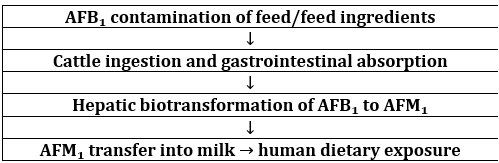
Aflatoxins are toxic fungal metabolites of major food- and feed-safety concern. In dairy production, aflatoxin B₁ (AFB₁) ingested in contaminated feed is metabolised to aflatoxin M₁ (AFM₁), which is excreted in milk. This narrative review synthesises evidence on AFB₁ in cattle feed and AFM₁ in milk, with emphasis on Northern Nigeria and Katsina State. Literature published principally between 2007 and 2025 was identified through PubMed, Scopus, Google Scholar and African Journals Online and was critically interpreted with attention to analytical method, matrix, regulatory benchmark and study design. Northern Nigerian evidence demonstrates substantial contamination: Omeiza et al. (2021) detected AFB₁ in 89% of 180 cattle-feed samples and AFM₁ in 94% of 180 cow-milk samples, while a 2025 Katsina study by Olanrewaju and Okunola reported AFB₁ and AFM₁ in all sampled feed and milk, respectively. These studies establish that paired feed–milk investigation has already been undertaken; the remaining needs are larger and more representative Katsina datasets, repeated seasonal sampling, clearer animal- or herd-level pairing, harmonised analytical quality assurance and stronger characterisation of feed storage and management. Differences among ELISA, TLC and chromatographic methods, together with inconsistent reporting units in parts of the literature, limit direct comparison. Future work should integrate validated HPLC-FLD or LC-MS/MS methods, seasonal sampling, feed-management data and exposure assessment to support practical prevention and regulatory surveillance.
References
Akinyemi, M. O., Ekpakpale, D. O., Oyedele, O. A., Ayeni, K. I., Fapohunda, S. O., & Ezekiel, C. N. (2021). Occurrence of aflatoxin M1 in raw animal milk and dairy products in northern Nigeria. Fungal Territory, 4(2), 12–15. https://doi.org/10.36547/ft.301
Atanda, O., Oguntubo, A., Adejumo, O., Ikeorah, J., & Akpan, I. (2007). Aflatoxin M1 contamination of milk and ice cream in Abeokuta and Odeda local governments of Ogun State, Nigeria. Chemosphere, 68(8), 1455–1458. https://doi.org/10.1016/j.chemosphere.2007.03.038
Baethge, C., Goldbeck-Wood, S., & Mertens, S. (2019). SANRA—a scale for the quality assessment of narrative review articles. Research Integrity and Peer Review, 4, 5. https://doi.org/10.1186/s41073-019-0064-8
Benkerroum, N. (2020). Chronic and acute toxicities of aflatoxins: Mechanisms of action. International Journal of Environmental Research and Public Health, 17(2), 423. https://doi.org/10.3390/ijerph17020423
Council for Agricultural Science and Technology. (2003). Mycotoxins: Risks in plant, animal, and human systems (Task Force Report No. 139). CAST.
Eskola, M., Kos, G., Elliott, C. T., Hajšlová, J., Mayar, S., & Krska, R. (2020). Worldwide contamination of food-crops with mycotoxins: Validity of the widely cited “FAO estimate” of 25%. Critical Reviews in Food Science and Nutrition, 60(16), 2773–2789. https://doi.org/10.1080/10408398.2019.1658570
European Parliament & Council of the European Union. (2002). Directive 2002/32/EC on undesirable substances in animal feed (consolidated version). Official Journal of the European Communities.
Ezekiel, C. N., Ortega-Beltran, A., Oyedeji, E. O., Atehnkeng, J., Kössler, P., Tairu, F., Hoeschle-Zeledon, I., Karlovsky, P., Cotty, P. J., & Bandyopadhyay, R. (2019). Aflatoxin in chili peppers in Nigeria: Extent of contamination and control using atoxigenic Aspergillus flavus genotypes as biocontrol agents. Toxins, 11(7), 429. https://doi.org/10.3390/toxins11070429
IARC. (1993). Some naturally occurring substances: Food items and constituents, heterocyclic aromatic amines and mycotoxins (IARC Monographs on the Evaluation of Carcinogenic Risks to Humans, Vol. 56). International Agency for Research on Cancer.
Kumar, P., Mahato, D. K., Kamle, M., Mohanta, T. K., & Kang, S. G. (2017). Aflatoxins: A global concern for food safety, human health and their management. Frontiers in Microbiology, 7, 2170. https://doi.org/10.3389/fmicb.2016.02170
Mahato, D. K., Lee, K. E., Kamle, M., Devi, S., Dewangan, K. N., Kumar, P., & Kang, S. G. (2019). Aflatoxins in food and feed: An overview on prevalence, detection and control strategies. Frontiers in Microbiology, 10, 2266. https://doi.org/10.3389/fmicb.2019.02266
Marchese, S., Polo, A., Ariano, A., Velotto, S., Costantini, S., & Severino, L. (2018). Aflatoxin B1 and M1: Biological properties and their involvement in cancer development. Toxins, 10(6), 214. https://doi.org/10.3390/toxins10060214
Mukhtar, F., Umar, S., Bukar, A., & Muhammad, H. R. (2022). Occurrence and level of aflatoxin M1 in fresh raw cow milk within Zaria metropolis. Bayero Journal of Pure and Applied Sciences, 13(1), 107–111. https://doi.org/10.4314/bajopas.v13i1.19S
Nazhand, A., Durazzo, A., Lucarini, M., Souto, E. B., & Santini, A. (2020). Characteristics, occurrence, detection and detoxification of aflatoxins in foods and feeds. Foods, 9(5), 644. https://doi.org/10.3390/foods9050644
Obani, F. T., Atehnkeng, J., Ikotun, B., & Bandyopadhyay, R. (2019). Natural occurrence of aflatoxin in different egusi types found in Nigeria. IOSR Journal of Agriculture and Veterinary Science, 12(1), 15–20.
Omeiza, G. K., Junaidu, K., Kwaga, J., Mwanza, M., Nafarnda, W. D., Enem, S. I., Adamu, A., Godwin, E., Adeiza, A., Okoli, C., & Kwaja, E. Z. (2021). A cross-sectional evaluation of aflatoxin B1 and M1 contaminations of dairy cattle production in Northern Nigeria. Journal of Veterinary Medicine and Animal Health, 13(2), 65–73. https://doi.org/10.5897/JVMAH2021.0916
Ostry, V., Malir, F., Toman, J., & Grosse, Y. (2017). Mycotoxins as human carcinogens—the IARC Monographs classification. Mycotoxin Research, 33, 65–73. https://doi.org/10.1007/s12550-016-0265-7
U.S. Food and Drug Administration. (2019). Compliance Policy Guide Sec. 683.100: Action levels for aflatoxins in animal food.
Unnevehr, L. J., & Grace, D. (Eds.). (2020). Aflatoxins: Finding solutions for improved food safety. International Food Policy Research Institute.
Zentai, A., Jóźwiak, Á., Süth, M., & Farkas, Z. (2023). Carry-over of aflatoxin B1 from feed to cow milk—A review. Toxins, 15(3), 195. https://doi.org/10.3390/toxins15030195
Olanrewaju, J. E., & Okunola, O. J. (2025). Assessment of aflatoxins content in cow feeds and milk in some cattle farms in Katsina State, Nigeria. Journal of Science Research and Reviews, 2(5), 65–73. https://doi.org/10.70882/josrar.2025.v2i5.122
European Commission. (2003). Commission Directive 2003/100/EC of 31 October 2003 amending Annex I to Directive 2002/32/EC on undesirable substances in animal feed. Official Journal of the European Union, L 285, 33–37.
Downloads
Published
Issue
Section
Categories
License
Copyright (c) 2026 Judith Ebunoluwa Olanrewaju, Oluwole Joshua Okunola

This work is licensed under a Creative Commons Attribution 4.0 International License.


