
Growth Performance of Corchorus olitorius (L.) under Varying Water Stress Conditions
DOI:
https://doi.org/10.33003/fjs-2026-1018-6049Keywords:
Corchorus olitorius, Growth Analysis, Relative Growth Rate, Net Assimilation Rate, Leaf Area Ratio, Field Capacity, Drought StressAbstract
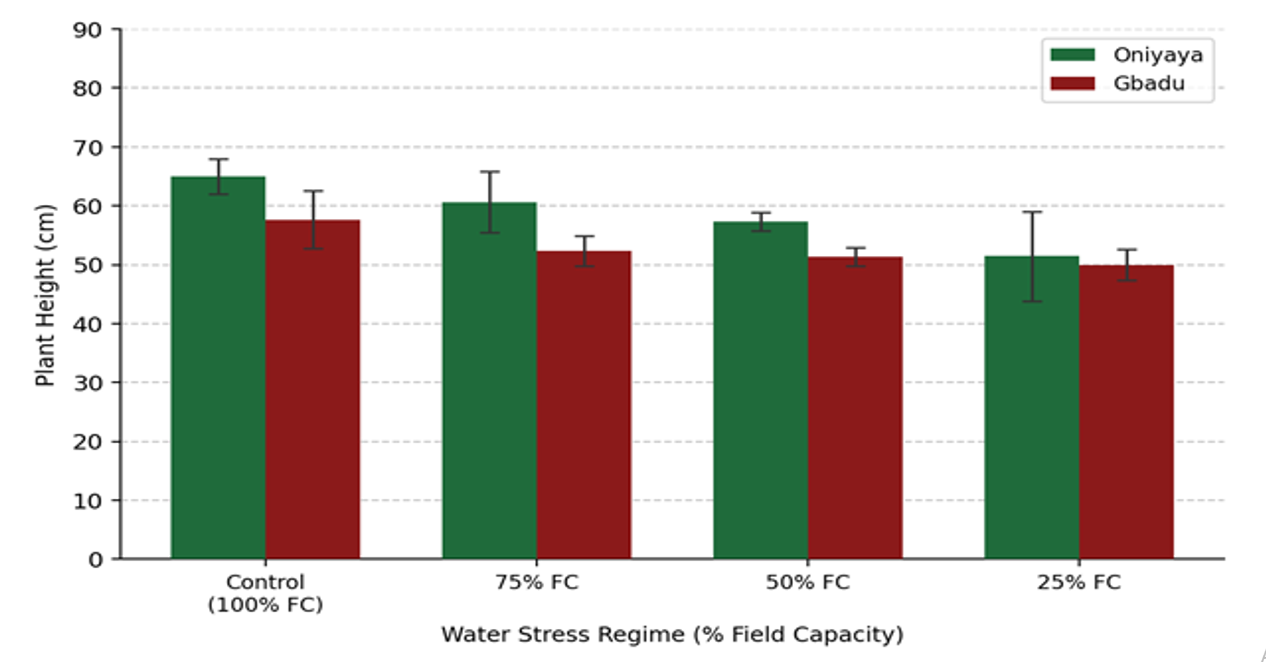
Although water deficit is a major constraint for vegetable crop production in tropical sub-Saharan Africa, systematic growth-analytical characterization of Jute Mallow, (Corchorus olitorius L.; Tiliaceae) under the various soil moisture stresses, is limited. In this study, the agronomic performance (classical growth analysis indices) of two varieties of C. olitorius (Oniyaya and Gbadu) were evaluated in relation to four water stress regimes under screen-house experiment conditions. The seeds were from the National Horticultural Research Institute (NIHORT), Ibadan, Nigeria and were planted in 4.5 litre plastic pots containing sandy-loam soil in a completely randomized design (CRD) with three replicates. The four water stress treatments applied were 100% field capacity (FC; control), 75%, 50% and 25% FC, each applied after 3 days (August – October, University of Agriculture, Abeokuta, Nigeria 7° 15′ N, 3° 25′ E). Agronomic parameters measured were plant height, number of leaves, leaf area, shoot dry weight, pod number, pod length, pod dry weight, relative growth rate (RGR), net assimilation rate (NAR) and leaf area ratio (LAR) measured weekly. An increase in water deficit resulted in significant (P<0.05) reduction in all agronomic parameters. The plant height of Oniyaya decreased from 65.00cm to 51.47cm as well as NAR and LAR which were also gradually reduced at 25% FC, while RGR found to be reduced from 0.61g g-1 month-1 to 0.25g g-1 month-1. Oniyaya also performed better than Gbadu in all parameters and under all stresses. Growth of C. olitorius and its yield is significantly affected by water stress.
References
Ajayi J.O. & A. W. Ojewumi. (2023). Effects of Sowing Depths on Nutritional Metabolites of Three Cucurbitaceae Species. Fountain Journal of Natural and Applied Sciences, 12(2): 75-82 DOI: /10.53704/fujnas.v12i2.449
Ajayi, J.O., David O. A., Ajiboye, M. D., Chukwuma, D. M., Ojewumi, A. W., Ameh, J. S., Oyetunji, O. S., & Agboola, D. A. (2026). Influence of Salinity on the Growth and Yield of two Varieties of Okra (Abelmoschus esculentus (L.) Moench) in Abeokuta, Ogun State, Nigeria. FUDMA Journal of Sciences, 10(14): 225 – 230 DOI: https://doi.org/10.33003/fjs-2026-1014-5800
Ayanlade, A., Oluwaranti, A., Ayanlade, O. S., Borderon, M., Sterly, H., Sakdapolrak, P., Jegede, M. O., Weldemariam, L. F., & Ayinde, A. F. O. (2022). Extreme climate events in sub-Saharan Africa: A call for improving agricultural technology transfer to enhance adaptive capacity. Climate Services, 27, 100311. https://doi.org/10.1016/j.cliser.2022.100311
Ayub, Q., Khan, S. M., Hussain, I., Naveed, K., Ali, S., Mehmood, A., Khan, M. J., Haq, N. U., & Shehzad, Q. (2021). Responses of different okra (Abelmoschus esculentus) cultivars to water deficit conditions. Journal of Horticultural Sciences, 16(1), 53–63. https://doi.org/10.24154/jhs.v16i1.1099
Chourasia, K. N., Meena, J. K., Bhowmick, R., Mangal, V., Arroju, A. K., Thribhuvan, R., Kar, C. S., Bera, A., Satya, P., Mitra, J., & Kar, G. (2025). Increasing jute (Corchorus olitorius L.) fiber yield through hybridization and combining ability studies to break the yield plateau. Frontiers in Plant Science, 16, 1499256. https://doi.org/10.3389/fpls.2025.1499256
Diedhiou, S., Maiga, A., Himbane, P. B., Iboko, M. P., Ndiaye, L. G., & Diedhiou, I. (2024). The biochar amendment improves tomato growth and yield under deficit irrigation in sandy loam soil in Senegal. Applied and Environmental Soil Science, 2024, 9945354. https://doi.org/10.1155/2024/9945354
Guzzetti, L., Panzeri, D., Ulaszewska, M., Sacco, G., Forcella, M., Fusi, P., Tommasi, N., Fiorini, A., Campone, L., & Labra, M. (2021). Assessment of dietary bioactive phenolic compounds and agricultural sustainability of an African leafy vegetable Corchorus olitorius L. Frontiers in Nutrition, 8, 667812. https://doi.org/10.3389/fnut.2021.667812
Haq, I. ul, Azam, N., Ashraf, M., Javaid, M. M., Murtaza, G., Ahmed, Z., Riaz, M. A., Iqbal, R., Rahman, M. H. ur, Alwahibi, M. S., Elshikh, M. S., Aslam, M. U., & Arslan, M. (2023). Improving the genetic potential of okra (Abelmoschus esculentus L.) germplasm to tolerate salinity stress. Scientific Reports, 13, Article 21526. https://doi.org/10.1038/s41598-023-48370-4
Hatfield, J. L., & Dold, C. (2019). Water-use efficiency: Advances and challenges in a changing climate. Frontiers in Plant Science, 10, 103. https://doi.org/10.3389/fpls.2019.00103
IBM Corp. (2020). IBM SPSS Statistics for Windows (Version 27.0) [Computer software]. IBM Corp.
Lambers, H., & Oliveira, R. S. (2019). Plant Physiological Ecology (3rd ed.). Springer. https://doi.org/10.1007/978-3-030-29639-1
Liyanage, D. K., Chathuranga, I., Mori, B. A., & Thilakarathna, M. S. (2022). A simple, semi-automated, gravimetric method to simulate drought stress on plants. Agronomy, 12(2), 349. https://doi.org/10.3390/agronomy12020349
Matplotlib Development Team. (2023). matplotlib/matplotlib: REL: v3.7.1 (Version 3.7.1) [Computer software]. Zenodo. https://doi.org/10.5281/zenodo.7697899
Mgolozeli, S., Tesfamariam, E. H., & Beletse, Y. (2022). Yield, mineral content and root growth response of jute mallow (Corchorus olitorius L.) to planting density and water availability. Journal of Agriculture and Food Research, 10, 100384. https://doi.org/10.1016/j.jafr.2022.100384
Mkhabela, S. S., Shimelis, H., Gerrano, A. S., & Mashilo, J. (2021). Phenotypic and genotypic divergence in okra [Abelmoschus esculentus (L.) Moench] and implications for drought tolerance breeding: A review. South African Journal of Botany,145, 56–64. https://doi.org/10.1016/j.sajb.2020.12.029
Poorter, H., Niinemets, Ü., Ntagkas, N., Siebenkäs, A., Mäenpää, M., Matsubara, S., & Pons, T. L. (2019). A meta-analysis of plant responses to light intensity for 70 traits ranging from molecules to whole-plant performance. New Phytologist, 223(3), 1073–1105. https://doi.org/10.1111/nph.15754
Rahman, K., Rahman, M., Ahmed, N., Alam, M. M., Rahman, A., Islam, M. M., & Hasanuzzaman, M. (2021a). Morphophysiological changes and reactive oxygen species metabolism in Corchorus olitorius L. under different abiotic stresses. Open Agriculture, 6(1), 549–562. https://doi.org/10.1515/opag-2021-0040
Rahman, K., Ahmed, N., Raihan, M. R. H., Nowroz, F., Jannat, F., Rahman, M., & Hasanuzzaman, M. (2021b). Jute responses and tolerance to abiotic stress: Mechanisms and approaches. Plants, 10(8), 1595. https://doi.org/10.3390/plants10081595
Saddiq, M. S., Iqbal, S., Hafeez, M. B., Ibrahim, A. M. H., Raza, A., Fatima, E. M., Baloch, H., Jahanzaib, Woodrow, P., & Ciarmiello, L. F. (2021). Effect of salinity stress on physiological changes in winter and spring wheat. Agronomy, 11(6), 1193. https://doi.org/10.3390/agronomy11061193
Sarker, U., & Oba, S. (2020). Phenolic profiles and antioxidant activities in selected drought-tolerant leafy vegetable amaranth. Scientific Reports, 10, 18287. https://doi.org/10.1038/s41598-020-71727-y
Sharma, L., Roy, S., Satya, P., Alam, N. M., Goswami, T., Barman, D., Baloch, H., Jahanzaib, Woodrow, P., & Ciarmiello, L. F. (2024). Exogenous ascorbic acid application ameliorates drought stress through improvement in morpho-physiology, nutrient dynamics, stress metabolite production and antioxidant activities recovering cellulosic fibre production in jute (Corchorus olitorius L.). Industrial Crops and Products, 217, 118808. https://doi.org/10.1016/j.indcrop.2024.118808
Singh, M., Singh, P., Singh, S., et al. (2021). A global meta-analysis of yield and water productivity responses of vegetables to deficit irrigation. Scientific Reports, 11, 22095. https://doi.org/10.1038/s41598-021-01433-w
Downloads
Published
Issue
Section
Categories
License
Copyright (c) 2026 Janet Ajayi, Anthony Ojewumi, Tolulope Ajewole, Kehinde Popoola, Opeyemi Oke, Ronke Komolafe, Ayoola Oluwajobi, Abiodun Ajiboye, David Agboola

This work is licensed under a Creative Commons Attribution 4.0 International License.


