
Comparative Analysis of Physicochemical Properties and Heavy Metal Concentrations in Fadama and Non-Fadama Soils of Bwari Area Council, Abuja, Nigeria
DOI:
https://doi.org/10.33003/fjs-2026-1018-6040Keywords:
Cation Exchange Capacity, Fadama Soils, Heavy Metals, Physicochemical Properties, Soil Compaction, Soil Texture, Spatial VariabilityAbstract
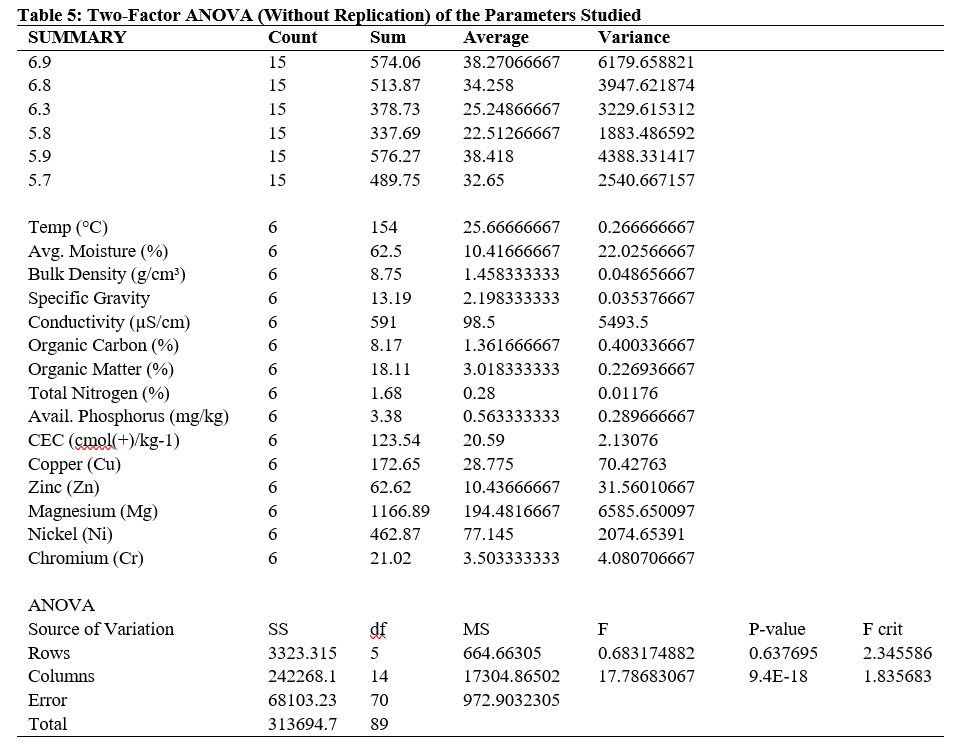
This study evaluates Fadama (lowland) and Non-Fadama (upland) soils across Kubwa, Bwari, and Ushafa in FCT Abuja, Nigeria employing 2 × 3 Factorial Design resulting in six treatment combinations. Eighteen composite samples were taken from the Fadama and Non-Fadama farms surface horizon (0–30 cm) during the dry season using a multistage stratified random sampling technique.. The samples were prepared and analyzed in triplicate for their physicochemical properties using Standardized analytical techniques of AOAC (Association of Official Analytical Chemists) and SSSA (Soil Science Society of America) methods. Data obtained were subjected to analysis of variance. The soils are predominantly coarse-textured and sand-dominated (70.91%–90.00%). Two-Way ANOVA indicated significant differences among the physicochemical properties (P < 0.05). Pearson correlation indicated correlation among the parameters temperature exhibits a near-perfect positive correlation with Nickel (r = 0.955). Baseline properties show stable pH (5.7–6.9) and Cation Exchange Capacity (17.81–21.55 cmol(+)/kg), but reveal major constraints: severe lowland compaction (up to 1.81 g/cm³), organic carbon depletion, and critical phosphorus deficiency (0.14–1.46 mg/kg). Among the toxic heavy metals, lithogenic Nickel is naturally elevated (>108 mg/kg) which might be due the presence of specific magmatic or metamorphic rock types like peridotite, dunite, serpentinite, or pyroxenite which naturally contain high concentrations of nickel (often 1,000 to 3,000+ mg/kg).
References
Akinwumi, O. O., & Ojetayo, A. O. (2022). Soil catena analysis in Guinea savanna zone, Niger State. Journal of Soil Science and Environmental Management, 13(4):112-125. https://academicjournals.org/journal/JSSEM/article-full-text-pdf/8B7E2A768093
Barnabas I. M., Lawal B.A., Tsado, P.A., Mohammed T., Wapa J. M. & Nwaka G.I.C. (2025). Characterization, classification and sustainability status of soils in Federal Capital Territory, Abuja, Nigeria. African Journal of Agricultural Economics, 5(1):1-15. https://ajae.ng/wp-content/uploads/2025/11/AJAE-Vol.-5-No-1-June.-2025-25.pdf
Babalola, T.S., Oso, A.S; Fasina, A.S. & Godonu. K. (2011). Land Evaluation Studies of two Wetland souls in Nigeria, Int. Res Journal of Agric Sci and Soil Sci, 16:193-204
Batjes, N. H., Ribeiro, E., & van Oostrum, A. (2019). Standardised soil profile data to support global mapping and modelling (WoSIS snapshot 2019). Earth System Science Data Discussions. https://doi.org/10.5194/essd-2019-84
Brady, N. C., & Weil, R. R. (2016). The nature and properties of soils (15th ed.). Pearson Education. Publisher: Pearson Education. ISBN: 978-0133254488
Chivenge, P., Mabhaudhi, T & Modi, A. T. (2020). Soil organic matter dynamics and agricultural productivity in Savannah ecosystems. Geoderma, 365:114–12
FAO & ISRIC. (2024). Providing quality-assessed and standardised soil data to support global mapping and modelling. https://holisoils.eu/new-paper-providing-quality-assessed-and-standardised-soil-data-to-support-global-mapping-and-modelling/
Iniubong, A., Edet, B & Akpan, E (2023). Assessment of soil pH dynamics and agronomic thresholds in tropical soils. Journal of Agricultural Science, 15(2):45–56.
Okeahialam, N.V., Asawalam, D.O & Adesemuyi, E.A (2006) Assessment of Physicochemical Properties of Soil at Fadama Lands in Southeastern Nigeria, UAES Journal of Innovative Science and Technology Development, 3(2):156-165
Oyetola, A. O., & Fasina, A. S. (2024). Evaluation of soil properties variability along a toposequence in Wasinmi, Southwest Nigeria. Acta Scientiarum. Agronomy. 4(12):705–711, https://doi.org/10.2478/ats-2024-0009
Singh, B.R. (2003). Characteristics of the fadama soils in Sokoto-Rima river basin in Dundaye District, Sokoto State. In: B.R. Singh' (Ed.). Management of Marginal Lands in Nigeria. Proceedings of the 23rd Annual Conference of Soil Science Society of Nigeria, UDUS, Pp 147-152
Solomon, R.I., Saddiq, A.M., Musa, S.A., , Yakubu., D and Nubiya, P(2026) MITIGATING AMMONIA VOLATILIZATION LOSSES USING BIOCHAR AMENDMENTS IN AN UPLAND RICE SOIL IN YOLA, DAMAWA STATE, NIGERIA, FUDMA Journal of Sciences, 10(4):92–102, DOI: https://doi.org/10.33003/fjs-2026-1004-4735
World Bank. (2024). Fadama III Additional Finance Project and sustainable agricultural development in Nigeria. International Journal of Research and Innovation in Applied Science, 9(6). https://rsisinternational.org/journals/ijrias/articles/fadama-iii-additional-finance-project-and-sustainable-agricultural-development-in-akure-ondo-state-nigeria/
World Bank. (2022). Delivering development: Collaboration key to success in Nigeria's Fadama projects. World Bank Blogs. https://blogs.worldbank.org/en/nasikiliza/delivering-development-collaboration-key-success-nigerias-fadama-projects
Zakari, M., Suleiman, A & Bello, H. (2021). Evaluation of cation exchange capacity and nutrient buffering in Nigerian agricultural soils. Nigerian Journal of Soil Research, 19(3): 88–97.
Downloads
Published
Issue
Section
Categories
License
Copyright (c) 2026 Noah Akoji Jibrin, Umukoro Rose Avweroswoghene Alale, Karimatu Lami Abdullahi

This work is licensed under a Creative Commons Attribution 4.0 International License.


