
Phenological Diversity and Yield-Component Variation among Early-Maturing Cowpea (Vigna unguiculata [L.] Walp.) Accessions in the Southern Guinea Savanna of Nigeria
DOI:
https://doi.org/10.33003/fjs-2026-1019-6035Keywords:
Cowpea, Earliness, Germplasm, Phenology, Yield componentsAbstract
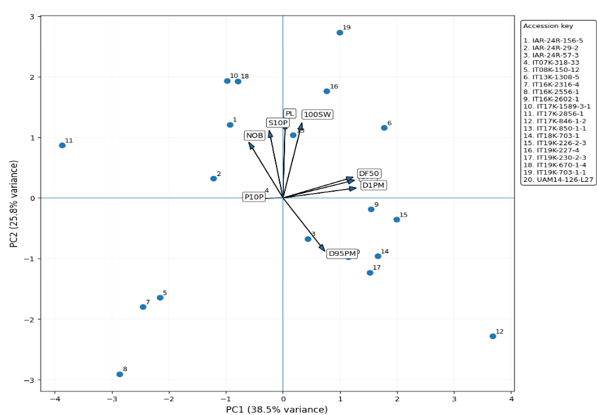
Cowpea (Vigna unguiculata [L.] Walp.) is an important grain legume in sub-Saharan Africa. However, the value of improved germplasm depends on the fit between crop duration, reproductive architecture and the target production environment. This study evaluated 20 early-maturing cowpea accessions at the National Cereals Research Institute (NCRI), Badeggi, Niger State, Nigeria, using a randomised complete block design with three replications. Data were collected on branch number, flowering and maturity, pod number, pod length, seed number and 100-seed weight. Accessions differed significantly for the principal phenological and reproductive traits, whereas branch number and pods per ten plants did not differ significantly. Days to 50% flowering ranged from 47.67 to 58.33 days, while 95% pod maturity ranged from 83.00 to 96.33 days. IT16K-2556-1 was earliest to 50% flowering, and IAR-24R-156-5 was earliest to 95% pod maturity. IT17K-850-1-1 produced the highest pod number (234.33 pods per ten plants), whereas IT17K-1589-3-1 combined the longest pods (18.19 cm) with the highest 100-seed weight (25.44 g). Days to first flowering were strongly correlated with days to 50% flowering (r = 0.905, P < 0.001) and first pod maturity (r = 0.960, P < 0.001). Pod length was positively associated with seeds per ten pods (r = 0.500, P < 0.05) and 100-seed weight (r = 0.445, P < 0.05). The accessions showed distinct phenological and reproductive strategies useful for parent selection and subsequent multi-environment testing. Grain-yield and stability trials are required before recommending any accession for broad cultivation.
References
REFERENCES
Edematie, V.E., Fatokun, C., Boukar, O., Adetimirin, V.O. & Kumar, P.L. (2021). Inheritance of pod length and other yield components in two cowpea and yard-long bean crosses. Agronomy, 11(4): 682. https://doi.org/10.3390/agronomy11040682
Hall, A.E. (2004). Breeding for adaptation to drought and heat in cowpea. European Journal of Agronomy, 21(4): 447–454. https://doi.org/10.1016/j.eja.2004.07.005
Iro Sodo, A.M., Ongom, P.O., Fatokun, C., Olasanmi, B., Dieng, I. & Boukar, O. (2025). Quantitative trait loci mapping for yield and related traits in cowpea. Genes, 16(3): 247. https://doi.org/10.3390/genes16030247
Kouakou, A.-G., Ogundapo, A., Smale, M., Jamora, N., Manda, J. & Abberton, M. (2022). IITA’s genebank, cowpea diversity on farms, and farmers’ welfare in Nigeria. CABI Agriculture and Bioscience, 3: 14. https://doi.org/10.1186/s43170-022-00083-w
Kusi, F., Padi, F.K., Asante, I.K., et al. (2025). Gains in genetic enhancement of early maturing advanced breeding lines of cowpea [Vigna unguiculata (L.) Walp.]. Ecological Genetics and Genomics, 35: 100339. https://doi.org/10.1016/j.egg.2025.100339
Mekonnen, T.W., Gerrano, A.S., Mbuma, N.W. & Labuschagne, M.T. (2022). Breeding of vegetable cowpea for nutrition and climate resilience in sub-Saharan Africa: Progress, opportunities, and challenges. Plants, 11(12): 1583. https://doi.org/10.3390/plants11121583
Moreira, R., Nunes, C., Pais, I.P., Nobre Semedo, J., Moreira, J., Bagulho, A.S., Pereira, G., Veloso, M.M. & Scotti-Campos, P. (2023). Are Portuguese cowpea genotypes adapted to drought? Phenological development and grain quality evaluation. Biology, 12(4): 507. https://doi.org/10.3390/biology12040507
Omoigui, L.O., Kamara, A.Y., Shaibu, A.S., Iorlamen, T., Ekeruo, G., Eseigbe, O.B., Solomon, R., Adeleke, M.A., Tofa, A.I. & Ibrahim, E.A. (2025). Agronomic and intercropping performance of newly developed elite cowpea lines for the West African Savannas. Agronomy, 15(11): 2548. https://doi.org/10.3390/agronomy15112548
Omomowo, O.I. & Babalola, O.O. (2021). Constraints and prospects of improving cowpea productivity to ensure food, nutritional security and environmental sustainability. Frontiers in Plant Science, 12: 751731. https://doi.org/10.3389/fpls.2021.751731
Popoola, B.O., Ongom, P.O., Mohammed, S.B., Togola, A., Ishaya, D.J., Bala, G., Fatokun, C. & Boukar, O. (2024). Assessing the impact of genotype-by-environment interactions on agronomic traits in elite cowpea lines across agro-ecologies in Nigeria. Agronomy, 14(2): 263. https://doi.org/10.3390/agronomy14020263
Downloads
Published
Issue
Section
Categories
License
Copyright (c) 2026 Dangana Mohammed Chata, Dickson Junior Nwosu, Aishatu Adamu Gado, Jiya Mohammed, Mohammed Dokodza Abdullahi, Muhammad Alhaji

This work is licensed under a Creative Commons Attribution 4.0 International License.


