
A Secure Face–Fingerprint Dual-Biometric Staff Attendance System for Confluence University of Science and Technology, Osara
DOI:
https://doi.org/10.33003/fjs-2026-1020-6030Keywords:
Fingerprint, Face, Attendance, Dual-Biometric Recognition, Deep Learning, SecurityAbstract
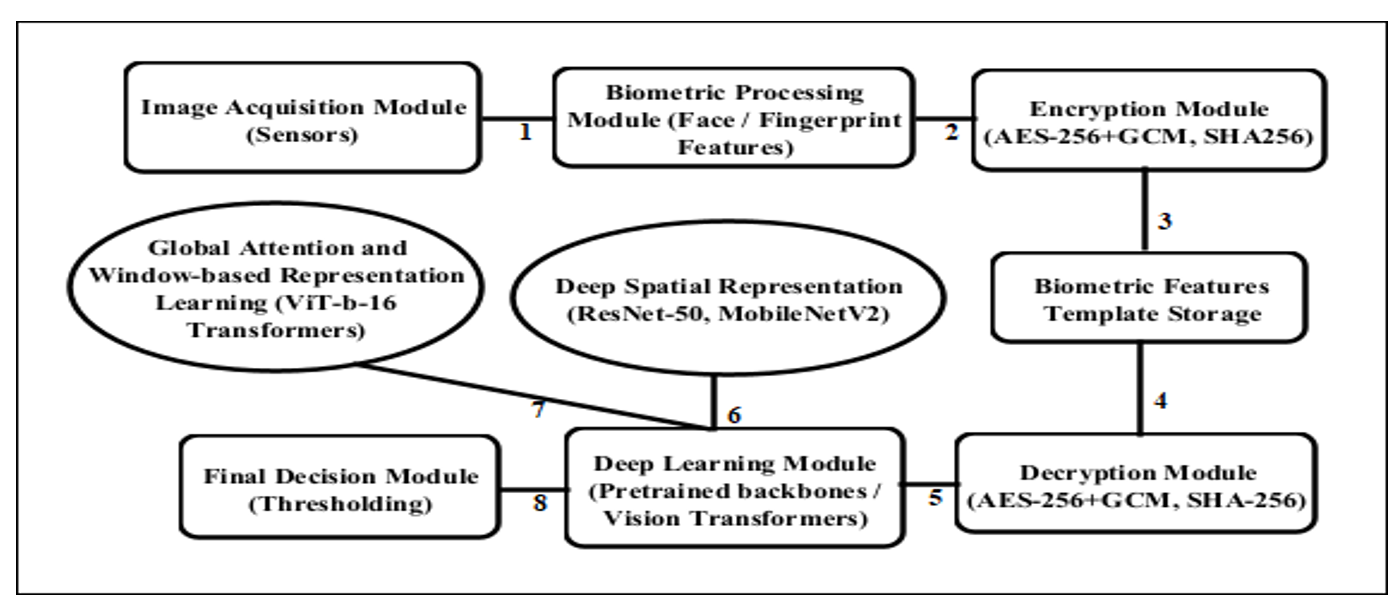
The paper presents the design, implementation, and evaluation of a secure dual-biometric staff attendance system for Confluence University of Science and Technology (CUSTECH), Osara. The methodology combined biometric acquisition and preprocessing, pretrained MobileNetV2, ResNet-50, and ViT-B/16 feature extractors, normalization, cosine-similarity matching, multimodal feature/score fusion, AES-256-GCM template cryptography, SHA-256 integrity safeguard, and SQLite-logging of grounded attendance data. Ten-subjects produced 10-genuine and 90-imposter verification pairs for the backbones. ResNet-50 showed the biggest general verification capability at accuracy of 0.77, EER of 0.2167, FAR of 0.2333, FRR of 0.20, decidability index of 1.565, and mean latency of 335.75 ms. MobileNetV2 produced the least latency of 207.93 ms, while ViT-B/16 attained accuracy of 0.72 and latency of 694.55 ms. ViT-B/16 revealed the greatest comparative performance against the backbone models. AES-256-GCM enlarged template storage from 10,368 to 10,396 bytes, with encryption times of 0.058 and and decryption time of 0.098 ms; SHA-256 hashing time of 0.043 ms, and template recovery of 100%. Initial usability evaluation using 10 volunteers across 60 task observations gave task success of 98.30%, mean task time of 24.30 s, ease rating of 4.20/5, mean SUS score of 80.50/100, and no unrecoverable crashes. This research interconnects verification decisions to secure official records, which runs role-based access and exportable reports, and a reproducible basis for future edge deployment and larger-scale validation studies. The results demonstrate proof-of-concept feasibility while supporting larger-scale validation before deployment.
References
Aldabagh, M. (2024). A review of students’ attendance management systems. Eurasian Journal of Science and Engineering, 10(3), 136-145. https://doi.org/10.23918/eajse.v10i3p13
Bisht, M. S., Aman, A., Singh, S. K., Gupta, J., & Singh, S. (2025). Automated access control system using biometric authentication technologies. In 2025 8th International Conference on Circuit, Power & Computing Technologies (ICCPCT) (pp. 1329-1334). IEEE. https://doi.org/10.1109/ICCPCT65132.2025.11176610
Calderón, L. F., & Laurent, A. (2025). Fingerprint-based attendance systems in organizational governance: A comprehensive theoretical, methodological, and empirical examination. The Parthenon Frontiers of Emerging Data Science and Machine Learning, 2(1), 13-18. https://www.parthenonfrontiers.org/index.php/ejedsml/article/view/402
Chitrapu, P., Morampudi, M. K., & Kalluri, H. K. (2026). A secure and explainable multimodal biometric system using trust adaptive fusion for face and fingerprint. Scientific Reports, 16(1), 14244. https://doi.org/10.1038/s41598-026-43252-x
Deepthi, L., Shetty, A. P., Shetty, S. S., Vaishnavi, K. S., & Manvitha, M. V. (2025). A multimodal biometric approach for physical locker security: integration of face and voice. In 2025 Third International Conference on Networks, Multimedia and Information Technology (NMITCON) (pp. 1-6). IEEE. https://doi.org/10.1109/NMITCON65824.2025.11187497
Garg, R., Pathak, P., & Singh, M. P. (2025). Multimodal biometric system combining Fingerprint, Iris, and ECG using convolutional attention frameworks. Systems and Soft Computing, 7, 200369. https://doi.org/10.1016/j.sasc.2025.200369
Gimba, U. A., Ariffin, N. A. B. M., Udzir, N. I., & Sani, N. F. M. (2025). Enhancing biometric authentication through multimodal approach combining face and fingerprint recognition using convolutional neural networks (CNN). Discover Computing, 28, 246. https://doi.org/10.1007/s10791-025-09775-z
Indhumathi, P., Aarthi, K., Saravanan, D., & Yogeshwaran, K. (2025). Two-step attendance system with RFID and facial recognition. In 2025 International Conference on Intelligent Computing and Control Systems (ICICCS) (pp. 109-115). IEEE. https://doi.org/10.1109/ICICCS65191.2025.10984920
Jagadiswary, D., & Saraswady, D. (2016). Multimodal Biometric Authentication System Using Fingerprint, Retina and Finger Vein. Procedia Computer Science, 85, 109–116. https://doi.org/10.1016/j.procs.2016.05.187
Jena, P. P., Kattigenahally, K. N., Nikitha, S., & Sarda, S. (2021). Multimodal biometric authentication: Deep learning approach. In 2021 International Conference on Circuits, Controls and Communications (CCUBE) (pp. 1-5). IEEE. https://doi.org/10.1109/CCUBE53681.2021.9702724
Jha, P. B., Basnet, A., Pokhrel, B., Pokhrel, B., Thakur, G. K., & Chhetri, S. (2023). An automated attendance system using facial detection and recognition technology. Apex Journal of Business and Management, 1(1), 103-120. https://doi.org/10.61274/apxc.2023.v01i01.008
Mishra, A. K., Nepal, A., & Aithal, P. S. (2022). Industry 4.0 concept for Nepal - operating virtual farming industry. In Krishna Prasad, K., P. S. Aithal, & A. Jayanthiladevi (ed.), Proceedings on Future Trends in ICCT and its Applications in IT, Management and Education (pp. 31-35). IEEE. https://doi.org/10.5281/zenodo.7215189
Mohammed, K., Tolba, A. S., & Elmogy, M. (2018). Educational business intelligence 3.0: multimodal student identification and attendance management system. Ain Shams Engineering Journal, 9(4), 2917–2929. https://doi.org/10.1016/j.asej.2018.08.002
Omari, A. l., & Jaradat, A. (2020). Attendance tracking systems: A review of the literature. International Journal of Advanced Computer Science and Application, 11(4), pp. 194-202.
Osazuwa-Ojo, V. O., & Elaigwu, V. O. (2024). A two-step authentication facial recognition system for automated attendance tracking. FUDMA Journal of Sciences, 8(6), 7-16. https://doi.org/10.33003/fjs-2024-0806-2773
Paul, J., Mitra, A., Kulhadiya, D., Pawar, T., Roy, A., & Sil, J. (2025). A comprehensive approach to real-time attendance systems: Integrating face recognition and emotion detection and with web technologies. Procedia Computer Science, 258, 3436-3446. https://doi.org/10.1016/j.procs.2025.04.600
Shrivastava, A., Suji Prasad, S. J., Yeruva, A. R., Mani, P., Nagpal, P., & Chaturvedi, A. (2025). IoT based RFID attendance monitoring system of students using Arduino ESP8266 & Adafruit.io on defined area. Cybernetics and Systems, 56(1), 21-32. https://doi.org/10.1080/01969722.2023.2166243
Sodiq, K., Kazeem, S., Adetunji, O., Saliu, A., Oyerinde, E., Salau, S., Ojosipe, A., Pelumi, I., Nofisat, A., Wisdom, U., & Akinfe, O. (2025). Development of a scalable and real-time biometric-based attendance monitoring system. FUDMA Journal of Sciences, 9(12), 590-598. https://doi.org/10.33003/fjs-2025-0912-4243
Tarafdar, R., Singh, H., Pahuja, V., Garg, G., Sivaraman, R., & Jegajothi, B. (2025). DL-based multi-modal biometric authentication for next-gen secure AI systems. In 2025 5th International Conference on Soft Computing for Security Applications (ICSCSA) (pp. 12-19). IEEE. https://doi.org/10.1109/ICSCSA66339.2025.11170949
Usiobaifo, A. R., & Osaseri, R. O. (2025). Design and implementation of a mobile fingerprint attendance system for student and lecturers. FUDMA Journal of Sciences, 9(5), 232–238. https://doi.org/10.33003/fjs-2025-0905-3136
Vardhan, R., Aftab, S., Sanyal, N., Ali, K., & Kumar, A. (2025). Automated attendance system using facial recognition: a comprehensive review. In S. Mishra, A. K. Singh, & P. Prajapati (Eds.), Challenges and Opportunities for Innovation in India (pp. 117-122). CRC Press. https://doi.org/10.1201/9781003606260-20
Downloads
Published
Issue
Section
Categories
License
Copyright (c) 2026 Abraham Ayegba Alfa, Emmanuel Eturpa Salami, Kharimah Bimbola Ahmed, Precious Bamiyo Metiboba

This work is licensed under a Creative Commons Attribution 4.0 International License.