
Adversarial Robustness Enhancement through Deep Feature Representations-Based CIFAR-10 Image Classification
DOI:
https://doi.org/10.33003/fjs-2026-1020-6029Keywords:
CIFAR-10, ResNet34, FGSM, PGD, Fractal Average PoolingAbstract
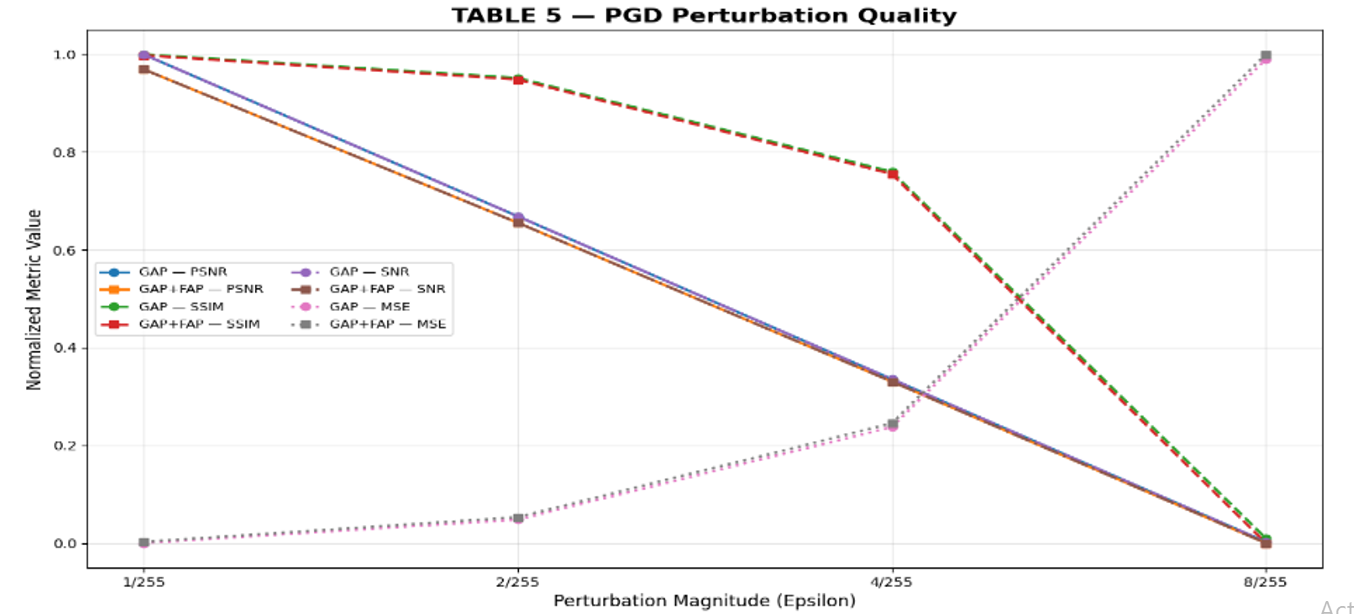
Adversarial perturbations pose a significant challenge to the reliability of deep neural networks in image classification. The conventional feature aggregation approaches are still vulnerable to adversarial noise, which inspires the improvement of more powerful feature presentations. In this study, the adversarial robustness of a ResNet34-based architecture is investigated on the CIFAR-10 dataset, where conventional global average pooling (GAP) is compared with a proposed framework combines Global Average Pooling (GAP) and Fractal Average Pooling (FAP) within a ResNet-34. Multiple perturbation budgets were tested on the models via the white-box fast gradient sign method (FGSM) and projected gradient descent (PGD) attacks. The test accuracy of the proposed model was 97.52% on clean data whereas the test accuracy of the GAP baseline was 95.69%, which is a 1.83% improvement. In the FGSM, the adversarial accuracy increased from 59.56% to 81.38% at e = 1/255 and from 15.81% to 70.81% at e = 8/255. With the PGD, the improvement was not significant; the accuracy increased from 0.06% to 14.99% at e = 1/255 but reached only 0.32% versus 0.03% at e = 8/255. The distortion characteristics of any of the above methods are highly similar to the perturbation-quality analysis results of the PSNR, SSIM, SNR, and MSE. Overall, the proposed representation enhances the ability to perform clean classification tasks while also being robust to FGSM attacks, while stronger iterative PGD attacks are still a major challenge
References
Aarthy, B., & Keerthi, B. S. (2023). Enhancement of various images using coefficients obtained from a class of Sakaguchi type functions. Scientific Reports, 13(1), 18722. https://doi.org/10.1038/s41598-023-45938-y
Chen, L., Li, S., Bai, Q., Yang, J., Jiang, S., & Miao, Y. (2021). Review of image classification algorithms based on convolutional neural networks. Remote Sensing, 13(22), 4712. https://doi.org/10.3390/rs13224712
Dargan, S., Kumar, M., Ayyagari, M. R., & Kumar, G. (2020). A Survey of Deep Learning and Its Applications: A New Paradigm to Machine Learning. Archives of Computational Methods in Engineering, 27(4), 1071–1092. https://doi.org/10.1007/s11831-019-09344-w
Eleftheriadis, C., Symeonidis, A., & Katsaros, P. (2024). Adversarial robustness improvement for deep neural networks. Machine Vision and Applications, 35(3), 35. https://doi.org/10.1007/s00138-024-01519-1
Florindo, J. B. (2024). Fractal pooling: A new strategy for texture recognition using convolutional neural networks. Expert Systems with Applications, 243, 122978. https://doi.org/10.1016/j.eswa.2023.122978
Goodfellow, I. J., Shlens, J., & Szegedy, C. (2014). Explaining and harnessing adversarial examples. ArXiv Preprint ArXiv: 1412.6572. https://doi.org/10.48550/arXiv.1412.6572
Gupta, A., Rajendhran, R., Stringham, N., Srikumar, V., & Marasović, A. (2024). Whispers of doubt amidst echoes of triumph in nlp robustness. Proceedings of the 2024 Conference of the North American Chapter of the Association for Computational Linguistics: Human Language Technologies (Volume 1: Long Papers), 5533–5590. https://doi.org/10.18653/v1/2024.naacl-long.310
He, K., Zhang, X., Ren, S., & Sun, J. (2016). Deep residual learning for image recognition. Proceedings of the IEEE Conference on Computer Vision and Pattern Recognition, 770–778. https://doi.org/10.1109/CVPR.2016.90.
Hu, J., Ye, J., Feng, Z., Yang, J., Liu, S., Yu, X., Jia, L., & Song, M. (2024). Improving adversarial robustness via feature pattern consistency constraint. Proceedings of the Thirty-Third International Joint Conference on Artificial Intelligence, 848–856. https://doi.org/10.24963/ijcai.2024/94
Karjauv, A. (2026). Rethinking Global Average Pooling: Your Classifier Is Secretly a Multi-Instance Learner. ArXiv Preprint ArXiv: 2606.14555.
Keleš, O., Yılmaz, M. A., Tekalp, A. M., Korkmaz, C., & Doğan, Z. (2021). On the computation of PSNR for a set of images or video. 2021 Picture Coding Symposium (PCS), 1–5. https://doi.org/10.1109/PCS50896.2021.9477470
Krizhevsky, A., & Hinton, G. (2009). Learning multiple layers of features from tiny images.
Li, F., Li, K., Wu, H., Tian, J., & Zhou, J. (2025). Toward robust learning via core feature-aware adversarial training. IEEE Transactions on Information Forensics and Security, 20, 6236–6251. https://doi.org/10.1109/TIFS.2025.3581021
Liao, J., Guo, L., Jiang, L., Yu, C., Liang, W., Li, K., & Pop, F. (2025). A machine learning-based feature extraction method for image classification using ResNet architecture. Digital Signal Processing, 160, 105036. https://doi.org/10.1016/j.dsp.2025.105036
Liu, C., Zhang, J., Fang, H., Ma, Z., Zhang, W., & Yu, N. (2023). Dear: A deep-learning-based audio re-recording resilient watermarking. Proceedings of the AAAI Conference on Artificial Intelligence, 37(11), 13201–13209. https://doi.org/10.1609/aaai.v37i11.26550
Liu, J., Li, Y., Guo, Y., Liu, Y., Tang, J., & Nie, Y. (2024). Generation and Countermeasures of adversarial examples on vision: a survey. Artificial Intelligence Review, 57(8), 199. https://doi.org/10.1007/s10462-024-10841-z
Madry, A., Makelov, A., Schmidt, L., Tsipras, D., & Vladu, A. (2017). Towards deep learning models resistant to adversarial attacks. ArXiv Preprint ArXiv: 1706.06083.
Mehra, N., Thakar, U., & Tokekar, V. (2026). Adversarial Training Using FGSM Attack for Convolutional Neural Networks. International Conference on Recent Advancement and Modernization in Sustainable Intelligent Technologies & Applications (RAMSITA-2026), 148–161.
Pang, Z., Yan, X., Guo, S., & Lu, Y. (2025). Diversity-enhanced reconstruction as plug-in defenders against adversarial perturbations. Frontiers in Artificial Intelligence, 8, 1665106. https://doi.org/10.3389/frai.2025.1665106
Riski, M. J., Noviandri, K. A., Hanggara, Y., Utama, N. P., & Purwarianti, A. (2025). Analysis of Defense Mechanisms Against FGSM Adversarial Attacks on ResNet Deep Learning Models Using the CIFAR-10 Dataset. Jurnal Sistem Cerdas, 8(2), 169–187. https://doi.org/10.37396/jsc.v8i2.527.
Shehu, A., Kirubakaran, P., Muhammad-Bello, B. L., & Ibrahim, N. (2026). Deep Learning for Image Steganalysis: A Structured Comparative Review of Dataset, Domain, and Robustness Coverage. FUDMA Journal of Sciences, 10(16), 551–556. https://doi.org/10.33003/fjs-2026-1016-5739
Shin, S., Shin, D., & Kim, J. (2025). Implementation and comparison of CNN models on CIFAR-10 dataset. 2025 IEEE 20th Conference on Industrial Electronics and Applications (ICIEA), 1–4. https://doi.org/10.1109/ICIEA65512.2025.11148839
Swain, S., Pattnaik, P. K., Jayasingh, S. K., Mohanty, S., Nayak, M., & Dash, B. B. (2026). Adversarial Image Quality Assessment against PGD Attack on ResNet-34. 2026 7th International Conference on Computational Intelligence and Networks (CINE), 1–5. https://doi.org/10.1109/CINE68769.2026.11502668
Tanay, T., & Griffin, L. (2016). A boundary tilting persepective on the phenomenon of adversarial examples. ArXiv Preprint ArXiv: 1608.07690.
Tharwat, A. (2021). Classification assessment methods. Applied Computing and Informatics, 17(1), 168–192. https://doi.org/10.1016/j.aci.2018.08.003
Villegas-Ch, W., Jaramillo-Alcázar, A., & Luján-Mora, S. (2024). Evaluating the robustness of deep learning models against adversarial attacks: An analysis with fgsm, pgd and cw. Big Data and Cognitive Computing, 8(1), 8. https://doi.org/10.3390/bdcc8010008
Wang, J., Wang, Z., Dong, Q., Zhang, S., Liu, M., & Zhang, J. (2026). A comprehensive survey of pattern recognition classification algorithms. Third International Conference on Power Electronics and Artificial Intelligence (PEAI 2026), 14136, 172–188.
Wang, Z., Bovik, A. C., Sheikh, H. R., & Simoncelli, E. P. (2004). Image quality assessment: from error visibility to structural similarity. IEEE Transactions on Image Processing, 13(4), 600–612. https://doi.org/10.1109/TIP.2003.819861
Wong, E., Rice, L., & Kolter, J. Z. (2020). Fast is better than free: Revisiting adversarial training. ArXiv Preprint ArXiv: 2001.03994. https://doi.org/10.48550/arXiv.2001.03994
Xu, Y., Li, F., Chen, Z., Liang, J., & Quan, Y. (2021). Encoding spatial distribution of convolutional features for texture representation. Advances in Neural Information Processing Systems, 34, 22732–22744.
Zhou, S., Liu, C., Ye, D., Zhu, T., Zhou, W., & Yu, P. S. (2022). Adversarial attacks and defenses in deep learning: From a perspective of cybersecurity. ACM Computing Surveys, 55(8), 1–39. https://doi.org/10.1145/3547330
Downloads
Published
Issue
Section
Categories
License
Copyright (c) 2026 Malik Al-sharaf

This work is licensed under a Creative Commons Attribution 4.0 International License.