
Distribution and Seasonal Variation of Snail Vector of Medical and Veterinary Importance in Communities Around Challawa Dam, Karaye Local Government Area, Kano State
DOI:
https://doi.org/10.33003/fjs-2026-1017-6027Keywords:
Snail Vector, Intermediate Hosts, Bulinus forskalii, Bulinus globosus, Biomphalaria sppAbstract
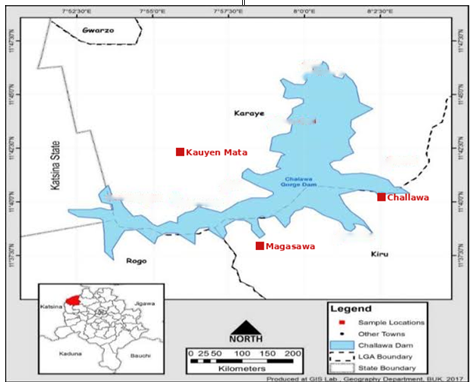
Snail are generally aquatic upon found in almost all fresh water bodies ranging from rivers, lakes, streams, irrigation channels, lakes, streams, Ponds and marshes attached to the water plants. The epidemiology of schistosomiasis involves a mollucs (snail) as an intermediate host, various species of fresh water snails are known to act as intermediate host of schistosomiasis. This study aims to determine the distribution and seasonal variation of snail vector species of medical and veterinary importance in communities around Challawa Dam, Karaye Local Government Area, Kano State. Three communities, Challawa, Kauyan Mata and Magasawa were selected based on their proximity to Dam and the Challawa River. Snails are collected on monthly basis for twelve consecutive months, using forceps technique. A total of six hundred and seventy-four (674) freshwater snails were collected from the three selected sampling sites, based on morphological appearance of the snail shells, three species were identified in all the sampling sites namely; Bulinus globosus 433 (64.24%), Bulinus forskalii 41 (6.08%) and Biomphalaria spp 200 (29.67%). All snail species were identify in all sampling site with Bulinus globosus the most abundant. Snails were more abundant during rainy season (Wet, n = 603. 89.47%, Dry, n = 71. 10.53%). In conclusion, Challawa Dam is a dwelling site for freshwater snails. Therefore, there is a great need for regular vector control such as use of molluscicides.
References
Adamu, T., Abubakar, U. and Muhammad, A. A. (2003). Urinary schistosomiasis in some villages around the Gorionyo Dam, Sokoto State. The Nigerian Journal of Parasitology,24: 109-114.
Angaye, T.C. (2016). A review on the epidemiology and control of schistosomiasis in Nigeria. Journal of Medical Health Research, 1(2): 1 -23.
Ayanda, O.I. (2009). Prevalence of snail vectors of schistosomiasis and their infection rates in two localities within Ahmadu Bello University (A.B.U.) Campus, Zaria, Kaduna State, Nigeria. Journal of Cell and Animal Biology, 3(4): 58-61.
Betterton, C., Ndifon, G.I. and Tan, R.M. (1988). Field studies on aestivation in Bulinus rohlfsi (Clessin). Bulinus globosus (Morelet) and their susceptibility to local strains of Schistosoma haematobium (Bilharz). Annals of Tropical Medicine and Parasitology, 82: 571-579.
Brown, D. S. (1980). Fresh water Snail of Africa and their medical importance, Taylor and Francis LMT London. Pp222.
Ejehu, Z.U., Ekwunife, C.A., Anumba, J.U., Onyido, A.E. and Umeanaeto,P.U. (2017). Snail fauna and investigations into the incidence of schistosoma infection in Lake of Oguta 1 Region, Imo State, Nigeria. Nigerian Journal of Parasitology, 38(2): 173-178.
Idris, H. S., Ajanusi, J. O., Omoh, J. U. Galadima, M. and ogbogu, V. C. (2001). Prevalence of schistosomiaisis among Pupils in some Local Government Areas in Katsina state. The Nigerian Journal of Parasitology, 22: 75-80.
Ingram, R.J., Bartlett, A., Brown, M.B., Marriot, C. and Whitfield, D. (2003). Penetration of human skin by the cercariae of Schistoosma: an investigation of the effect of multiple cercarial infection. Journal of Helminthol.77(1):27-31
Ngele, K.K., Kalu, E.O., Ukwe, M.C. and Onyeuwu, C.N. (2012). A survey of fresh water snails: the intermediate hosts of schistosomiasis in Bende L.G.A., Abia State, Nigeria. International Journal of Science and Nature, 3(4): 879-882.
Okpara, K. N., Udoidung, N. I. and Ukpong, I. G. (2007), Genitourinary schistosomiasis among pre-primary school children in a rural community within the Cross-River Basin, Nigeria. Journal of Helminthol,4: 393-7.
Owojori, O.J., Asaolu, S. O. and Ofoezie, I.E. (2006). Ecology of freshwater snails in Opa Reservoir and research from ponds at Obafemi Awolowo University Ile-Ife, Nigeria. Journal of Applied Sciences, 6(15): 3004-3015.
Preston, H. B. (1910) "Addition to the non-Marine Molluscan Fauna of British and German East Africa and Lake Albert Edward". The Annals and Magazine of Natural History Including Zoology, Botany, and Geology, 6(8 series, 35): 526-. 535.
Simoonga, C., Utzinger, J. and Brooker, S. (2009). Remote sensing, geographical information system and spatial analysis for schistosomiasis epidemiology and ecology in Africa. Parasitology, 136 (13): 1683–1693.
Shove, S., de Vlas, S.J., Mbaye, A., Polman, K. and Gryseels, B. (2010). Low awareness of intestinal schistosomiasis in northern Senegal after 7 years of health education as part of intense control and research activities. Tropical Medicine and International Health. 8(8):744–9.
Taopiq, S., Bunza, M.A., Majeed, Q., Abubakar, M.B. and Ladan, M.U. (2017). Studies on snail vectors of Helminth Disease Agents along Rima River Valley at Kwalkwalawa Village, Wamakko Local Government Area Sokoto State, Nigeria. SM Tropical Medicine Journal2(1):10-11.
World Health Organisation (2010). Fact sheet February, 2010 Schistosomiasis. Retrieved on October, 28, 2011, from https://www.apps.who.int/iris/handle/11736/16739
Downloads
Published
Issue
Section
Categories
License
Copyright (c) 2026 Abdullahi Umar Bature, Abdulrahman Umar, Saminu Atiku Lawan, kilawa Aishatu Sale

This work is licensed under a Creative Commons Attribution 4.0 International License.


