
Green Synthesis of Zinc Oxide Nanoparticles Using Baobab (Adansonia digitata) Leaf Extract for Co(II), Pb(II), and Ni(II) Removal from Synthetic and Industrial Wastewater
DOI:
https://doi.org/10.33003/fjs-2026-1017-6025Keywords:
Baobab(Adansonia digitata), Zinc Oxide Nanoparticles, Cobalt, Lead, Nickel, WastewaterAbstract
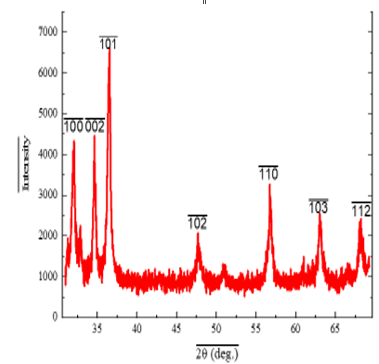
This study aimed at synthesizing and characterizing Leaf ZnO nanoparticles from baobab (Adansonia digitata) for adsorption of Co(II), Pb(II) and Ni(II) from wastewater. Green synthesis method was carried out using a mixture 50 ml of 0.02 M zinc acetate dihydrate solution and 50 ml of plant extract under continuous stirring at constant temperature of 70 0C. The ZnO NPs were characterized using XRD, FTIR and SEM-EDX. XRD analysis confirmed the crystallinity of the synthesized ZnO nanoparticles, with crystallite sizes ranging from 12.7nm to 22.4nm. It also shows that Zn-O was the predominant crystalline phase, accounting for 90.3 wt.% ZnO. FTIR analysis showed the presence of a strong band at 551cm-1, while SEM reveals the morphology of the synthesized Nanoparticles. In addition, the EDX analysis revealed Zn-O were the predominant elements present, with zinc accounting for 81.95 wt.%, and oxygen accounted for 17.54 wt.%. The results for treatments of synthetic wastewater was obtained, maximum removal efficiencies of 77.40%, 82.7% and 72.1% were achieved for Co(II), Pb(II) and Ni(II) ions respectively, under optimized conditions of pH 6, 80 min and 200 mg adsorbent dosage. Increasing the initial metal concentration decreased removal efficiency while interfering ions enhanced Co2+ removal but reduced Pb2+ and Ni2+ adsorption. The results for the treatment of industrial wastewater for Co2+, Pb2+ and Ni2+ ions adsorption using the synthesized NPs gave a maximum adsorption efficiencies of 80.10%, 68.33%, and 63.92%, respectively) at the same experimental conditions. The results showed that synthesized ZnO-nanoparticles effectively removed these heavy metals from solution.
References
Abirami, S., Kadirvelu, K., & Baskar, S. (2024). Trace Metal Based Eco-Biological and Health Risk Status of Surface Water and Sediments of Noyyal River Basin, Tamil Nadu, India. Soil and Sediment Contamination: An International Journal, 33(7), 799–828. https://doi.org/10.1080/15320383.2023.2258234
Ahmed, S., Ahmad, M., Swami, B. L., & Ikram, S. (2016). Green synthesis of silver nanoparticles using Azadirachta indica aqueous leaf extract. Journal of Radiation Research and Applied Sciences, 9(1), 1–7.
Ain, Q. U., Shah, S. A., & Haq, A. U. (2013). Nanomaterials: A review of synthesis methods, properties, recent progress, and challenges. Materials Today: Proceedings, 1(1), 79–90.
Akpomie, K. G., Conradie, J., Adegoke, K. A., Oyedotun, K. O., Ighalo, J. O., Amaku, J. F., Olisah, C., Adeola, A. O., & Iwuozor, K. O. (2023). Adsorption mechanism and modeling of radionuclides and heavy metals onto ZnO nanoparticles: A review. Applied Water Science, 13, 20
Al-Arjan, W. S. (2022). Zinc oxide nanoparticles and their application in adsorption of toxic dye from aqueous solution. Polymers, 14(15), 3086, 1 - 25.
Alswata, A. A., Ahmad, M. B., Al-Hada, N. M., Kamari, H. M., Hussein, M. Z. B. & Ibrahim, N. A. (2017). Preparation of zeolite/zinc oxide nanocomposites for toxic metals removal from water. Results in Physics, 7, 723–731
American Public Health Association, American (APHA) (2017). Water Works Association, & Water Environment Federation. Standard methods for the examination of water and wastewater (23rd ed.). American Public Health Association.
Bagheri, M., Azizian, S., Jaleh, B. & Chehregani, A. (2014). Adsorption of Cu(II) from aqueous solution by micro-structured ZnO thin films. Journal of Industrial and Engineering Chemistry, 20, 2439–2446.
Banerjee, J. & Narendhirakannan, R.T. (2011). Biosynthesis of silver nano-particles from Syzygium cumini (L.) seed extract and evaluation of their in vitro antioxidant activities. Digest Journal of Nanomaterials and Biostructures, 6, 961-968.
Boukhemkhem, A., Aissa-Ouaissi-Sekkouti, B., Bedia, J., Belver, C., Molina, C.B., 2022. Adsorption of crystal violet on kaolinite clay: kinetic and equilibrium study using non-linear models. Clay Miner. 57 (1), 41–50. http://dx.doi.org/10.1180/clm.2022.18.
Elsharkawy, W. B., Mwafy, E. A., Alghamdi, S. M., Alsubhe, E., Albeydani, O., Mostafa, A. M., Toghan, A., & Rezk, R. A. (2024). Isotherm and kinetics study of Ni(II) ions adsorption from wastewater using carbon nanotubes decorated with ZnO nanoparticles. Fullerenes, Nanotubes and Carbon Nanostructures, 32(11), 1005–1016.
Elumalai, K., & Velmurugan, S. (2015). Green synthesis, characterization and antimicrobial activities of zinc oxide nanoparticles from the leaf extract of Azadirachta indica (L.). Applied Surface Science, 345, 329–336.
Fouladi-Fard, R., Aali, R., Mohammadi-Aghdam, S., & Mortazavi-Derazkola, S. (2022). The surface modification of spherical ZnO with Ag nanoparticles: A novel agent, biogenic synthesis, catalytic and antibacterial activities. Arabian Journal of Chemistry, 15(3), 1-15
Fu, F. & Wang, Q. (2011). Removal of heavy metal ions from wastewaters: A review. Journal of Environmental Management, 92(3), 407–418.
Gupta, V. K., Nayak, A., & Agarwal, S. (2015). Bioadsorbents for remediation of heavy metals: Current status and their future prospects. Environmental Engineering Research, 20(1), 1–18.
Habila, M. A., ALOthman, Z. A., Hakami, H. M. & Alanazi, A. G. (2023). Influence of Synthesis-Heating Conditions on the Porosity and Per formance of a Carbon Nanotube/SDS-Alumina Nanocomposite for Effective Wastewater Treatment: Fabrication, Characterization, and Adsorption Modeling. Industrial Engeneering Chemistry. Research. 62, 12571–12588.
Huang, X., & Chen, Y. (2007). Coagulation behaviors of aluminum sulfate and polyaluminum chloride in synthetic colored wastewater. Desalination, 202(1–3), 351–360.
Jha, A. K., Prasad, K., & Kulkarni, A. R. (2009). Synthesis of silver nanoparticles using Cycas leaf and its electrocoagulation application for dye removal. Colloids and Surfaces B: Biointerfaces, 73(2), 219–223.
Kalaiselvi, A., Roopan, S.M., Madhumitha, G., Ramalingam, C. and El-ango, G. (2015). Synthesis and characterization of palladium nanopar-ticles using Catharanthus roseus leaf extract and its application in the photo-catalytic degradation. Spectrochimica acta. Part A, Molecular and Biomolecular Spectroscopy, 135: 116-119.
Kane, A. O., Thior, S., Ndiaye, N. M., Ngom, B. D., & Sakho, O. (2020). Influence of Adansonia digitata leaves dye extraction solvent nature on the structural and physical properties of biosynthesized ZnO nanoparticles. American Journal of Nanomaterials, 8(1), 10–17.
Kołodziejczak-Radzimska, A., & Jesionowski, T. (2014). Zinc Oxide—From Synthesis to Application: A Review. Materials, 7(4), 2833–2881.
Kumar, R., Umar, A., Kumar, G., & Nalwa, H. S. (2015). Antimicrobial properties of ZnO nanomaterials: A review. Ceramics International, 43(5), 3940–3961.
Kumar, S. G., & Rao, K. S. R. K. (2017). Comparison of modification strategies towards enhanced charge carrier separation and photocatalytic degradation activity of metal oxide semiconductors (TiO₂, WO₃ and ZnO). Applied Surface Science, 391, 124–148.
Lagergren, S. (1898). Zur Theorie der sogenannten Adsorption gelöster Stoffe. Kungliga Svenska Vetenskapsakademiens Handlingar, 24(4), 1–39.
Lanjwani, M. F., Khuhawar, M. Y., Khuhawar, T. M. J., Lanjwani, A. H., Memon, S. Q., Soomro, W. A. & Rind, C, I. K. (2022). Photocatalytic deg radation of eriochrome black T dye by ZnO nanoparticles using multivariate factorial, kinetics and isotherm models. Journal of Cluster Science 18:1–2.
Mahdavi, S., Afkhami, A., & Merrikhpour, H. (2015) Modified ZnO nanoparticles with new modifiers for the removal of heavy metals in water. Clean Technology Environmental Policy 17(6):1645–1661.
Majeed, S., Danish, M., Ismail, M. H. B., Ansari, M. T. & Ibrahim, M. N. M. (2019). Anticancer and apoptotic activity of biologically synthesized zinc oxide nanoparticles against human colon cancer HCT 116 cell line- in vitro study. Sustain Chem Pharm 14:100179.
Masoud, M. S., Zidan, A. A., E. l., Zokm, G. M., Elsamra, R. M. I., Okbah, M. A. (2022). Humic acid and nano-zeolite NaX as low cost and eco-friendly adsorbents for removal of Pb (II) and Cd (II) from water: characterization, kinetics, isotherms and thermodynamic studies. Biomass Conver Biorefin. https:// doi. org/ 10. 1007/ s13399- 022- 02608-9
Mittal, A. K., Chisti, Y., & Banerjee, U. C. (2013). Synthesis of metallic nanoparticles using plant extracts. Biotechnology Advances, 31(2), 346–356.
Mohamed E. A., Habila, M.A., Abbas, I. M., Puzon, L. J., ALOthman, Z. A. (2014). Simple and Facile Synthesis of Amino Functionalized Hollow Core–Mesoporous Shell Silica Spheres Using Anionic Surfactant for Pb (II), Cd (II), and Zn (II) Adsorption and Recovery. Chemical Engineering Journal, 251, 441–451.
Monda, H., Ndikubwimana, T., & Hatakeyama, M. (2011). Biosynthesis of metal oxide nanoparticles using plant extracts: A green chemistry approach. Journal of Environmental Nanotechnology, 1(2), 43–53.
Moreira V. R., Lebron Y.A.R., Lange L.C., Santos L.V.S. (2019). Simultaneous biosorption of Cd (II), Ni (II) and Pb (II) onto a brown macroalgae Fucus vesiculosus: Mono-and multi-component isotherms, kinetics and thermodynamics. Journal of Environmental Management, 251: 109587, 10.1016/j.jenvman.2019.109587
Mostafa, N. G., Yunnus, A. F., Elawwad, A., & Kyzas, G. (2022). Adsorption of Pb(II) from water onto ZnO, TiO₂, and Al₂O₃: Process study, adsorption behaviour, and thermodynamics. Adsorption Science & Technology, 7582756.
Muhammad R., M., Yahya, R., Hassan, M. S., & Othman, N. H. (2021). A review on green synthesis of zinc oxide nanoparticles using plant extracts and microbial synthesis. Journal of Photochemistry and Photobiology, 43–53
Prasad, M., Amritphale, S., Saxena, S., & Chandra, N. (2000). Attenuation of heavy metal ions by lean grade phosphorite. Minerals Engineering, 13(12), 1301–1305.
Rajkumari, J., & Sanatombi, K. (2017). Green synthesis of zinc oxide nanoparticles using Camellia sinensis leaf extract and their antibacterial activity. Materials Today: Proceedings, 4(9), 3179–3185.
Remedhan, S. T. (2020). Experimental investigation of thermodynamics, kinetics, and equilibrium of nickel ion removal from wastewater using zinc oxide nanoparticles as the adsorbent. Engineering and Technology Journal, 38(7A), 1047–1061.
Shah F., S., Jan, H., Shah, S. A., Shah, S., Khan, A., Akbar, M. T., Rizwan, M., Jan, F., Wajidullah, Akhtar, N., Khattak, A., & Syed, S. (2021). Green synthesis of zinc oxide (ZnO) nanoparticles using aqueous fruit extracts of Myristica fragrans: Their characterizations and biological and environmental applications. ACS Omega, 6(14), 9709–9722.
Sharma, B. & Shukla, P. (2021). Lead bioaccumulation mediated by Bacillus cereus BPS-9 from an industrial waste contaminated site encoding heavy metal resistant genes and their transporters. Journal of Hazardous Materials, 401: 401, 123285, 10.1016/j.jhazmat.2020.123285
Siddiqi, K. S., ur Rahman, A., Tajuddin, & Husen, A. (2018). Properties of zinc oxide nanoparticles and their activity against microbes. Nanoscale Research Letters, 13, 141.
Silverstein, R. M., Webster, F. X., Kiemle, D. J., & Bryce, D. L. (2014). Spectrometric Identification of Organic Compounds (8th ed.). Wiley.
Singh, A. K., Hussain, A., Priyadarshi, M., & Haider, A. (2024). Heavy metals removal from synthetic and industrial wastewater using synthesized zinc oxide nanoparticles. Journal of the Indian Chemical Society, 101(5): 101 - 145
Thao, T. T., Tam, K. T., Thom, N. T. H., & Tuan, N. T. (2022). Green synthesis of ZnO Nanoparticles using Piper chaudocanum L. Leaf Extract : Characterization and its Application in Pb(II) adsorption. VNU Journal of Science: Natural Sciences and Technology, 38(3): 45 - 53
Torab-Mostaedi, M., Ghassabzadeh, H., Ghannadi-Maragheh, M., Ahmadi, S. J., & Taheri, H. (2010). Removal of cadmium and nickel from aqueous solution using expanded perlite. Brazilian Journal of Chemical Engineering, 27(2), 299–308.
Vijayaraghavan, K., & Ashokkumar, T. (2017). Plant-mediated biosynthesis of zinc oxide nanoparticles using Atalantia monophylla leaf extract and evaluation of their biological activities. Journal of Photochemistry and Photobiology B: Biology, 177, 250–258.
Xingjie, L., Zhigang, Z., Qiusheng, X., Ning, H., Jiejie, K., Daofeng, Z., Rungen, L., Qin, S. (2023). Potential application of Curtobacterium sp. GX_31 for efficient biosorption of Cadmium: Isotherm and kinetic evaluation. Environmental Technology and Innovation, 30, 103 – 112
Zang, L., Lin, R., Dou, T., Wang, L., Ma, J., & Sun, L. (2019). Electrospun superhydrophilic membranes for effective removal of Pb(II) from water. Nanoscale Advances, 1(1), 389–394.
Zidan, A. A., El Zokm, G. M., & Okbah, M. A. (2022). Green synthesis of nanostructured zinc oxide by Ocimum tenuiflorum extract: Characterization, adsorption modeling, cytotoxic screening, and metal ions adsorption applications. Biomass Conversion and Biorefinery, 14, 16843–16856
Downloads
Published
Issue
Section
Categories
License
Copyright (c) 2026 Faridah Dauda Salehkyari, Shaibu Yusuf, Hussaini Garba

This work is licensed under a Creative Commons Attribution 4.0 International License.


