
Accuracy–Efficiency Trade-Offs in Euler and Runge–Kutta Fourth-Order Methods: A Comparative Error Analysis
DOI:
https://doi.org/10.33003/fjs-2026-1019-6019Keywords:
Euler Scheme, RK4, Numerical Approximation, Ordinary Differential Equations, Initial Value Problems, Error Analysis, Work-Precision Diagram, Accuracy vs. EfficiencyAbstract
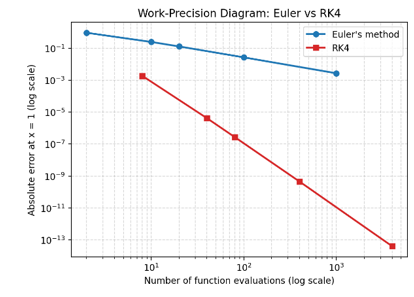
Numerical techniques are essential for approximating solutions to ordinary differential equations (ODEs) that lack closed-form solutions. Although Euler's method and the fourth-order Runge–Kutta (RK4) scheme are frequently compared, most studies report accuracy at a single step size, which cannot by itself demonstrate a genuine accuracy–efficiency trade-off. This paper addresses that gap by solving the benchmark initial value problem over with both methods across five step sizes, tracking absolute error against the number of function evaluations required at each . At , Euler required 10 evaluations and produced 3.187485 (absolute error ), while RK4 required 40 evaluations and produced 3.436559 (absolute error ). Across the full range of step sizes, Euler's error decreases roughly in proportion to , consistent with its first-order global accuracy, whereas RK4's error decreases roughly in proportion to , so RK4 attains errors several orders of magnitude smaller than Euler even after its four-fold higher per-step cost is taken into account. A work-precision diagram of error against function evaluations places RK4's curve consistently below Euler's across every tested , confirming that RK4 dominates Euler over the tested range rather than only at one operating point. Maple 17 code implementing both schemes with an adjustable step-size parameter is provided to support reproduction and extension of these results. These findings give multi-point, quantitative support for preferring RK4 whenever accuracy per function evaluation matters, while Euler remains attractive only when a single, very cheap evaluation is the overriding constraint.
References
Akinsola, V. (2023). Numerical methods: Euler and Runge-Kutta. In K. Shah, B. Carpentieri, & A. Ali (Eds.), Qualitative and computational aspects of dynamical systems. IntechOpen. https://doi.org/10.5772/intechopen.108533
Alemu Wendimu, A., Matušů, R., Gazdoš, F., & Shaikh, I. (2025). A comparative study of one-step and multi-step numerical methods for solving ordinary differential equations in water tank drainage systems. Engineering Reports, 7(3), e70080. https://doi.org/10.1002/eng2.70080
Burden, R. L., & Faires, J. D. (2015). Numerical analysis (10th ed.). Cengage Learning.
Butcher, J. C. (2008). Numerical methods for ordinary differential equations (2nd ed.). Wiley.
Hairer, E., Nørsett, S. P., & Wanner, G. (1993). Solving ordinary differential equations I: Nonstiff problems (2nd ed.). Springer.
Kadam, P. S. (2024). A comparative analysis of numerical solutions to an ODE's IVP using the Euler method and the Runge-Kutta method. International Journal of Integrated Sciences and Mathematics, 1(1), 22–27. https://doi.org/10.54646/ijism.2024.04
Muhammad, R. (2020). The order and error constant of a Runge-Kutta type method for the numerical solution of initial value problem. FUDMA Journal of Sciences, 4(2), 743–748. https://doi.org/10.33003/fjs-2020-0402-256
Yenesew, W., Mekonnen, H., & Belew, B. (2024). Numerical methods for solving second-order initial value problems of ordinary differential equations with Euler and Runge-Kutta fourth-order methods. Frontiers in Applied Mathematics and Statistics, 10, 1360628. https://doi.org/10.3389/fams.2024.1360628
Downloads
Published
Issue
Section
Categories
License
Copyright (c) 2026 Audu Abdulrahman, Abdul Mohammed Hasheem, Chinwendu Jacinta Okigbo, Yusuf Adejo Tahiru

This work is licensed under a Creative Commons Attribution 4.0 International License.