
Effects of Fermentation and Succinylation on the Structural, Functional and Nutritional Properties of African Oil Bean Seed Protein Concentrate
DOI:
https://doi.org/10.33003/fjs-2026-1017-6001Keywords:
African Oil Bean Seed, Succinylation, Fermentation, Modified Protein Concentrate, Pentaclethra Macrophylla, Techno-Functional PropertiesAbstract
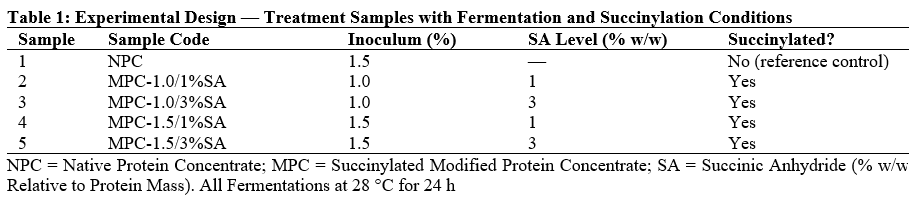
This study evaluated the effects of yeast fermentation and succinylation on the structural, techno-functional and nutritional properties of protein concentrate from African oil bean seed (Pentaclethra macrophylla Benth., AOBS). Native protein concentrate (NPC), from flour fermented with Saccharomyces cerevisiae at 1.5% (w/w) inoculum, served as the unmodified control. Four modified concentrates (MPC) were produced from fermented flour (1.0% or 1.5% inoculum, Factor A) by succinylation with succinic anhydride (1% or 3% w/w, Factor B) in a 2×2 factorial design. A significant fermentation × succinic-anhydride interaction (p < 0.05) was found for degree of succinylation and several functional properties, indicating that inoculum concentration was statistically associated with the succinylation response, based on interaction effects and FTIR data rather than direct measurement of unfolding. Degree of succinylation ranged from 58.64% to 86.92%, with a corresponding FTIR Amide II downshift (1,541.2 → 1,524.8 cm⁻¹) and a succinyl carbonyl band at ~1,718 cm⁻¹. Succinylation significantly (p < 0.05) improved nitrogen solubility index (52.38 → 84.62% at pH 7), emulsifying activity index (28.46 → 58.92 m²/g), emulsion stability index (18.64 → 52.18 min), foaming capacity (42.18 → 72.46%), foaming stability (48.62 → 74.26%) and water-holding capacity (2.84 → 4.24 g/g), while digestibility decreased from 74.82% to 64.28%. Processing reduced saponins by 98.8–99.4%, alkaloids by 99.3%, tannins by 74.6–80.8%, and cyanogenic glycosides by 99.0–99.5% relative to raw seed. These findings show that fermentation-modulated succinylation improves functional properties at the cost of reduced digestibility; further nutritional and safety studies are needed before any food-application recommendation is made.
References
Abbey, L., & Iwe, M. O. (2017). Extraction and characterization of protein concentrates from underutilized African legumes. Journal of Food Science and Technology, 54(8), 2345–2353.
AOAC International. (2019). Official methods of analysis of AOAC International (21st ed.). AOAC International.
Bajpai, S., & Mishra, H. N. (2022). Structural and functional characterization of legume storage proteins: A review. Food Reviews International, 38(6), 1123–1145.
Basak, S., & Singhal, R. S. (2022). Succinylation of food proteins — a concise review. LWT – Food Science and Technology, 154, 112866. https://doi.org/10.1016/j.lwt.2021.112866
Benzie, I. F. F., & Strain, J. J. (1996). The ferric reducing ability of plasma (FRAP) as a measure of ‘antioxidant power’: The FRAP assay. Analytical Biochemistry, 239(1), 70–76.
Emkani, M., Oliete, B., & Saurel, R. (2022). Effect of lactic acid fermentation on legume protein properties: A review. Fermentation, 8(6), 244.
FAO. (2023). The future of food and agriculture: Drivers and triggers for transformation (3rd ed.). Food and Agriculture Organization of the United Nations.
Gemede, H. F., & Ratta, N. (2014). Antinutritional factors in plant foods: Potential health benefits and adverse effects. International Journal of Nutrition and Food Sciences, 3(4), 284–289.
Harborne, J. B. (1973). Phytochemical methods: A guide to modern techniques of plant analysis. Chapman and Hall.
Kasprowicz-Potocka, M., Borowczyk, P., Zaworska, A., Nowak, W., Frankiewicz, A., & Gulewicz, P. (2022). The effect of dry yeast fermentation on chemical composition, protein in vitro digestibility and biological activity of lupin seeds. Food Technology and Biotechnology, 60(1), 30–40.
Kong, X., & Yu, Z. (2007). Investigation of protein changes in fractions during soybean seed germination. LWT – Food Science and Technology, 40(2), 398–404.
Kumar, M., Tomar, M., Potkule, J., Punia, S., Dhakane-Lad, J., Singh, S., Dhumal, S., & Morya, S. (2022). Functional characterization of plant-based protein to determine its quality for food application. Food Hydrocolloids, 123, 106986.
Lam, A. C. Y., Karaca, A. C., Tyler, R. T., & Nickerson, M. T. (2018). Pea protein isolates: Chemistry, modifications, and food applications. Trends in Food Science and Technology, 81, 1–12.
Lian, Z., Yang, S., Dai, S., Tong, X., Wang, H., & Jiang, L. (2022). Relationship between flexibility and interfacial functional properties of soy protein isolate: Succinylation modification. Journal of the Science of Food and Agriculture, 102(5), 1956–1965.
McClements, D. J., & Grossmann, L. (2021). A brief review of the science behind the design of healthy and sustainable plant-based foods. npj Science of Food, 5, 17.
Mune Mune, M. A., Minka, S. R., & Mbome, I. L. (2011). Functional properties of acetylated and succinylated cowpea protein concentrate and effect of enzymatic hydrolysis on solubility. International Journal of Food Sciences and Nutrition, 62(4), 310–317.
Nwokocha, B. C., Chatzifragkou, A., & Fagan, C. C. (2023). Impact of ultrasonication on African oil bean (Pentaclethra macrophylla Benth) protein extraction and properties. Foods, 12(8), 1627.
Obadoni, B. O., & Ochuko, P. O. (2001). Phytochemical studies and comparative efficacy of the crude extracts of some haemostatic plants in Edo and Delta States of Nigeria. Global Journal of Pure and Applied Sciences, 8(2), 203–208.
Onyeike, E. N., Olungwe, T., & Uwakwe, A. A. (2016). Effect of heat treatment and defatting on the proximate composition of some Nigerian local soup thickeners. Food Chemistry, 53(2), 173–175.
Patil, N. D., Bains, A., Kaur, S., Yadav, R., Goksen, G., Ali, N., AlAsmari, A. F., & Chawla, P. (2024). Effect of dual modifications with ultrasonication and succinylation on Cicer arietinum protein-iron complexes. Food Research International, 186, 114344.
Sá, A. G. A., Moreno, Y. M. F., & Carciofi, B. A. M. (2020). Food processing for the improvement of plant proteins digestibility. Critical Reviews in Food Science and Nutrition, 60(20), 3367–3386.
Samtiya, M., Aluko, R. E., & Dhewa, T. (2020). Plant food anti-nutritional factors and their reduction strategies: An overview. Food Production, Processing and Nutrition, 2, 6.
Senanayake, D., Torley, P. J., Chandrapala, J., & Terefe, N. S. (2023). Microbial fermentation for improving the sensory, nutritional and functional attributes of legumes. Fermentation, 9(7), 635.
Shevkani, K., Singh, N., Kaur, A., & Rana, J. C. (2015). Structural and functional characterization of kidney bean and field pea protein isolates: A comparative study. Food Hydrocolloids, 43, 679–689.
Stone, A. K., Karalash, A., Tyler, R. T., Warkentin, T. D., & Nickerson, M. T. (2015). Functional attributes of protein concentrates and isolates from yellow pea, green pea and chickpea. Food Research International, 76, 1–11.
Udenigwe, C. C., & Aluko, R. E. (2017). Food protein-derived bioactive peptides: Production, processing activities and food applications. International Journal of Food Science and Technology, 52(1), 36–48.
Verni, M., Pontonio, E., Montemurro, M., & Rizzello, C. G. (2022). Fermentation as a strategy for improving nutritional, functional, technological, and sensory properties of legumes. In Legumes Research (Vol. 2). IntechOpen.
Villacrés, E., Quelal, M., Espin, S., García-Vega, L., & Cueva, G. (2020). Nutritional quality and bioactive compounds of chickpea affected by processing methods. Foods, 9(2), 250.
Wan, Y., Liu, J., & Guo, S. (2018). Effects of succinylation on the structure and thermal aggregation of soy protein isolate. Food Chemistry, 245, 542–550.
Zhang, Q., Fu, B., & Wang, Z. (2021). Succinylation modification of pea protein isolate and its impact on physicochemical and functional properties. Food Chemistry, 343, 128523.
Zhu, W., Sun, L., Gu, Y., Zhuang, Y., Fan, X., & Ding, Y. (2025). Exploring succinylation in proteins: A comprehensive review from functional improvements to application potential. Food Research International, 213, 116571.
Downloads
Published
Issue
Section
Categories
License
Copyright (c) 2026 Habeeb Abdulmalik, James Samaila

This work is licensed under a Creative Commons Attribution 4.0 International License.