
Assessment of Inbreeding Depression and Broodstock Management Practices in Catfish Farming in Lagos State, Nigeria
DOI:
https://doi.org/10.33003/fjs-2026-1015-5993Keywords:
Inbreeding depression, Broodstock management, Effective population size, Clarias gariepinus, Lagos StateAbstract
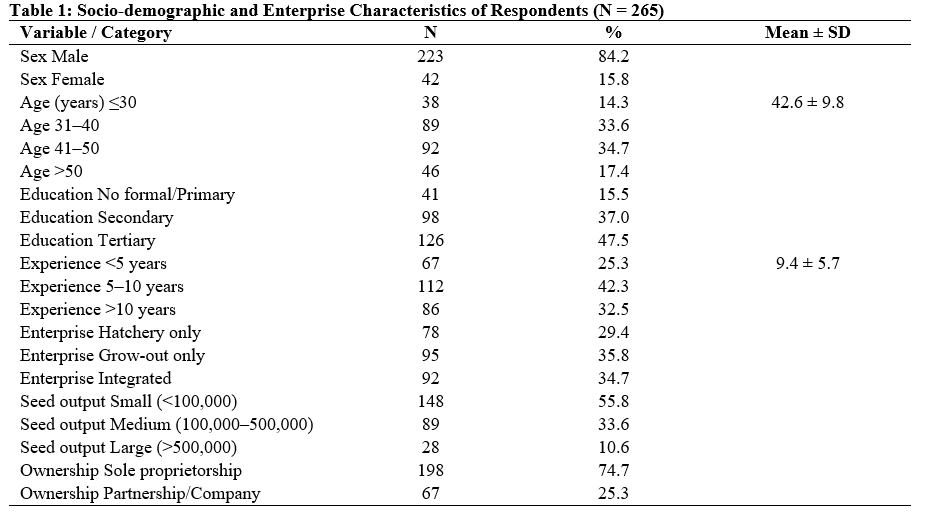
This study assessed inbreeding depression and broodstock management practices among catfish farmers and hatchery owners in Lagos State, Nigeria. Structured questionnaires were administered to 265 respondents; data were analyzed using descriptive statistics, Chi-square tests, independent-samples t-tests, one-way ANOVA and Pearson correlation at p< 0.05. Most respondents (79.6%) sourced broodstock through purchase from other farms, 58.9% used multiple sources, and only 6.8% relied exclusively on own-farm stock. Nearly half (46.8%) used skewed sex ratios of four or more females per male. Effective population size (Ne) fell below the recommended threshold of 50 for most farms, with 67.2% recording an inbreeding rate above one percent per generation. Over 90% selected fast-growing "shooters" as breeding stock, while only 17.7% kept systematic breeding records. Farm scale, experience, education and record-keeping significantly predicted Ne category and management outcomes (p < 0.05). Mean Ne and the number of inbreeding-depression signs observed differed significantly by farm scale, shooter-selection practice, record-keeping status and education (p < 0.001). Broodstock holding size correlated positively with Ne (r = 0.684, p < 0.001), and Ne correlated negatively with the number of inbreeding-depression signs (r = –0.412, p < 0.001). Leading constraints were insufficient supply of genetically diverse catfish (74.7%) and lack of documentation (71.3%). The study concluded that broodstock management practices were significantly associated with inbreeding-depression risk, and recommended zonal broodstock banks, mandatory record-keeping and targeted extension services.
References
Areola, F. O., Osanyinlusi, O. I., Alatise, O. M., & Oladele, O. O. (2024). Implications of inbreeding in Clarias gariepinus fish farming: Farmers' perspectives in Nigeria. Journal of Aquaculture, Marine Biology and Ecology, JAMBE-124.
Christie, M. R., French, R. A., Marine, M. L., & Blouin, M. S. (2012). How much does inbreeding contribute to the reduced fitness of hatchery-born steelhead (Oncorhynchus mykiss) in the wild? Journal of Heredity, 103(1), 38–43.
Eknath, A. E., & Doyle, R. W. (1990). Effective population size and rate of inbreeding in aquaculture of Indian major carps. Aquaculture, 85(1–4), 293–305.
Kabir, H. Y., Abubakar, G. A., Ikenga, E. E., Mukoro, J. E., Abdul-Azeez, H., Rafindadi, H. A., & Galambi, A. Y. (2026). Interaction of crosses and stocking density on breeding of Clarias gariepinus from three eco-regions in Nigeria: River Niger (N), River Benue (B) and River Hadejia (H). FUDMA Journal of Sciences, 10(1), 362–365.
Kwikiriza, G., Tebitendwa, S. M., Rwezawula, P., Mwanja, W. W., Abaho, I., & Meimberg, H. (2025). Enhancing African catfish (Clarias gariepinus) aquaculture in Uganda: Insights into hatchery propagation, population suitability, and broodstock management. Fishes, 10(6), Article 290.
Megbowon, I., Fashina-Bombata, H. A., Akinwale, M. M. A., Hammed, A. M., & Mojekwu, T. O. (2014). Growth performance of wild strains of Clarias gariepinus from Nigerian waters. Journal of Fisheries and Aquatic Science, 9(4), 252–256.
Sanda, M. K., Metcalfe, N. B., Capstick, M., Nichols, J., & Mable, B. K. (2026). Genetic diversity, population structure and differentiation of farmed and wild African catfish (Clarias gariepinus) in Nigeria. Evolutionary Applications, 19(2), Article e70204.
Tine, M., Ndiaye, F., Bale, K., Dossou Magblenou, L., & Sene, M. A. (2022). Effects of inbreeding depression on the success of artificial reproduction in the African catfish Clarias gariepinus (Burchell, 1822). International Journal of Aquaculture and Fisheries Sciences, 8(2), 32–37.
Downloads
Published
Issue
Section
Categories
License
Copyright (c) 2026 Micheal Sanni, Bayo John Olusegun Ayorinde, Abubakar Baman, Alfred Oluwabiyi Ogundeji, Kazeem Tunji Asiru

This work is licensed under a Creative Commons Attribution 4.0 International License.