
Geospatial Analysis and Quadratic Regression Modelling of Soil Chemical Properties and Exchangeable Sodium in Aridisols of Sahel Savannah for Sustainable Soil Management
DOI:
https://doi.org/10.33003/fjs-2026-1018-5990Keywords:
Aridisols, Exch. Na+, Geospatrial Analysis, Quadratic Regression, Soil sodicityAbstract
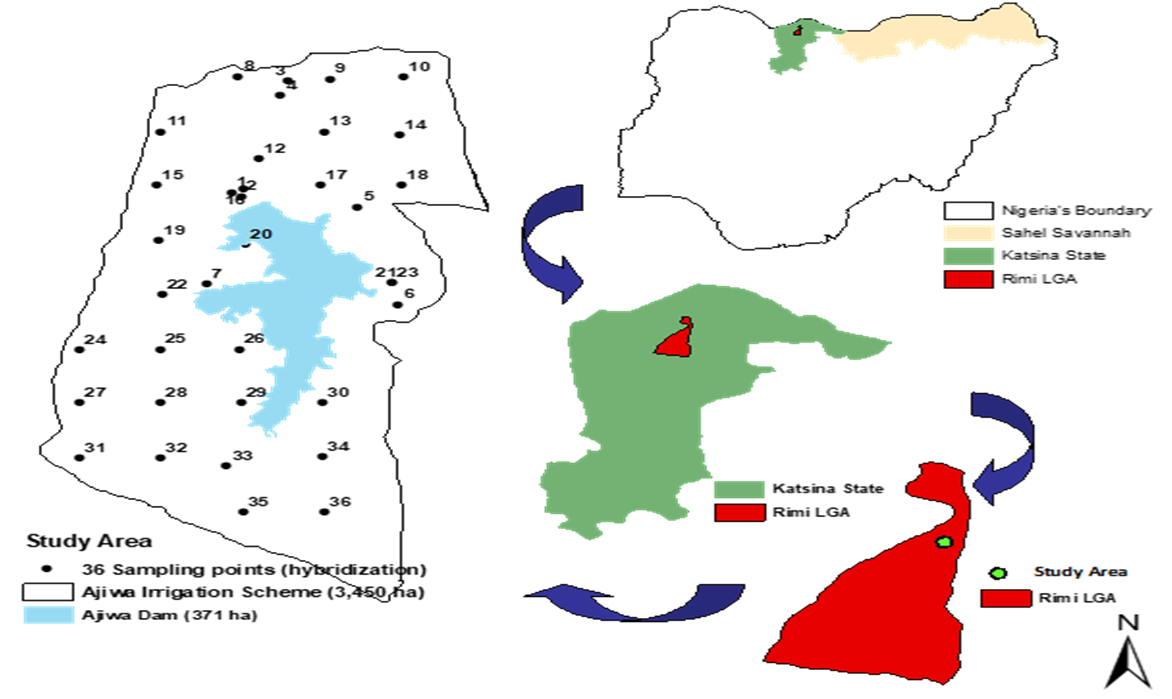
Soil degradation, particularly sodicity, constitutes a major constraint to soil fertility and sustainable irrigation agriculture in semi-arid environments. Exchangeable sodium (Exch. Na⁺) is a critical indicator of sodicity because its accumulation can impair soil structure, permeability and agricultural productivity. This study aimed to evaluate the spatial distribution of total exchangeable bases (TEB), soil organic carbon (SOC) and soil pH, and quantify their linear and nonlinear relationships with Exch. Na⁺ in the Ajiwa Irrigation Scheme, Katsina State, Nigeria. Thirty-six surface soil samples (0–30 cm) were collected using a hybrid purposive-systematic sampling technique and analysed for exchangeable cations, TEB, SOC and soil pH. In ArcGIS 10.8, inverse distance weighting (IDW) was employed to generate spatial distribution surfaces, while second-order quadratic regression was used to model Exch. Na⁺ using standardized TEB, SOC and soil pH. Model robustness was evaluated using leave-one-out cross-validation (LOOCV). Results revealed distinct spatial relationships, with high TEB zones [>15 cmol(+)/kg] coinciding with Exch. Na⁺ hotspots [>25 cmol(+)/kg], particularly at sampling points 3, 5, 7 and 36. The quadratic regression explained 78.9% of the variation in Exch. Na⁺ (R² = 0.789; adjusted R² = 0.746) and was highly significant (F = 18.10, p < 0.001). TEB was significant (β = −0.738, p = 0.033), while its quadratic component was highly significant (β = 0.052, p = 0.002), demonstrating a pronounced nonlinear threshold effect. The TEB–Exch. Na⁺ quadratic relationship achieved R² = 0.899, compared with 0.521 for the linear relationship. LOOCV produced a low RMSE of 0.459, supporting predictive robustness.
References
Adane, H., Gebrekidan & Kibret, K. (2019): Effects of Treatment Application Rates (Fym and Gypsum) on Selected Chemical Properties of Saline Sodic Soils under Water Limited Condition in Eastern Lowlands Ethiopia. Forestry Research and Engineering Internationa Journal. 3(3): 106-113, http://doi.org/10.15406/frei.2019.03.00086
Baba, H. (2016): Soil organic and Carbon Potential in Nigeria. Geoderma, 271: 202–215, http://doi.org/10.1016/j.geoderma.2016.02.015
Balasubramanian, A. (2017): Soil Taxonomy and Classification. Technical Report, http://doi.org/10.13140/rg.2.2.15832.08964
Chang, N., Jing, X., Zeng, W., Zhang, Y., Li, Z., Chen, D., Jiang, D., Zhong, X., Dong, G. & Liu, Q. (2023): Soil Organic Carbon Prediction Based on Different Combinations of Hyperspectral Feature Selection and Regression Algorithm. Agronomy, 13(7): http://doi.org/10.3390/agronomy13071806
Chapman, H. D. (1965): Cation Exchange Capacity. In: C. A. Black (Ed.). Methods of Soil Analysis - Chemical and Microbiological Properties, Agronomy 9: 891–901, Madison, http://doi.org/10.2134/agronmonogr9.2.c7
Cemek, B., Guler, M., Kilic, K., Demir, Y. & Arslan, H. (2007): Assessment of Spatial Variability in some Soil Properties as Related to Soil Salinity and Alkalinity in Bafra Plain in Northern Turkey. Environmental Monitoring & Assessment., 124: 223-234, http://doi.org/10.1007/s10661-006-9220-y
Day, A.D. & Ludeke, K.L. (1993): Plant Nutrients in Environments. Springer-Verlag, Berlin Heidelberg.
Day, P.R., & Ludeke, K.L. (1993): How Do Sodic Soils Behave – the Effects of Sodicity on Soil Physical Behavior. Soil Research, 31(1): 761–777, https://doi.org/10.1071/SR9930761
Demo, A.H., Gemeda, M.K., Abdo, D.R., Guluma, T.N. & Adugna, D.B. (2025): Impact of Soil Salinity, Sodicity and Irrigation Water Salinity on Crop Production and Coping Mechanism in Areas of Dryland Farming. Agrosytems, Geosciences & Environment http://doi.org/10.1002/agg2.70072
El-Seedy, M.E., El-Hamdi, K.H., El-Harty, H.M.F. & Saeed, M.A. (2024): Application of GIS Techniques and ASLE Program for Soil Fertility Assessment of Samannoud District, Gharbia Governorate, Egypt, Egyptian Journal of Science, 64(1): 119-134, http://doi.org/10.21608/ejss.2023.235525.1660
Fitzpatrick, R.W., Boucher, S.C., Naidu, R. & Fritsch (1994): Environmental Consequences of Soil Sodicity. Australian Journal of Soil Resources, 32: 1069-93, http://doi.org/10.1071/sr9941069
Gopal, B., Shetty, A., Jayaprakash & Chaya, D.Y. (2015): Spatial Variability of Topsoil Chemical Properties. Indian Journal of Agricultural Research, 49(2): 134-141, http://doi.org/10.5958/0976-058x.2015.00019.0
Ibrahim, J.A., Mbaya, A.L., Akande, D., Agaku, D.T. & Haruna, S. (2020): Impact of Toposequence on Soil Properties and Classification in Zaria, Kaduna State, Northern Guinea Savanna, Nigeria. EQA – International Journal of Environmental Quality, 38: 48–58, https://doi.org/10.6092/issn.2281-4485/10043
Ibrahim, M., Bello, A. & Yusuf, H. (2021): Soil Salinity and Crop Productivity in Irrigated Fields of Sokoto State, Nigeria. Journal of Arid Environments, 185: 104-338, https://doi.org/10.1016/j.jaridenv.2020.104338
Iwasaki, S., Endo, Y. & Hatano, R. (2017): The Effect of Organic Matter Application on Carbon Sequestration and Soil Fertility in Upland Fields of Different Types of Andosols. Soil Science and Plant Nutrition, 68(2): 200-220, http://doi.org/10.1080/00380768.2017.1309255
Jackson, M. L. (1958): Soil Chemical Analysis. Agronomy Journal, 50, 5, Englewood Cliffs, Prentice-Hall Inc., http://doi.org/10.2134/agronj1958.00021962005000050022x
James, G., Witten, D. Hastie, T. & Tibshirani, R. (2024): An Introduction to Statistical Learning: with Applications in R. Springer Science & Business Media, 24, ch. 5: Resampling Methods.
James, G., Witten, D., Hastie, T., & Tibshirani, R. (2023). An Introduction to Statistical Learning (2nd ed.). Springer Texts in Statistics. https://doi.org/10.1007/978-3-031-387470_5
James, L.A., Scott, C.J., Barnerd, L.A. Owen, M.J., Lang, M.S. & Jones, S.R. (2023): Sensitivity of Model Estimates of CME Propagation and Arrival Time to Inner Boundary Conditions. Space Weather, 21(4): http://doi.org/10.1029/2022sw003289
Kramer, I., Peleg, N & Mau, Y. (2025): Climate Change Shifts Risk of Soil Salinity and Degradation in Water-scarce Regions. Agricultural Water Management, 307: 109223, http://doi.org/10.1016/j.agwat.2024.109223
Lehmann, A., Zheng, W. & Rillig, M.C. (2017): Soil Biota Contributions to Soil Aggregation. Nature Ecology & Evolution, 1(12): 1828–1835, https://doi.org/10.1038/s41559-017-0344-y
Liu, Y., Zhu, L., Ding, L. & Sui, H. (2024): A Hybrid Sampling Method for Highly Imbalanced and Overlapped Data Classification with Complex Distribution. Information Sciences, 661, 4: 120117, https://doi.org/10.1016/j.ins.2024.120117
McLean, E.O. (1982): Soil pH and Lime Requirement. In: Methods of Soil Analysis, Part 2. (Edited by A.L. Page, R.H. Miller and D.R. Keeney). American Society of Agronomy, Madison, Wisc, 199-224, http://doi.org/10.2334/agronmonogr9.2.2ed.c12
Mendieta-Mendoza, A., Renteria-Villalobos, M., Randall, H., Rόiz-Gomez & Rios-Lopez, M. (2023): Chemical Degradation of Agricultural Soil under Arid Conditions by the Accumulation of Potentially Toxic Elements and Salts. Geoderma Regional, 35: e00736, http://doi.org/10.1016/j.geodrs.2023.e00736
Microsoft Corporation, Microsoft Excel, Version 16.0, Redmond, WA, USA: Microsoft, 2023.
Mohanavelu, A., Naganna, S.R. & Al-ansari, N. (2021): Irrigation Induced Salinity and Sodicity Hazards on Soil and Groundwater: An Overview of its Causes, Impacts and Mitigation Strategies. Agriculture, 11(10): 983, http://org/doi.10.3390/agriculture11100983
Naorem, A., Jayaraman, S., Dang, Y.P., Dalal, R.C., Sinha, N.K., Rao, C.S. & Patra, A.K. (2023): Soil Constraints in an Arid Environment - Challenges, Prospects and Implications, Agronomy, 13: 220, http://doi.10.3390/agronomy13010220
Narvaez-Ortiz, W.A., Reyes-Valdes, M.H., la Fuente, M.C. & Benavides-Mendoza, A. (2022): Multiple, Linear and Polynomial Models for Studying the dynamics of the Soil Solution. Soil Systems, 6, 2, (42), http://org/doi.10.3390/soilssystems6020042
Njoku, J.D., Nnaji, A.O. & Iwuji, M.C. (2011): Spatial Analysis of Soil Fertility using Geographical Information Systems Technology. An International Multidisciplinary Journal, Ethiopia, 5(4): 511-524, http://doi.org/10.4314/afrrev.v514.69300
Olaniyi, I.K., Adeosun, B.A. & Ojo, O.I. (2025): Climatic and Anthropogenic Influences on Soil Salinity and Groundwater Quality in Semi Arid Irrigated Agriculture: A Review with Insights from Oba Dam, Nigeria. Asian Journal of Research in Agriculture and Forestry, 11(4): 179-187, https://doi.org//10.9734/ajraf/2025/v11i445
Ouzemou, J., Laamrani, A., El-Battay, A. & Whalen,J.K. (2025): Predicting Soil Salinity Based on Salt/Water Extracts in a Semi-Arid Region of Morocco. Soil Systems, 9(1): 3, http://doi.org/10.3390/soilssystems9010003
Pistocchi, C., Ragaglini, G., Colla, V., Branca, T.A., Tozzini, C. & Romaniella.L. (2017): Exchangeable Sodium Percentage Decrease in Saline-Sodic Soil after Basic Oxygen Furnace Slag application in a lysimeter trial,” Journal of Environmental Management, 203(3): 896-906, http://doi.org/10.1016/j.jenvman.2017.05.007
Qadir, M., Schubert, S. & Prasad, N. (2025): Innovative Approaches for Sodicity Reduction in Semi-Arid Regions. Land Degradation & Development, 36(4): 1162-1178.
Qadir, A.A., Farooqi, Z.U.R., Ahmad, I., Sabir, M., Jamal, A., Hopkins, B.G. & Ashraf, M.N. (2025): Gypsum and Manure Impacts on Contrasting Textured Saline-Sodic Soils and Greenhouse Gas Emissions. Journal of Soil Science and Plant Nutrition. https://doi.org/10.1007/s42729-025-02852-8
Rodriguez-albarracin, H.S., Dematte, J.A.M., Rosin N.A., Contreras, A.E.D., Silvero, N.E.Q., Cerri, C.E.P., Mendes, W. & Tayebi, M. (2023): Potential of Soil Minerals to Sequester Soil Organic Carbon. Geoderma, 436, http://org/doi.10.1016/j.geoderma.2023.116549
Sani, S., Abdulkadir, A., Muhammad, M., Ibrahim, M., Nababa, A.S., Ubaidullah, A. & Suleiman, A. (2024): Assessment of Soil Salinity and sodicity Status at Jibia Irrigation Project Katsina State Nigeria, Life Sciences: An International Journal, 1, 1: http://airccse.com/lsij/papers/1124lsij09.pdf
Sappor, D.K., Osei, B.A. & Ahmed, M.R. (2017): Reclaiming Sodium Affected Soil: The Potential of Organic Amendments. International Journal of Plant Science, 16(2), http://doi.org/10.9734/ijpss/2017/33410
Shahabi, M., Jafarzadeh, A.A., Neyshabouri, M.R., Ghorbani, M.A. and Kamran, K.V. (2016): Spatial Modelling of Soil Salinity using Multiple Linear Regression, Ordinary Kriging and A Neutral Network Methods. Archives of Agronomy and Soil Science http://doi.10.1080/03650340.2016.1193162
Stavi, I., Thevs, N. & Priori, S. (2021): Soil Salinity and Sodicity in Drylands: A Review of Causes, Effects, Monitoring and Restoration Measures. Frontiers in Environmental Science, 9:712831, http://doi.org/10.3389/fenvs.2021.712831
Subhasree, N., Sajeen, S., Prasanthi, K. & Abdul Hakkim, V.M. (2022): Spatial Variability Mapping of Soil Chemical Properties using GIS and GPS. International Journal of Environment & Climate Change, 12(12): 512-520, http://doi.10.9734/ijecc/2022/v12i121488 Sumner, M.E. (1993): Sodic Soils – New Perspectives. Soil Research, 31(6): 683–750, https://doi.org/10.1071/SR9930683
Tuncay, T., Kilic, S., Dedeoglu, M. Dengiz, O., Baskan, O. & Bayramin, I. (2021): Assessing Soil Fertility Index Based on Remote Sensing and GIS Techniques with Field Validation in Semi-Arid Agricultural Ecosystem. Journal of Arid Environments, 190: 104525, http://doi.org/10.1016/j.jaridenv.2021.104525
Tuncay, T., Bayramin, I., Atalay, F. & Unver, I. (2016): Assessment of Inverse Distance Weighted (IDW) Interpolation on Spatial Variability of Selected Soil Properties in the Cukurova Plain, Journal of Agricultural Sciences, 22(3): 377-384, http://doi.org/10.1501/tarimbil_0000001396
Walkley, A.J. & Black, I.A. (1934): Estimation of Organic Carbon by the Chromic Acid Titration Method. Soil Science, 37: 29-38, http://doi.org/10.1097/00010694183401000- 00003
Wang, S., Yao, X., Zhang, Z., He, X. & Ye, S. (2020): Soil Aggregation and Aggregate-Related Exchangeable Base Cations under Different Aged Tea Plantations in Southern Guangxi, China. Soil Science and Plant Nutrition, 66(4): 636–644, https://doi.org/10.1080/00380768.2020.1780471
Wang, H., Ren, T., Feng, Y., Liu, K., Feng, H., Liu, G. & Shi, H. (2020): Effects of the Application of Biochar in Four Typical Agricultural Soils in China. Agronomy, 10(11): 1649, http://doi.org/10.3390/agronomy1000111649
Wang, K., Li, J., Zhou, Z. & Zhang (2023): Editorial: Soil Degradation and Restoration in Arid and Semi-Arid Regions. Frontiers in Environmental Science, 11:1307500, http://doi.org/10.3389/fenvs.2023.1307500
Wang, Y., Gao, M., Chen, H., Fu, X., Wang, L., & Wang, R. (2023): Soil Moisture and Salinity Dynamics of Drip Irrigation in Saline-Alkali Soil of Yellow River basin. Frontiers in Environmental Science, 11: 1130455, https://doi.org/10.3389/fenvs.2023.1130455
Wang, Y., Yin, Y., Joseph, S., Flury, M. Wang, X., Tahery, S., Li, B. & Shang, J. (2023): Stabilization of Organic Carbon in Top and Sub-Soil by biochar Application into Calcareous Farmlands. Science of the Total Environment, 907, http://org/10.1016/j.scitotenv.2023.168046
Yang, F., An, F., Ma, H., Wang, Z., Zhou, X. & Liu, Z. (2016): Variations on Soil Salinity and Sodicity and its driving Factors Analysis under Microtopography in Different Hydrological Conditions. Water, 8: 227, http://doi.org/10.3390/w8060227
Downloads
Published
Issue
Section
Categories
License
Copyright (c) 2026 Abubakar Dangiwa, Buba Adamu Ndawayo

This work is licensed under a Creative Commons Attribution 4.0 International License.


