
Growth Performance and Genetic Variation of African Ebony (Diospyros mespiliformis Hochst. ex A. DC.) In Bade, Yobe State
DOI:
https://doi.org/10.33003/fjs-2026-1015-5978Keywords:
African Ebony, Growth Performance, Genetic Diversity, Gashua, Yobe StateAbstract
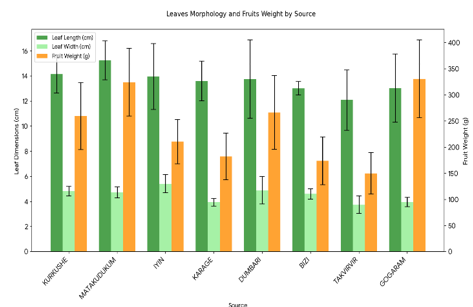
Growth performance and genetic variation of Diospyros mespiliformis were evaluated across eight locations in Bade Emirate, Yobe State, Nigeria. Diospyros mespiliformis is a multipurpose tree species that is mostly found in Sahel ecosystems. Despite the importance of this species, human activities have subjected the species to serious threats; hence, the need to evaluate its growth performance and variation for improvement. The objective of this study was to evaluate the early growth performance and genetic variation of Diospyros mespiliformis in the study area. Purposive selection of eight (8) locations with Diospyros mespiliformis trees was adopted for the study. Mature and healthy trees were identified for fruits and data collection; fruits collected were measured and processes to seeds and the processed seeds were measured for morphometric traits, and early growth studies. Seed morphometric and seedling traits were assessed. Data collected were subjected to analysis of Variance to identify growth performance and genetic variability. The results of the analysis indicated significant variation (p < 0.05) in leaf and fruit morphology among the locations. The highest mean leaf length (15.26cm) was recorded at Matakudukum, while the lowest (3.74cm) was recorded at Takvirvur. The observed variation suggest that the environmental factors may have a greater influence on these morphological traits than the genetic factors. Furthermore, no significant difference was observed in growth traits among the locations. PVC (34.34%) was higher than the GCV (15.56%), suggesting that environmental and other non-genetic factors contributed sustainably to the observed phenotypic variation in the studied traits
References
Akagi, T., Henry, I. M., Tao, R., & Comai, L. (2014). Plant genetics. A Y-chromosome encoded small RNA acts as a sex determinant in persimmons, Science 346:646–650.
Barton, M. K. (2010). Twenty years on: the inner workings of the shoot apical meristem, a developmental dynamo. Developmental Biology, 341(1), 95–113.
Beaulieu J, Lenz P, & Bousquet J. Metadata 2022. Analysis indicates biased estimation of genetic parameters and gains using conventional pedigree information instead of genomic-based approaches in tree breeding. Sci Rep. 2022 Mar 10; 12(1):3933.
Dobrescu, A., Giuffrida, M. V., & Tsaftaris, S. A. 2017. “Leveraging multiple datasets for deep leaf counting,” in 2017 IEEE International Conference on Computer Vision Workshop (ICCVW) (IEEE), 2072–2079.
FAO. (1984). Forest Genetic Resources Information No. 13. Food and Agriculture Organization of the United Nations.
FAO: State of the world’s forests, 2009. Rome: Food and Agriculture Organization of the United Nations; 2009
Gnonlonfin L.1, Biaou H. & Ouinsavi C. A. I. N. 2022. Morphological variation in Diospyros mespiliformis (Ebenaceae) among different habitats in Benin, West Africa. Journal of Ecology and the Natural Environment, Vol. 14(2), pp. 44-55, April-June 2022. DOI: https://doi.org/10.5897/JENE2022.0925.
Groninger, J. W., & Lasko, R. J. 2011. Water for agriculture: challenges and opportunities in a war zone. Water International, 36(6), 693–707.
Iroko, O. A., Kazeem-Ibrahim, F., Bobadoye, O. A and Bobadoye, B. O 2020. Seedlings Growth Performance of Diospyros mespiliformis Hocst. as Influenced by Different Locations. Journal of Forestry Research and Management. Vol. 17(3).147-153; 2020, ISSN 0189-8418.
Ivan Scotti & Santiago C. González-Martínez & Katharina B. Budde & Hadrien Lalagüe 2016. Fifty years of genetic studies: what to make of the large amounts of variation found within populations?. Annals of Forest Science 73:69–75.
Ivetiæ, V., Devetakoviæ, J., Noniæ, M., Stankoviæ, D., & Šijaèiæ-Nikoliæ, M. (2016). Genetic diversity and forest reproductive material—from seed source selection to planting. iForest, 9(5), 801–812. https://doi.org/10.3832/ifor1657-009.
Jingshan Ren, Xinyue Ji, Changhai Wang, Jianjun Hu, Giuseppe Nervo and Jinhua Li. 2020. Variation and Genetic Parameters of Leaf Morphological Traits of Eight Families from Populus simonii × P. nigra. Forests 2020, 11:1319.
Kanmegne, G., Mbakop, C. N., & Fonkou, T. (2020). Germination of West African ebony (Diospyros mespiliformis Hochst) seeds: Effects of dehydration and different pre-sowing treatments. Journal of Forest and Environmental Science, 36(4), 267–273. https://doi.org/10.7747/JFES.2020.36.4.267.
Kouyaté A.M. 2005. Aspects ethnobotaniques et etude de la variabilite morphologique, biochimique et phenologique de detarium microcarpum guill. & perr. au mali. Sciences Ingénieurs Section Agronomie, Gent University. Doctor.
Malakar, A., Sinha, A., 2024. Genetic variability assessment of Azadirachta indica A.Juss in Eastern India: implications for tree improvement. Env. Earth Sci. Proc. 31 (1), 13.
Małgorzata Wistuba , Ireneusz Malik , Holger Gärtner, Paweł Kojs, Piotr Owczarek (2013). Application of eccentric growth of trees as a tool for landslide analyses: The example of Picea abies Karst. In the Carpathian and Sudeten Mountains (Central Europe). CATENA Vol 111, Pp 41-55.
Mir-Marqués A., Domingo A., Cervera M.L., and Guardia M. de la m. 2015. Mineral profile of kaki fruits (Diospyros kaki L.), Food Chem. 172 (2015) 291–297.
Mkwezalamba I, Munthali CR, Missanjo E. 2015. Phenotypic Variation in Fruit Morphology among Locations of Sclerocarya birrea (A. Rich.) Hochst. International Journal of Forestry Research, 2015.
Moles, A. T., Ackerly, D. D., Webb, C. O., Tweddle, J. C., Dickie, J. B., & Westoby, M. 2005. A brief history of seed size. Science, 307(5709), 576–580. doi.org
Mubariz Mehak, Ashfaq A. Mir, P.A. Khan, M.M. Rather, M.I. Jeelani and M.A. Islam. 2025. Variability Studies in Seedling Growth and Biomass Characteristics in Half-sib Progenies of Ulmus villosa Brandis in Kashmir. Biological Forum an International Journal. 17(6): 136-144.
Nicotra, A.B.; Leigh, A.; Boyce, C.K.; Jones, C.S.; Niklas, K.J.; Royer, D.L.; Tsukaya, H. 2011. The evolution and functional significance of leaf shape in the angiosperms. Funct. Plant Biol. 38, 535–552.
Pérez-Luna, A., & López-Upton, J. 2026. Advances in the genetic improvement of forest species in Latin America: a review. Discover Forests, 6(1), Article 73. doi.org.
Priyadevi S, T hangan M, Desai AR and Adusule P. 2022. Studies on variability in physic-chemical characters of different jamun (cumini) accession.
Pšidová, E.; Živˇcák, M.; Stojni´c, S.; Orlovi´c, S.; Gömöry, D.; Kuˇcerová, J.; Ditmarová, L’. Stˇrelcová, K.; Brestiˇc, M.; Kalaji, H.M. 2018. Altitude of origin influences the responses of PSII photochemistry to heat waves in European beech (Fagus sylvatica L.). Environ. Exp. Bot. 152, 97–106.
Roy, M. M., Roy, A. K., & Gupta, S. K. 2004. Concepts in tree breeding. In K. Vanangamudi (Ed.), Advances in tree seed science and technology (pp. 115–132). Agrobios.
Shalizi M.N., Khurram S., Groninger J.W, Akamani K, Morrissey R.C. 2020. Redbud woodlands conservation status in Afghanistan: implications for sustaining vulnerable ecosystems under multiple drivers of change Glob. Ecol. Conserv., 22 (2020), Article e00942, Doi: https://doi.org/10.1016/j.gecco.2020.e00942
Szymański, N., Wilczyński, S., Kowalczyk, J., & Kowalkowski, W. 2025. The tree-ring width and interval trend values as indicators of sensitivity to temperature and precipitation in different locations of European larch. Scientific Reports, 15, 1656.
Tsukaya, H. 2006.Mechanism of leaf-shape determination. Annu. Rev. Plant Biol. 2006, 57, 477–496.
Wani, S. H. 2012. Genetic diversity and heterosis in crop plants. Selected Academic Press.
Westoby, M., Leishman, M., & Lord, J. 1996. Seed mass and species ecological strategies. Trends in Ecology & Evolution, 11(7), 260–264. doi.org
Zanne, A. E., Chapman, C. A., & Kitajima, K. 2005. Seed, seedling and bark traits as predictors of canopy position and growth form in East African species. Journal of Tropical Ecology, 21(4), 463–472. doi.org
Ayoade, J.O. 1988. On Drought and Desertification in Nigeria. In Environmental Issues and Management in Nigerian Development, ed. P.O. Sada and F.O. Odemerho, 271–290. Ibadan: Evans Brothers (Nigerian Publishers) Limited.
Downloads
Published
Issue
Section
Categories
License
Copyright (c) 2026 Aminu Suleiman Abdulhamid, Bulama Ali, Lucky Dartsa Wakawa

This work is licensed under a Creative Commons Attribution 4.0 International License.