
A Predictive Model for Pregnancy Loss Among Reproductive Aged Women
DOI:
https://doi.org/10.33003/fjs-2026-1015-5975Keywords:
Rice Husk Ash, Clay Bricks, Compressive Strength, Regression Modelling, Soil StabilizationAbstract
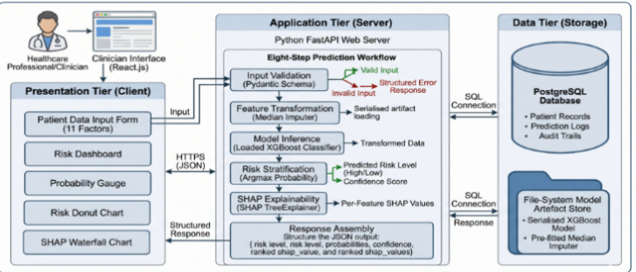
Pregnancy loss remains a critical global public health challenge, affecting approximately 23 million women annually and accounting for 15.3% of all clinically recognized pregnancies worldwide, with the highest burden concentrated in sub-Saharan Africa and other low-resource settings. Despite its prevalence, clinically deployable, explainable predictive tools capable of integrating multiple risk domains at the point of individual care remain largely absent from routine antenatal practice. This study developed, implemented, and evaluated PregLoss PredictorAI, a machine learning-based clinical decision support system for pregnancy loss risk stratification among reproductive-aged women. A dataset of 1,187 patients with eleven clinical and demographic features was used to train and evaluate three supervised ensemble classifiers (XGBoost, LightGBM, and Random Forest) under 5-fold stratified cross-validation. The XGBoost model was selected as the best-performing classifier, achieving a weighted AUC-ROC of 99.95%, accuracy of 98.90%, weighted F1-score of 0.9890, High-risk sensitivity of 98.52%, and High-risk specificity of 99.16%. SHAP analysis identified BMI, pre-existing diabetes, mental health concern, heart rate, and blood sugar as the five most influential predictors, findings consistent with established clinical evidence. The trained model was deployed as a 3-tier web-based application comprising a Python FastAPI backend, React.js clinical interface, and PostgreSQL database. The system provides patient-level SHAP explainability alongside risk classification, bridging the persistent translational gap between machine learning research and clinical practice. These findings demonstrate that a multi-domain, explainable, low-cost predictive system for pregnancy loss risk is achievable and clinically viable.
References
Audu, B. M., Massa, A. A., Bukar, M., El-Nafaty, A. U., & Sa'ad, S. T. (2020). Prevalence of miscarriage and its socio-demographic characteristics in a tertiary hospital in northeastern Nigeria. Journal of Obstetrics and Gynaecology, 29(4), 350–354. https://doi.org/10.1080/01443610902780129
Barnhart, K. T., Sammel, M. D., Rinaudo, P. F., Zhou, L., Hummel, A. C., & Guo, W. (2004). Symptomatic patients with an early viable intrauterine pregnancy: HCG curves redefined. Obstetrics & Gynecology, 104(1), 50–55. https://doi.org/10.1097/01.AOG.0000128174.48843.12
Battista, M. J., Eichler, C., Eichler, M., Oltmann, S., Schulz, M., & Schmidt, M. (2022). Deep learning in obstetrics and gynaecology: A systematic review of clinical applications. Archives of Gynecology and Obstetrics, 306(3), 619–633. https://doi.org/10.1007/s00404-022-06459-7
Bender Atik, R., Christiansen, O. B., Elson, J., Kolte, A. M., Lewis, S., Middeldorp, S., & Quenby, S. (2023). ESHRE guideline: Recurrent pregnancy loss. Human Reproduction Open, 2023(1), hoac042. https://doi.org/10.1093/hropen/hoac042
Blencowe, H., Cousens, S., Jassir, F. B., Say, L., Chou, D., Mathers, C., & Lawn, J. E. (2016). National, regional, and worldwide estimates of stillbirth rates in 2015, with trends from 2000: A systematic analysis. The Lancet Global Health, 4(2), e98–e108. https://doi.org/10.1016/S2214-109X(15)00275-2
Breiman, L. (2001). Random forests. Machine Learning, 45(1), 5–32. https://doi.org/10.1023/A:1010933404324
Bright, T. J., Wong, A., Dhurjati, R., Bristow, E., Bastian, L., Coeytaux, R. R., & Lobach, D. (2012). Effect of clinical decision-support systems: A systematic review. Annals of Internal Medicine, 157(1), 29–43. https://doi.org/10.7326/0003-4819-157-1-201207030-00450
Burgos-Artizzu, X. P., Coronado-Gutiérrez, D., Valenzuela-Alcaraz, B., Bonet-Carne, E., Eixarch, E., Crispi, F., & Gratacos, E. (2020). Evaluation of deep convolutional neural networks for automatic classification of common maternal fetal ultrasound planes. Scientific Reports, 10(1), 10200. https://doi.org/10.1038/s41598-020-67076-5
Chen, T., & Guestrin, C. (2016). XGBoost: A scalable tree boosting system. Proceedings of the 22nd ACM SIGKDD International Conference on Knowledge Discovery and Data Mining, 785–794. https://doi.org/10.1145/2939672.2939785
Coleman, B., Bhattacharyya, M., Harber, M., & Krishnamurthy, R. (2019). Automated risk stratification and clinical decision support in obstetric triage. British Medical Journal Open, 9(4), e026737. https://doi.org/10.1136/bmjopen-2018-026737
Collins, G. S., Reitsma, J. B., Altman, D. G., & Moons, K. G. M. (2015). Transparent reporting of a multivariable prediction model for individual prognosis or diagnosis (TRIPOD): The TRIPOD statement. Annals of Internal Medicine, 162(1), 55–63. https://doi.org/10.7326/M14-0697
Coomarasamy, A., Williams, H., Truchanowicz, E., Seed, P. T., Small, R., Quenby, S., & Rai, R. (2015). A randomized trial of progesterone in women with recurrent miscarriages. New England Journal of Medicine, 373(22), 2141–2148. https://doi.org/10.1056/NEJMoa1504927
Cortes, C., & Vapnik, V. (1995). Support-vector networks. Machine Learning, 20(3), 273–297. https://doi.org/10.1007/BF00994018
Daly, M., Spillane, N., Higgins, C., & McAuliffe, F. M. (2022). Development and pilot evaluation of a web-based risk assessment tool for recurrent pregnancy loss. European Journal of Obstetrics, Gynecology, and Reproductive Biology, 272, 114–120. https://doi.org/10.1016/j.ejogrb.2022.03.021
Dimitriadis, E., Menkhorst, E., Saito, S., Kutteh, W. H., & Brosens, J. J. (2020). Recurrent pregnancy loss. Nature Reviews Disease Primers, 6(1), 98. https://doi.org/10.1038/s41572-02000228-z
Empson, M., Lassere, M., Craig, J., & Scott, J. (2005). Prevention of recurrent miscarriage for women with antiphospholipid antibody or lupus anticoagulant. Cochrane Database of Systematic Reviews, 2005(2), CD002859. https://doi.org/10.1002/14651858.CD002859.pub2
Esteve-Codina, A., Aróstegui, I., Barri, P. N., Martínez-Salazar, J., Miró, O., & Espinàs, J. A. (2021). Application of random forest algorithm in perinatal outcome prediction. Journal of Perinatal Medicine, 49(5), 611–619. https://doi.org/10.1515/jpm-2020-0442
Farren, J., Jalmbrant, M., Falconieri, N., Mitchell-Jones, N., Bobdiwala, S., Al-Memar, M., & Bourne, T. (2020). Post-traumatic stress, anxiety and depression following miscarriage and ectopic pregnancy: A multi-centre, prospective, cohort study. American Journal of Obstetrics and Gynecology, 222(4), 367.e1–367.e22. https://doi.org/10.1016/j.ajog.2019.10.102
Fiorentino, F., Capalbo, A., Bertocci, F., Bono, S., Spizzichino, L., Nuccitelli, A., & Baldi, M. (2017). Mobile decision support application for miscarriage risk assessment: A validation study. Human Reproduction, 32(3), 600–607. https://doi.org/10.1093/humrep/dew347
Free, C., Phillips, G., Galli, L., Watson, L., Felix, L., Edwards, P., & Haines, A. (2013). The effectiveness of mobile-health technology-based health behaviour change or disease management interventions for health care consumers: A systematic review. PLOS Medicine, 10(1), e1001362. https://doi.org/10.1371/journal.pmed.1001362
Goddijn, M., & Leschot, N. J. (2000). Genetic aspects of miscarriage. Baillière's Best Practice & Research Clinical Obstetrics & Gynaecology, 14(5), 855–865. https://doi.org/10.1053/beog.2000.0124
Guo, X. Y., Liu, X. M., Jin, L., Wang, T. T., Ullah, K., Sheng, J. Z., & Huang, H. F. (2021). Construction and validation of a clinical nomogram for predicting the probability of spontaneous abortion. Clinical and Experimental Medicine, 21(3), 439–448. https://doi.org/10.1007/s10238-021-00685-0
Holzinger, A., Langs, G., Denk, H., Zatloukal, K., & Müller, H. (2019). Causability and explainability of artificial intelligence in medicine. WIREs Data Mining and Knowledge Discovery, 9(4), e1312. https://doi.org/10.1002/widm.1312
Hsieh, Y. T., Chen, C. H., Kuo, Y. H., & Liu, C. H. (2020). Comparing machine learning algorithms for gestational diabetes prediction. Diabetes Care, 43(2), e18–e19. https://doi.org/10.2337/dc19-1694
Iliodromiti, S., Mackay, D. F., Smith, G. C. S., Pell, J. P., & Nelson, S. M. (2016). Customised and noncustomised birth weight centiles and prediction of stillbirth. PLOS Medicine, 11(12), e1001768. https://doi.org/10.1371/journal.pmed.1001768
Johnson, A. E. W., Bulgarelli, L., Shen, L., Gayles, A., Shammout, A., Horng, S., & Mark, R. G. (2023). MIMIC-IV, a freely accessible electronic health record dataset. Scientific Data, 10(1), 1. https://doi.org/10.1038/s41597-022-01899-x
Ke, G., Meng, Q., Finley, T., Wang, T., Chen, W., Ma, W., & Liu, T. Y. (2017). LightGBM: A highly efficient gradient boosting decision tree. Advances in Neural Information Processing Systems, 30, 3146–3154.
Koivu, A., & Sairanen, M. (2020). Predicting risk of stillbirth and preterm pregnancies with machine learning. Health Information Science and Systems, 8(1), 14. https://doi.org/10.1007/s13755-020-00105-9
Kovalevsky, G., Gracia, C. R., Berlin, J. A., Sammel, M. D., & Barnhart, K. T. (2004). Evaluation of the association between hereditary thrombophilias and recurrent pregnancy loss. Archives of Internal Medicine, 164(5), 558–563. https://doi.org/10.1001/archinte.164.5.558
Lawn, J. E., Blencowe, H., Waiswa, P., Amouzou, A., Mathers, C., Hogan, D., & Cousens, S. (2016). Stillbirths: Rates, risk factors, and acceleration towards 2030. The Lancet, 387(10018),587–603. https://doi.org/10.1016/S0140-6736(15)00837-5
LeCun, Y., Bengio, Y., & Hinton, G. (2015). Deep learning. Nature, 521(7553), 436–444. https://doi.org/10.1038/nature14539
Liu, H., Logman, J., Peeters, P., de Groot, H. G. W., & Bonsel, G. J. (2019). Support vector machine approach for predicting preterm birth from serum biomarker profiles. Journal of Maternal-Fetal & Neonatal Medicine, 32(2), 260–267. https://doi.org/10.1080/14767058.2017.1379067
Lundberg, S. M., & Lee, S. I. (2017). A unified approach to interpreting model predictions. Advances in Neural Information Processing Systems, 30, 4765–4774.
Lund, M., Kamper-Jorgensen, M., Nielsen, H. S., Lidegaard, O., Andersen, A. N., & Christiansen, O. B. (2012). Prognosis for live birth in women with recurrent miscarriage. Obstetrics & Gynecology, 119(1), 37–43. https://doi.org/10.1097/AOG.0b013e31823c0413
Machtinger, R., Weissman, A., Oron, G., Bokobza, B., Abramovici, H., & Ben-Chetrit, A. (2017). Machine learning for unexplained recurrent pregnancy loss. Reproductive Sciences, 24(9), 1324–1331. https://doi.org/10.1177/1933719116687613
Maconochie, N., Doyle, P., Prior, S., & Simmons, R. (2019). Risk factors for first trimester miscarriage: results from a UK-population-based case-control study. BJOG: An International Journal of Obstetrics and Gynaecology, 114(2), 170–186. https://doi.org/10.1111/j.1471-0528.2006.01193.x
Maguire, R., Drummond, J., Katrina, H., & Sherwood, A. (2015). Problems with data completeness in antenatal risk assessment in primary care: An observational study. Midwifery, 31(6), 627–633. https://doi.org/10.1016/j.midw.2015.02.007
Mol, B. W., Lijmer, J. G., Ankum, W. M., van der Veen, F., & Bossuyt, P. M. M. (1998). The accuracy of single serum progesterone measurement in the diagnosis of ectopic pregnancy: A meta-analysis. Human Reproduction, 13(11), 3220–3227. https://doi.org/10.1093/humrep/13.11.3220
Mor, G., Aldo, P., & Alvero, A. B. (2021). Machine learning predicts adverse neonatal outcomes from CTG data with high accuracy. American Journal of Reproductive Immunology, 85(5), e13388. https://doi.org/10.1111/aji.13388
Musters, A. M., Taminiau-Bloem, E. F., van den Boogaard, E., van der Veen, F., & Goddijn, M. (2014). Supportive care for women with unexplained recurrent miscarriage. Human Reproduction, 26(4), 873–877. https://doi.org/10.1093/humrep/der021
Nybo Andersen, A. M., Wohlfahrt, J., Christens, P., Olsen, J., & Melbye, M. (2000). Maternal age and fetal loss: Population based register linkage study. British Medical Journal, 320(7251), 1708–1712. https://doi.org/10.1136/bmj.320.7251.1708
Obermeyer, Z., & Emanuel, E. J. (2016). Predicting the future: big data, machine learning, and clinical medicine. New England Journal of Medicine, 375(13), 1216–1219. https://doi.org/10.1056/NEJMp1606181
Peffers, K., Tuunanen, T., Rothenberger, M. A., & Chatterjee, S. (2007). A design science research methodology for information systems research. Journal of Management Information Systems, 24(3), 45–77. https://doi.org/10.2753/MIS0742-1222240302
Pineles, B. L., Park, E., & Samet, J. M. (2014). Systematic review and meta-analysis of miscarriage and maternal exposure to tobacco smoke during pregnancy. American Journal of Epidemiology, 179(7), 807–823. https://doi.org/10.1093/aje/kwt334
Practice Committee of the American Society for Reproductive Medicine. (2012). Evaluation and treatment of recurrent pregnancy loss: A committee opinion. Fertility and Sterility, 98(5), 1103-1111. https://doi.org/10.1016/j.fertnsteel.2012.06.048
Quenby, S., Gallos, I. D., Dhillon-Smith, R. K., Podesek, M., Stephenson, M. D., Fisher, J., & Coomarasamy, A. (2021). Miscarriage matters: The epidemiological, physical, psychological, and economic costs of early pregnancy loss. The Lancet, 397(10285), 1658–1667. https://doi.org/10.1016/S0140-6736(21)00682-6
Rai, R., & Regan, L. (2006). Recurrent miscarriage. The Lancet, 368(9535), 601–611. https://doi.org/10.1016/S0140-6736(06)69204-0
Rampasek, L., & Goldenberg, A. (2018). TensorFlow: Biology's gateway to deep learning? Cell Systems, 2(1), 12–14. https://doi.org/10.1016/j.cels.2016.01.009
Regan, L., & Rai, R. (2020). Epidemiology and the medical causes of miscarriage. Baillière's Best Practice & Research Clinical Obstetrics & Gynaecology, 14(5), 839–854. https://doi.org/10.1053/beog.2000.0123
Reyes, M., Meier, R., Pereira, S., Silva, C. A., Dahlweid, F. M., von Tengg-Kobligk, H., & Wiest, R. (2020). On the interpretability of artificial intelligence in radiology. Radiology: Artificial Intelligence, 2(3), e190043. https://doi.org/10.1148/ryai.2020190043
Robertson, L., Wu, O., Langhorne, P., Twaddle, S., Clark, P., Lowe, G. D. O., & Greer, I. A. (2006). Thrombophilia in pregnancy: A systematic review. British Journal of Haematology, 132(2), 171–196. https://doi.org/10.1111/j.1365-2141.2005.05847.x
Rochebrochard, E. L. and Thonneau, P. (2002) Paternal age and maternal age are risk factors for miscarriage; results of a multicentre European study, Human Reproduction, Volume 17, Issue 6, 1 June 2002, Pages 1649–1656, https://doi.org/10.1093/humrep/17.6.1649
Salim, R., Woelfer, B., Backos, M., Regan, L., & Jurkovic, D. (2012). Reproducibility of three dimensional ultrasound diagnosis of congenital uterine anomalies. Ultrasound in Obstetrics & Gynecology, 21(6), 578–582. https://doi.org/10.1002/uog.123
Saravelos, S. H., Cocksedge, K. A., & Li, T. C. (2008). Prevalence and diagnosis of congenital uterine anomalies in women with reproductive failure. Human Reproduction Update, 14(5), 415-429. https://doi.org/10.1093/humupd/dmn018
Seeber, B. E., Sammel, M. D., Guo, W., Zhou, L., Hummel, A., & Barnhart, K. T. (2006). Application of redefined human chorionic gonadotropin curves for the diagnosis of women at risk for ectopic pregnancy. Fertility and Sterility, 86(2), 454–459. https://doi.org/10.1016/j.fertnsteel.2005.12.070
Sendak, M. P., D'Arcy, J., Kashyap, S., Gao, M., Nichols, M., Corey, K., & Balu, S. (2020). A path for translation of machine learning products into healthcare delivery. European Medical Journal Innovations, 10(1), 19–29. https://doi.org/10.33590/emjinnov/19-00020
Smith, G. C. S., Crossley, J. A., Aitken, D. A., Pell, J. P., Cameron, A. D., Connor, J. M., & Dobbie, R. (2004). First-trimester placentation and the risk of antepartum stillbirth. Journal of the American Medical Association, 292(18), 2249–2254. https://doi.org/10.1001/jama.292.18.2249
Sonia M. G., Stefanie, N. H., Sunni, L. M., Lindsey, A. S., Katherine, L. G., Pauline, M., James, L. M., Anna, Z. P., Edwina, Y., Cuilin, Z., Enrique, F. S. (2022). Long-Term Mortality in Women With Pregnancy Loss and Modification by Race/Ethnicity, American Journal of Epidemiology, 191(5), 787–799, https://doi.org/10.1093/aje/kwac023
Stagnaro-Green, A., Abalovich, M., Alexander, E., Azizi, F., Mestman, J., Negro, R., & Wiersinga, W. (2011). Guidelines of the American Thyroid Association for the diagnosis and management of thyroid disease during pregnancy and the postpartum. Thyroid, 21(10), 1081=-125. https://doi.org/10.1089/thy.2011.0087
Stephensen, M. D., Awartani, K. A., & Robinson, W. P. (2002). Cytogenetic analysis of miscarriages from couples with recurrent miscarriage: A case-control study. Human Reproduction, 17(2), 446–451. https://doi.org/10.1093/humrep/17.2.446
Steyerberg, E. W., Moons, K. G., van der Windt, D. A., Hayden, J. A., Perel, P., Schroter, S., & Harrell, F. E. (2013). Prognosis Research Strategy (PROGRESS) 3: Prognostic model research. PLOS Medicine, 10(2), e1001381. https://doi.org/10.1371/journal.pmed.1001381
Steyerberg, E. W., Vickers, A. J., Cook, N. R., Gerds, T., Gonen, M., Obuchowski, N., & Kattan, M. W. (2010). Assessing the performance of prediction models: A framework for traditional and novel measures. Epidemiology, 21(1), 128–138. https://doi.org/10.1097/EDE.0b013e3181c30fb2
Steyerberg, E. W., & Harrell, F. E. (2019). Prediction models need appropriate internal, internal external, and external validation. Journal of Clinical Epidemiology, 69, 245–247. https://doi.org/10.1016/j.jclinepi.2015.04.005
Sufriyana, H., Wu, Y. W., & Su, E. C. Y. (2020). Artificial intelligence-assisted prediction of preeclampsia. EBioMedicine, 54, 102710. https://doi.org/10.1016/j.ebiom.2020.102710
Thangaratinam, S., Rogozinska, E., Jolly, K., Glinkowski, S., Roseboom, T., Tomlinson, J. W., & Khan, K. S. (2012). Effects of interventions in pregnancy on maternal weight and obstetric outcomes. British Medical Journal, 344, e2088. https://doi.org/10.1136/bmj.e2088
Thomas, J., Boughey, M., Jupe, C., & Thomas, K. (2022). AI-assisted ultrasound for early pregnancy assessment in a low-resource African setting. Ultrasound in Obstetrics & Gynecology, 59(4), 508–515. https://doi.org/10.1002/uog.23757
Tuckerman, E., Laird, S. M., Prakash, A., & Li, T. C. (2010). Prognostic value of the measurement of uterine natural killer cells. Human Reproduction, 22(8), 2208–2213. https://doi.org/10.1093/humrep/dem177
United Nations Population Fund. (2022). State of world population 2022: Seeing the unseen. UNFPA. https://www.unfpa.org/swop . Accessed on 18th April, 2026
Unterscheider, J., Daly, S., Geary, M. P., Kennelly, M. M., McAuliffe, F. M., O'Donoghue, K., & Malone, F. D. (2016). Optimizing the definition of intrauterine growth restriction: The multicenter prospective PORTO Study. American Journal of Obstetrics and Gynecology, 208(4), 290.e1–290.e6. https://doi.org/10.1016/j.ajog.2012.11.019
van den Boogaard, E., Vissenberg, R., Land, J. A., van Wely, M., van der Post, J. A. M., Goddijn, M., & Bisschop, P. H. (2011). Significance of (sub)clinical thyroid dysfunction and thyroid autoimmunity before conception and in early pregnancy. Human Reproduction Update, 17(5), 605–619. https://doi.org/10.1093/humupd/dmr024
van Oppenraaij, R. H. F., Jauniaux, E., Christiansen, O. B., Horcajadas, J. A., Farquharson, R. G., & Exalto, N. (2009). Predicting adverse obstetric outcome after early pregnancy events and complications: A review. Human Reproduction Update, 15(4), 409–421. https://doi.org/10.1093/humupd/dmp009
Verhaegen, J., Gallos, I. D., van Mello, N. M., Abdel-Aziz, M., Takwoingi, Y., Harb, H., & Coomarasamy, A. (2012). Accuracy of single progesterone test to predict early pregnancy outcome in women with pain or bleeding: Meta-analysis of cohort studies. British Medical Journal, 345, e6077. https://doi.org/10.1136/bmj.e6077
Villar, J., Cheikh Ismail, L., Victora, C. G., Ohuma, E. O., Bertino, E., Altman, D. G., & Papageorghiou, A. T. (2014). International standards for newborn weight, length, head circumference, weight-for-length, head circumference-for-age and length-for-age: The INTERGROWTH-21st Project. The Lancet, 384(9946), 857–868. https://doi.org/10.1016/S0140-6736(14)60932-6
Wahabi, H. A., Fayed, A. A., Esmaeil, S. A., & Al Zeidan, R. A. (2018). Progestogen for treating threatened miscarriage. Cochrane Database of Systematic Reviews, 2018(8), CD005943. https://doi.org/10.1002/14651858.CD005943.pub4
Waljee, A. K., Mukherjee, A., Singal, A. G., Zhang, Y., Warren, J., Balis, U., & Higgins, P. D. (2013). Comparison of imputation methods for missing laboratory data in medicine. British Medical Journal Open, 3(8), e002847. https://doi.org/10.1136/bmjopen-2013-002847
World Health Organization. (2019). WHO guideline: Recommendations on digital interventions for health system strengthening. WHO. https://apps.who.int/iris/handle/10665/311941
World Health Organization. (2021). Abortion care guideline. WHO. https://www.who.int/publications/i/item/9789240039483
Yehuala, T. Z., Mengesha, S. B., & Baykemagn, N. D. (2025). Predicting pregnancy loss and its determinants among reproductive-aged women using supervised machine learning algorithms in Sub-Saharan Africa. Frontiers in Global Women's Health, 6, 1456238.
Yousuf, A., Wong, K. W., Chen, Q., Kowal, M., Wilson, P., & Cagampang, F. R. (2021). Transfer learning for automated classification of early pregnancy ultrasound images. Frontiers in Medicine, 8, 648681. https://doi.org/10.3389/fmed.2021.648681
Zhang, J., Troendle, J., Meikle, S., Klebanoff, M. A., & Rayburn, W. F. (2023). Deep learning on electronic health records for first-trimester pregnancy loss prediction. The Lancet Digital Health, 5(2), e98–e107. https://doi.org/10.1016/S2589-7500(22)00232-5
Downloads
Published
Issue
Section
Categories
License
Copyright (c) 2026 Betty Ahubele, Lizzy Oguma, Kingsley O. Obahiagbon

This work is licensed under a Creative Commons Attribution 4.0 International License.


