AI-Based Mobile Money Scam Detection: A Comparative Study of Logistic Regression and LSTM Models
DOI:
https://doi.org/10.33003/fjs-2026-1015-5973Keywords:
Financial scam detection, Fintech security, LSTM, Mobile money fraud, Machine learning, SMOTEAbstract
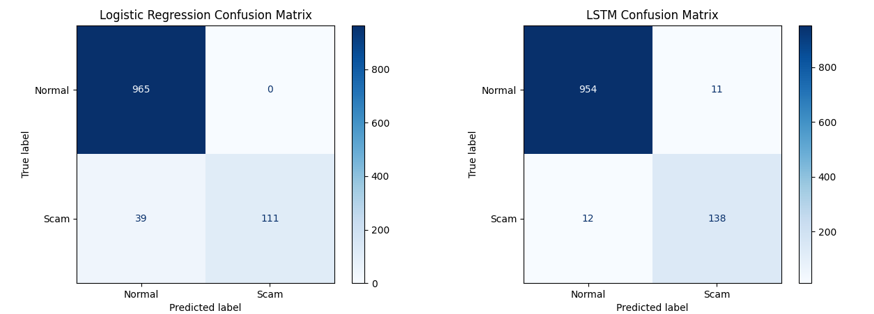
The rapid proliferation of mobile money services across Sub-Saharan Africa and other developing economies has been accompanied by a corresponding surge in mobile money fraud, posing significant risks to financial inclusion and consumer welfare. This paper presents a comparative investigation of two machine learning approaches Logistic Regression (LR) and Long Short-Term Memory (LSTM) neural networks for the automated detection of mobile money scams. Using a synthetically augmented transaction dataset of 1,048,575 records modelled on real-world mobile financial service patterns, we construct a comprehensive preprocessing pipeline encompassing missing-value imputation, feature engineering, class imbalance mitigation via Synthetic Minority Over-sampling Technique (SMOTE), and temporal sequence formatting for the LSTM model. The LSTM model, while competitive with an ROC-AUC of 0.9991, exhibits marginally lower recall, indicating sensitivity to sequential data representation. Logistic Regression, although interpretable and computationally efficient, yields comparatively lower performance, reflecting its linear decision boundary limitations in highly nonlinear fraud patterns. We discuss the implications of these findings for real-time fraud prevention systems in resource-constrained telecommunications environments, and identify avenues for future research including graph neural network integration and federated learning deployment.
References
Abdulraheem, M., Ojo, O., Balogun, A. O., & Basri, S. (2023). Comparative analysis of machine learning classifiers for mobile banking fraud detection under class imbalance. Journal of King Saud University – Computer and Information Sciences, 35(4), 101–114. https://doi.org/10.1016/j.jksuci.2023.01.009
Alfaiz, N. S., & Fati, S. M. (2022). Enhanced credit card fraud detection model using machine learning. Electronics, 11(4), 662. https://doi.org/10.3390/electronics11040662
Eneh, A., Ebem, D. U., Jiya, E. A., Etuh, E., & Raskeb, B. (2024). Machine Learning Models For Classification and Prediction of Preeclampsia in Kaduna, Nigeria. Fudma Journal of Sciences, 8(6), 55-62.
Asongu, S. A., Nting, R. T., & Osabuohien, E. (2022). Mobile money, mobile banking and financial fraud in Sub-Saharan Africa: Contextual and comparative evidence. Journal of Financial Crime, 29(3), 1053–1075. https://doi.org/10.1108/JFC-03-2021-0057
Benchaji, I., Douzi, S., El Ouahidi, B., & Jaafari, J. (2022). Enhanced credit card fraud detection based on attention mechanism and LSTM deep model. Journal of Big Data, 9(1), 1–21. https://doi.org/10.1186/s40537-022-00670-y
Bussmann, N., Giudici, P., Marinelli, D., & Papenbrock, J. (2023). Explainability for fraud detection with machine learning: Evidence from mobile banking. Expert Systems with Applications, 213, 118888. https://doi.org/10.1016/j.eswa.2022.118888
Douzas, G., Bacao, F., Lango, M., & Stefanowski, J. (2022). Imbalanced learning for fraud detection: A systematic review. ACM Computing Surveys, 55(5), 1–38. https://doi.org/10.1145/3527849
GSMA. (2024). State of the industry report on mobile money 2024. GSMA Intelligence. https://www.gsma.com/mobilefordevelopment/resources/state-of-the-industry-report-on-mobile-money-2024
Islam, M. R., Liu, S., Wang, X., & Xu, G. (2022). Deep learning for financial fraud detection: A review and comparative analysis. Artificial Intelligence Review, 55(4), 3359–3388. https://doi.org/10.1007/s10462-021-10057-3
Jeong, Y., Park, J., & Kim, K. (2023). Transformer-based fraud detection for mobile payment systems using tabular data augmentation. IEEE Transactions on Dependable and Secure Computing, 20(6), 4872–4884. https://doi.org/10.1109/TDSC.2022.3230415
Kaffenberger, M., & Koala, J. (2022). Mobile money fraud: Vulnerabilities and policy responses in low-income country markets. Journal of Development Economics, 156, 102826. https://doi.org/10.1016/j.jdeveco.2022.102826
Kurshan, E., & Shen, H. (2023). Graph neural networks for fraud detection in mobile financial networks: Architecture and deployment insights. IEEE Access, 11, 8241–8257. https://doi.org/10.1109/ACCESS.2023.3237791
Li, Z., Chen, X., Liu, P., & Zhang, J. (2023). Adaptive threshold calibration for real-time mobile money fraud detection under distributional shift. IEEE Transactions on Information Forensics and Security, 18, 4211–4224. https://doi.org/10.1109/TIFS.2023.3245612
López-Rojas, E. A., Elmir, A., & Axelsson, S. (2016). PaySim: A financial mobile money simulator for fraud detection. In The 28th European Modeling & Simulation Symposium (pp. 249–255). EMSS.
Ndung'u, N., & Signé, L. (2022). The fourth industrial revolution and digitisation will transform Africa's economies. Brookings Africa Growth Initiative Policy Brief, January 2022.
Osei-Bonsu, K., Arthur-Hayford, P., & Amewu, G. (2023). Mobile money fraud in Ghana: Attack patterns, detection challenges, and machine learning countermeasures. International Journal of Information Security, 22(3), 741–758. https://doi.org/10.1007/s10207-023-00681-1
Randhawa, K., Loo, C. K., Seera, M., Lim, C. P., & Nandi, A. K. (2022). Credit card fraud detection using AdaBoost and majority voting ensemble strategies. IEEE Access, 10, 28752–28766. https://doi.org/10.1109/ACCESS.2022.3157938
Rtayli, N., & Enneya, N. (2022). Selection features and support vector machine for credit card fraud detection. Procedia Manufacturing, 32, 521–528. https://doi.org/10.1016/j.promfg.2019.02.249
Zheng, W., Li, H., Wang, S., & Chen, Q. (2024). FedFraud: Privacy-preserving federated learning for mobile payment fraud detection. IEEE Transactions on Network and Service Management, 21(1), 1031–1045. https://doi.org/10.1109/TNSM.2023.3331522
Downloads
Published
Issue
Section
Categories
License
Copyright (c) 2026 Suleiman Ismail, Ibrahim Sani Lugga, Eli Adama Jiya

This work is licensed under a Creative Commons Attribution 4.0 International License.