
Socio-Demographic and Environmental Risk Factors Associated with Soil-Transmitted Helminth Infections Among Primary School Children in Hong Local Government Area, Adamawa State, Nigeria
DOI:
https://doi.org/10.33003/fjs-2026-1015-5970Keywords:
Soil-transmitted helminths, Risk factors, Sanitation, deworming, School children, Hong LGAAbstract
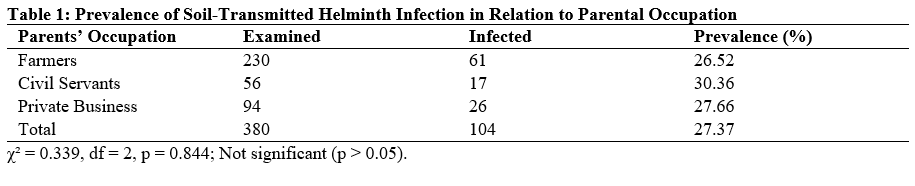
Soil-transmitted helminth (STH) infections remain an important public-health problem among school-aged children, particularly in communities with inadequate sanitation and hygiene. This study assessed the prevalence and socio-demographic and environmental factors associated with STH infections among primary school children in Hong Local Government Area (LGA), Adamawa State, Nigeria. A school-based cross-sectional study was conducted among pupils aged 3–12 years in six selected primary schools from April to September, 2024. Data were collected using structured questionnaires, while stool samples were examined using the Formol-Ether concentration technique. Data were analysed using descriptive statistics and chi-square tests at a 5% significance level. Of 380 pupils examined, 104 (27.37%) were infected. Ascaris lumbricoides was predominant (14.47%), followed by Trichuris trichiura (7.89%) and hookworm (5.00%). Prevalence was highest among pupils from households practising open defecation (36.47%) and lowest among those using water-closet facilities (17.43%). Faecal-disposal method was significantly associated with infection (χ² = 9.217, p = 0.010), whereas parental occupation, water source, footwear use, deworming history, school, gender and age were not significant. The findings highlight the need for improved sanitation, sustained deworming and health education to reduce STH transmission.
References
Adebayo, A. A. (1999). Climate I: Sunshine, Temperature, Evaporation and Relative humidity in Adebayo, AA & Tukur, AL (Eds) Adamawa State in Maps. Geography Department, Fedearal University of Technology, YoIa.
Agbroko, S. O., Udofia, L. E., & Owowo, E. E. (2025). Prevalence of soil transmitted helminths among primary school children in Ikpa Ibom, Mkpat Enin Local Government Area, Akwa Ibom State. Journal of Disease and Global Health, 18(2), 343–351. https://doi.org/10.56557/jodagh/2025/v18i29949
Agrawal, R., Pattnaik, S., Kshatri, J. S., Kanungo, S., Mandal, N., Palo, S. K., & Pati, S. (2024). Prevalence and correlates of soil-transmitted helminths in schoolchildren aged 5 to 18 years in low- and middle-income countries: A systematic review and meta-analysis. Frontiers in Public Health, 12, 1283054. https://doi.org/10.3389/fpubh.2024.1283054
Aribodor, O. B., Jacob, E. C., Azugo, N. O., Ngenegbo, U. C., Obika, I., Obikwelu, E. M., & Nebe, O. J. (2025). Soil-transmitted helminthiasis among adolescents in Anaocha Local Government Area, Anambra State, Nigeria: Insights and recommendations for effective control. PLOS ONE, 20(1), e0292146. https://doi.org/10.1371/journal.pone.0292146
Awotokun, F., Sowemimo, O. A., Olawoyin, R., & Adeleke, A. A. (2024). Soil-transmitted helminthiasis among school-aged children in selected primary schools in southwest Nigeria: A cross-sectional study. Christian Journal for Global Health, 11(1), 91–98. https://doi.org/10.15566/cjgh.v11i1.833
Cheesbrough, M. (2006). District laboratory practice in tropical countries. Cambridge university press.
Ikpeoha, B. C., Aribodor, D. N., Okwelogu, I. S., Okoye, C. M., & Anyanebechi, W. C. (2024). Soil-transmitted helminthiasis among pupils in semi-urban communities in Anambra State, Nigeria. South Asian Journal of Parasitology, 7(2), 141–151.
Imalele, E. E., et al. (2023). Environmental contamination by soil-transmitted helminths ova and subsequent infection in school-age children in Calabar, Nigeria. Scientific African, e01580. https://doi.org/10.1016/j.sciaf.2023.e01580
Innocent, A., Qadeer, M. A., Atinga, A., & Benson, O. (2026). Prevalence of intestinal parasites and Plasmodium co-infection in two wards of Hong Local Government Area, Adamawa State, Nigeria. Trends in Biological Sciences, 2(2), 179–188. https://doi.org/10.21124/tbs.2026.179.188
National Population Commission. (2006). 2006 population and housing census of the Federal Republic of Nigeria. National Population Commission.
Obi, D. C., Nwazulu, B. H., & Udeh, S. C. (2024). Knowledge, attitudes and preventive practices towards soil-transmitted helminthiases among teachers in schools implementing the home-grown school feeding program in Enugu Metropolis, Enugu State, Nigeria. BMC Public Health, 24, 3601. https://doi.org/10.1186/s12889-024-21159-4
Oseamehon, P., Qadeer, M. A., & Godly, C. (2026). Prevalence and risk factors associated with intestinal helminth infections among school children in Adamawa Central Zone, Nigeria. FUDMA Journal of Sciences, 10(4), 108–112. https://doi.org/10.33003/fjs-2026-1004-4468
Usang, A. U., Imalele, E. E., Effanga, E. O., Ukoha, U. K., & Eleng, I. E. (2025). Soil-transmitted helminth infections and nutritional indices among children (5–9 years) and adolescents (10–12 years) in Calabar, Nigeria. BMC Public Health, 25, 1. https://doi.org/10.1186/s12889-024-21210-4
World Health Organization Regional Office for Africa. (2024). Disease outlook report: Soil-transmitted helminthiases (STH). World Health Organization Regional Office for Africa.
World Health Organization. (2023). Soil-transmitted helminth infections. https://www.who.int/news-room/fact-sheets/detail/soil-transmitted-helminth-infections
Yamane, T. (1967). Statistics: An introductory analysis (2nd ed.). Harper & Row.
Downloads
Published
Issue
Section
Categories
License
Copyright (c) 2026 Donaldson Thadawus, Nuwanyada Enock

This work is licensed under a Creative Commons Attribution 4.0 International License.