
Effect of Fermentation Duration and Co-fermentation Materials on the Proximate Composition, Fibre Fractions and Tannin Content of Parkia Biglobosa Husk
DOI:
https://doi.org/10.33003/fjs-2026-1018-5969Keywords:
proximate composition, fruit exudates, poultry droppings, rice husk, fibre fractions, fermentation, Parkia biglobosaAbstract
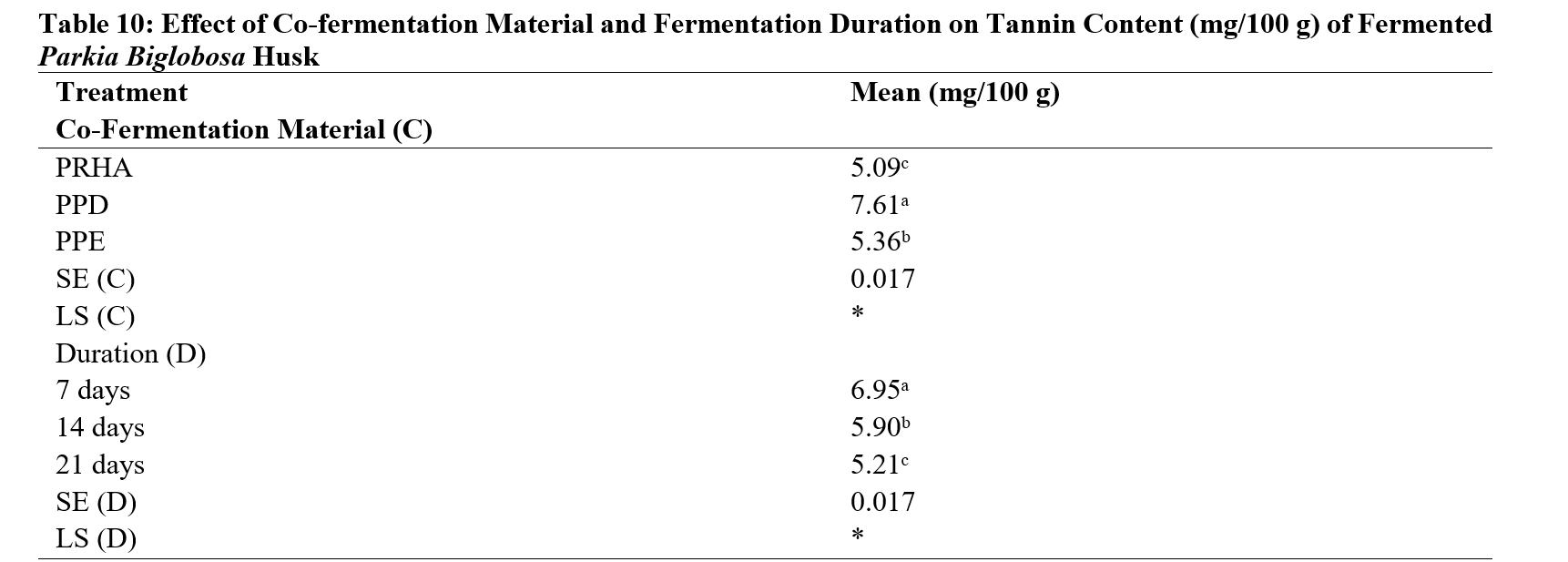
This study evaluated the effects of fermentation duration and co-fermentation materials on the proximate composition, fibre fractions and tannin content of Parkia biglobosa husk at the Agriculture Laboratory, College of Education, Oro, Kwara State, Nigeria. The experiment was arranged as a 3 × 3 factorial comprising three co-fermentation materials: rice husk ash (PRHA), poultry droppings (PPD) and fruit exudates (PPE), and three fermentation durations of 7, 14 and 21 days, with three independent fermentation batches per treatment combination, giving 27 experimental units (n = 27). Fermented samples were analysed for moisture, residual moisture, crude protein, ash, crude fibre, crude fat, carbohydrate (CHO), neutral detergent solubles (NDS), neutral detergent fibre (NDF) and tannin. Data were subjected to two-way analysis of variance (ANOVA), and means were separated using Tukey’s honestly significant difference (HSD) test at P ≤ 0.05. Co-fermentation material and fermentation duration significantly affected most parameters, with significant interactions for moisture, residual moisture, crude protein, ash, crude fibre, CHO, NDS, NDF and tannin, whereas crude fat showed no significant interaction. PRHA recorded the highest crude protein (9.13%) and ash (13.55%), while PPE had the highest crude fibre (43.09%), crude fat (2.05%) and NDS (41.44%). Fermentation for 21 days increased crude protein (8.84%) and ash (9.85%) but reduced crude fibre (37.04%), crude fat (1.39%), CHO (30.19%) and tannin (5.21%). Fermentation produced distinct changes in the nutritional and fibre characteristics of P. biglobosa husk, indicating its potential for improving the feed value of this underutilisedagro-processing residue.
References
Abiola-Olagunju, O., Mako, A. A., Ettu, R., & Afolabi, B. O. (2024). Improving nutritional quality of some fibrous agricultural wastes using white rot fungi (Pleurotus plumonarius). Nigerian Journal of Animal Production, 798–801. https://doi.org/10.51791/njap.vi.5745
Ariwaodo, C. A., & Olaniyan, O. F. (2024). Fleshy fruit waste and the green chemistry of its conversion to valuable products for humans and animals. Food Chemistry Advances, 4, 100634. https://doi.org/10.1016/j.focha.2024.100634
Association of Official Analytical Chemists International. (2023). Official methods of analysis of AOAC INTERNATIONAL (22nd ed.; G. W. Latimer, Jr., Ed.). AOAC INTERNATIONAL.
Azokpota, P., Hounhouigan, D., & Nago, M. (2006). Microbiological and chemical changes during the fermentation of African locust bean (Parkia biglobosa) to produce afitin, iru and sonru, three traditional condiments produced in Benin. International Journal of Food Microbiology, 107(3), 304–309. https://doi.org/10.1016/j.ijfoodmicro.2005.10.026
Chilakamarry, C. R., Sakinah, A. M., Zularisam, A., Sirohi, R., Khilji, I. A., Ahmad, N., & Pandey, A. (2021). Advances in solid-state fermentation for bioconversion of agricultural wastes to value-added products: Opportunities and challenges. Bioresource Technology, 343, 126065. https://doi.org/10.1016/j.biortech.2021.126065
Esse, M. Y., Guehi, T. S., Lebrun, M., Morel, G., Grabulos, J., Mestres, C., & Achir, N. (2022). Kinetic study of some flavor and bioactive compounds during fermentation of Parkia biglobosa. Journal of Food Processing and Preservation, 46, e16888. https://doi.org/10.1111/jfpp.16888
Islam, M. T., Hossen, M. F., Asraf, M. A., Kudrat-E-Zahan, M., & Zakaria, C. M. (2024). Production and characterization of silica from rice husk: An updated review. Asian Journal of Chemical Sciences, 14(2), 83–96. https://doi.org/10.9734/ajocs/2024/v14i2296
Latimer, G. W., Jr. (Ed.). (2023). Official methods of analysis of AOAC INTERNATIONAL (22nd ed.). AOAC INTERNATIONAL. https://doi.org/10.1093/9780197610145.001.0001
Ndukwe, M., & Solomon, M. (2017). Proximate and antinutrient composition of some local food condiments in their raw and fermented forms. International Journal of Biochemistry Research & Review, 20(1), 1–8. https://doi.org/10.9734/ijbcrr/2017/37727
Ogbadu, L., & Okagbue, R. (1988). Fermentation of African locust bean (Parkia biglobosa) seeds: involvement of different species of Bacillus. Food Microbiology, 5(4), 195–199. https://doi.org/10.1016/0740-0020(88)90018-4
Perwez, M., & Asheh, S. A. (2024). Valorization of agro-industrial waste through solid-state fermentation: Mini review. Biotechnology Reports, 45, e00873. https://doi.org/10.1016/j.btre.2024.e00873
Postigo, L. O. C. Y., Jacobo-Velázquez, D. A., Guajardo-Flores, D., Amezquita, L. E. G., & García-Cayuela, T. (2021). Solid-state fermentation for enhancing the nutraceutical content of agrifood by-products: Recent advances and its industrial feasibility. Food Bioscience, 41, 100926. https://doi.org/10.1016/j.fbio.2021.100926
Postigo, L. O. C. Y., Jacobo-Velázquez, D. A., Guajardo-Flores, D., Amezquita, L. E. G., & García-Cayuela, T. (2021). Solid-state fermentation for enhancing the nutraceutical content of agrifood by-products: Recent advances and its industrial feasibility. Food Bioscience, 41, 100926. https://doi.org/10.1016/j.fbio.2021.100926
Price, M. L., Hagerman, A. E., & Butler, L. G. (1980). Tannin content of cowpeas, chickpeas, pigeon peas, and mung beans. Journal of Agricultural and Food Chemistry, 28(2), 459–461. https://doi.org/10.1021/jf60228a047
Sadh, P. K., Duhan, S., & Duhan, J. S. (2018). Agro-industrial wastes and their utilization using solid state fermentation: A review. Bioresources and Bioprocessing, 5, 1. https://doi.org/10.1186/s40643-017-0187-z
Shrivastava, B., Jain, K. K., Kalra, A., & Kuhad, R. C. (2014). Bioprocessing of wheat straw into nutritionally rich and digested cattle feed. Scientific Reports, 4, 6360. https://doi.org/10.1038/srep06360
Urua, I. S., Uyoh, E. A., Ntui, V. O., & Okpako, E. C. (2013). Effect of processing on proximate composition, anti-nutrient status and amino acid content in three accessions of African locust bean (Parkia biglobosa (Jacq.) Benth.). International Journal of Food Sciences and Nutrition, 64(1), 94–102. https://doi.org/10.3109/09637486.2012.704903
Van Soest, P., Robertson, J., & Lewis, B. (1991). Methods for dietary fiber, neutral detergent fiber, and nonstarch polysaccharides in relation to animal nutrition. Journal of Dairy Science, 74(10), 3583–3597. https://doi.org/10.3168/jds.s0022-0302(91)78551-2
Wang, J., Huang, Z., Jiang, Q., Roubík, H., Xu, Q., Gharsallaoui, A., Cai, M., Yang, K., & Sun, P. (2023). Fungal solid-state fermentation of crops and their by-products to obtain protein resources: The next frontier of food industry. Trends in Food Science & Technology, 138, 628–644. https://doi.org/10.1016/j.tifs.2023.06.020
Yafetto, L., Odamtten, G. T., & Wiafe-Kwagyan, M. (2023). Valorization of agro-industrial wastes into animal feed through microbial fermentation: A review of the global and Ghanaian case. Heliyon, 9(4), e14814. https://doi.org/10.1016/j.heliyon.2023.e14814
Yakubu, C. M., Sharma, R., Sharma, S., & Singh, B. (2022). Fermentation of locust bean (Parkia biglobosa): Modulation in the anti-nutrient composition, bioactive profile, in vitro nutrient digestibility, functional and morphological characteristics. International Journal of Food Science & Technology, 57(2), 753–762. https://doi.org/10.1111/ijfs.15288
Downloads
Published
Issue
Section
Categories
License
Copyright (c) 2026 Lukman Abdulquadri Olarewaju, Abdulmajeed Tijani Majengbesan, Dupe Olufunke Ogunbosoye, Dare Abdulkadir Okanla, Opeyemi Femi Afolayan, Muyiwa Adefioye Sheriff

This work is licensed under a Creative Commons Attribution 4.0 International License.


