
Beyond the Triple Helix: An Infrastructure-Conditional Framework for Management Information Systems Innovation in Nigeria
DOI:
https://doi.org/10.33003/fjs-2026-1017-5967Keywords:
Triple Helix Model, Management Information Systems, Entrepreneurship, Sustainable Development, Digital Public Infrastructure, Broadband PenetrationAbstract
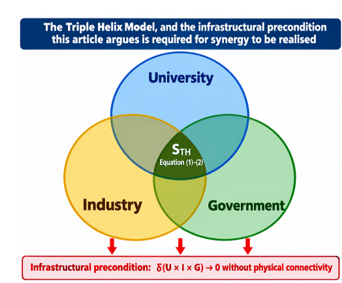
Why do some countries translate university research into scalable public systems, productive firms, and effective governance, while others struggle to move beyond isolated innovation? This conceptual, theory-building article addresses that question through the Triple Helix Model of university–industry–government collaboration, using Management Information Systems (MIS) as an interdisciplinary lens; it combines a targeted, non-systematic literature synthesis with a quantitative secondary-data case analysis, and develops an infrastructure-conditional perspective in which institutional collaboration is shaped by the digital and organisational conditions required for implementation. Evidence is drawn from China’s industry–education cities and enterprise artificial-intelligence ecosystem, India’s digital public infrastructure, and Nigeria’s emerging technology ecosystem. For Nigeria, six years of official regulator data (2020–2025) are analysed using an endpoint growth ratio, ordinary-least-squares trend estimation, denominator-harmonised regression, Durbin–Watson diagnostics, and out-of-sample validation. Realised annual broadband penetration growth reached only about 38% of the rate required to meet the national target, despite substantial growth in raw subscriptions; a two-year patent-filing comparison indicates this innovation gap is persistent rather than a single-year fluctuation. Triple Helix collaboration cannot be treated as an unconditional additive process: its effectiveness depends on infrastructure, institutional capacity, and mechanisms for translating knowledge into deployment. The study proposes an infrastructure-aware Nigerian Triple Helix framework centred on open data governance, university-based MIS research, and intermediary institutions connecting research, policy, and implementation, contributing an empirically grounded extension of Triple Helix theory for resource-constrained digital economies.
References
References
Abah, J., Baptista, K., MacKenzie, C., & Varghese, A. (2022). Putting people at the centre of digital policy. Routledge. https://doi.org/10.4324/9781003274322-12
AfCFTA Secretariat. (2023). Digital trade protocol and ICT integration in African continental trade [Policy report]. African Continental Free Trade Area Secretariat.
Aidonojie, P. A., Majekodunmi, T. A., Edetalehn, O. I., & Adeyemi-Balogun, O. J. (2023). A facile review on the protection of an invention in Nigeria: Issues and challenges. Journal of Human Rights, Legal and Peace Studies, 12(2), 371–408. https://doi.org/10.25216/jhp.12.2.2023.371-408
Àkànle, O., & Ola-Lawson, D. O. (2021). Diaspora networks and investments in Nigeria. Journal of Asian and African Studies. Advance online publication. https://doi.org/10.1177/00219096211052970
Almeida, H., & Sequeira, B. (Eds.). (2019). The role of knowledge transfer in open innovation. IGI Global. https://doi.org/10.4018/978-1-5225-5849-1
Businessday. (2022, December 28). Nigeria’s broadband penetration rate moves at snail’s pace. Businessday NG. https://businessday.ng/technology/article/nigerias-broadband-penetration-rate-moves-at-snails-pace/
Businessday. (2023, January 24). Telcos gain 13m internet subscribers in 2022. Businessday NG. https://businessday.ng/technology/article/telcos-gain-13m-internet-subscribers-in-2022/
Businessday. (2024, February 20). Nigeria plans local government broadband, misses 50% target. Businessday NG. https://businessday.ng/technology/article/nigeria-plans-local-government-broadband-misses-50-target/
Cai, Y., & Etzkowitz, H. (2020). Theorizing the Triple Helix model: Past, present, and future. Triple Helix, 7(2–3), 189–226. https://doi.org/10.1163/21971927-bja10003
Cai, Y., & Lattu, A. (2021). Triple Helix or quadruple helix: Which model of innovation to choose for empirical studies? Minerva, 60(2), 257–280. https://doi.org/10.1007/s11024-021-09453-6
Champenois, C., & Etzkowitz, H. (2017). From boundary line to boundary space: The creation of hybrid organizations as a Triple Helix micro-foundation. Technovation, 68, 28–39. https://doi.org/10.1016/j.technovation.2017.11.002
Cheng, C., Cheng, S., & Feng, C.-S. (2024). The Triple Helix model for industry-education city integration in China: A development approach. SAGE Open, 14(2). https://doi.org/10.1177/21582440241250111
Danson, M., & Todeva, E. (2016). Government and governance of regional Triple Helix interactions. Industry and Higher Education, 30(1), 13–26. https://doi.org/10.5367/ihe.2016.0293
DeLone, W. H., & McLean, E. R. (2016). Information systems success measurement. Foundations and Trends in Information Systems, 2(1), 1–116. https://doi.org/10.1561/2900000005
Emelogu, C. I. (2024). Exploring digital strategy as a business management and transformation tool in developing countries: The Nigerian experience. Journal of Management and Strategy, 15(1), 12–24. https://doi.org/10.5430/jms.v15n1p12
Enholm, I. M., Papagiannidis, E., Mikalef, P., & Krogstie, J. (2021). Artificial intelligence and business value: A literature review. Information Systems Frontiers, 24(5), 1709–1734. https://doi.org/10.1007/s10796-021-10186-w
Etzkowitz, H., & Adeoti, J. O. (2023). Technological informality as a development strategy: Iconic Ikeja Computer Village at risk. In D. Boer, H. Sander, K. Friz, & A. Anastasi (Eds.), Private sector development in an emerging world: Inclusive policies and strategies for the formal and informal economy (pp. 207–214). De Gruyter. https://doi.org/10.1515/9783111071251-013
FIJ. (2026, January 9). FG promised 70% broadband by 2025. Bosun Tijani spoke, $500m followed—and Nigeria still missed it. Foundation for Investigative Journalism. https://fij.ng/article/fg-promised-70-broadband-by-2025-bosun-tijani-spoke-500m-followed-and-nigeria-still-missed-it/
Gatune, J. (2023). Triple helix as model for driving innovation in emerging economies—What it takes. In D. Boer, H. Sander, K. Friz, & A. Anastasi (Eds.), Private sector development in an emerging world: Inclusive policies and strategies for the formal and informal economy (pp. 215–230). De Gruyter. https://doi.org/10.1515/9783111071251-014
Heeks, R. (2002). Information systems and developing countries: Failure, success, and local improvisations. The Information Society, 18(2), 101–112. https://doi.org/10.1080/01972240290075039
Holmes, M., Lacerda, T., & Schwartz, R. (2026). Making AI evaluation deployment relevant through context specification [Preprint, not peer-reviewed] (arXiv:2603.06811). Cornell University. https://doi.org/10.48550/arxiv.2603.06811
Iammarino, S., Rodríguez-Pose, A., & Storper, M. (2018). Regional inequality in Europe: Evidence, theory and policy implications. Journal of Economic Geography, 19(2), 273–298. https://doi.org/10.1093/jeg/lby021
Leydesdorff, L. (2011). The Triple Helix, quadruple helix, …, and an N-tuple of helices: Explanatory models for analyzing the knowledge-based economy? Journal of the Knowledge Economy, 3(1), 25–35. https://doi.org/10.1007/s13132-011-0049-4
Linton, G. (2024). Triple Helix dynamics and hybrid organizations: An analysis of value creation processes. Journal of the Knowledge Economy, 15(4), 20797–20822. https://doi.org/10.1007/s13132-024-01911-2
Ma, J., & Yang, D. (2024). Research on the mechanism of government-industry-university-research collaboration for cultivating innovative talent based on game theory. Heliyon, 10(4), Article e25335. https://doi.org/10.1016/j.heliyon.2024.e25335
Mariani, M. M., Machado, I., Magrelli, V., & Dwivedi, Y. K. (2022). Artificial intelligence in innovation research: A systematic review, conceptual framework, and future research directions. Technovation, 122, Article 102623. https://doi.org/10.1016/j.technovation.2022.102623
Nairametrics. (2025, December 25). Broadband penetration crosses 50% in November, as Nigeria misses target. Nairametrics. https://nairametrics.com/2025/12/25/broadband-penetration-crosses-50-in-november-as-nigeria-misses-target/
Nigerian Communications Commission. (2021). 2021 subscriber/network data annual report. https://www.ncc.gov.ng/sites/default/files/2024-11/Documents/2021-year-end-subscriber-network-data-report%20(1).pdf
Nigerian Communications Commission. (2022). 2022 subscriber/network data annual report. https://www.ncc.gov.ng/sites/default/files/2024-11/Documents/2022%20YEAR%20END%20PERFORMANCE%20REPORT.pdf
Nigerian Communications Commission. (2023). 2023 subscriber/network performance report. https://ncc.gov.ng/sites/default/files/2025-04/2023-YEAR-END-PERFORMANCE-REPORT.pdf
Nigerian Communications Commission. (2024). 2024 subscriber/network performance report. https://ncc.gov.ng/sites/default/files/2025-11/2024-Year-End-Performance-Report.pdf
NITDA. (2023). National digital economy policy and strategy for a digital Nigeria, 2020–2030. National Information Technology Development Agency.
Nwagwu, W. E. (2008). The Nigerian university and the Triple Helix model of innovation systems: Adjusting the wellhead. Technology Analysis & Strategic Management, 20(6), 683–696. https://doi.org/10.1080/09537320802426374
Oghuvbu, E. A., Gberevbie, D. E., & Oni, S. (2022). Technology policy and sustainable development in Nigeria. Vestnik RUDN International Relations, 22(2), 385–396. https://doi.org/10.22363/2313-0660-2022-22-2-385-396
Passos, J. B., Enrique, D. V., Dutra, C. C., & ten Caten, C. S. (2022). University-industry collaboration process: A systematic review of literature. International Journal of Innovation Science, 14(3/4), 617–636. https://doi.org/10.1108/ijis-11-2021-0216
Piqué, J. M., Berbegal-Mirabent, J., & Etzkowitz, H. (2018). Triple Helix and the evolution of ecosystems of innovation: The case of Silicon Valley. Triple Helix, 5(1), Article 11. https://doi.org/10.1186/s40604-018-0060-x
Schebesch, K. B., Șoim, H. F., & Blaga, R. L. (2024). The Triple Helix model as foundation of innovative entrepreneurial ecosystems. Journal of Entrepreneurship and Emerging Economies. Advance online publication. https://doi.org/10.1108/jeet-08-2024-0026
Soumya, J. (2025). The pivotal role of digital public infrastructure in shaping the global economy [Working paper]. Harvard University. https://dash.harvard.edu/handle/1/42719067
Sowande, O. A., Idachaba, F. E., Ekpo, S., Faruk, N., Uko, M., & Ogunmodimu, O. (2022). Sub-6 GHz 5G spectrum for satellite-cellular convergence broadband internet access in Nigeria. International Review on Modelling and Simulations, 15(2). https://doi.org/10.15866/irease.v15i2.20240
Tamtik, M. (2018). “Innovation policy is a team sport”: Insights from non-governmental intermediaries in the Canadian innovation ecosystem. Triple Helix, 5(1), Article 8. https://doi.org/10.1186/s40604-018-0062-8
The Cable. (2026, January 7). NCC: Mobile data usage rose from 518k terabytes to 1.23m within three years. The Cable. https://www.thecable.ng/ncc-mobile-data-usage-rose-from-518k-terabytes-to-1-23m-within-three-years/
TechAfrica News. (2025, September 8). NCC report shows 169m active telecom subscriptions as broadband penetration hits 48%. TechAfrica News. https://techafricanews.com/2025/09/08/ncc-report-shows-169m-active-telecom-subscriptions-as-broadband-penetration-hits-48/
Techcabal. (2025, December 24). Nigeria’s internet penetration reaches 50% as 70% target far off. TechCabal. https://techcabal.com/2025/12/24/nigeria-50-percent-internet-penetration-broadband-target/
THISDAY. (2023, April 6). Broadband subscriptions maintain steady growth, reached 92.6m in February 2023. THISDAY Live. https://www.thisdaylive.com/index.php/2023/04/06/broadband-subscriptions-maintain-steady-growth-reached-92-6m-in-february-2023/
Wang, X., Zhou, B., Guan, W., & Dai, J. (2026). Triple Helix synergy at the subsidy threshold: Government support, IUR collaboration, and knowledge spillovers in enterprise AI innovation. Technovation. Advance online publication. https://www.sciencedirect.com/science/article/abs/pii/S0040162526001034
Wang, Z., Zhang, X., Song, X., & Huang, J. (2025). Unlocking AI’s radical innovation potential: The contingent roles of digital foundation and government subsidy. Systems, 13(8), Article 702. https://doi.org/10.3390/systems13080702
WIPO. (2026). Statistical country profile: South Africa. World Intellectual Property Organization. https://www.wipo.int/edocs/statistics-country-profile/en/za.pdf
World Bank. (2026a). Individuals using the Internet (% of population) [Data set]. World Bank Open Data. https://data.worldbank.org/indicator/IT.NET.USER.ZS
World Bank. (2026b). Patent applications, residents [Data set]. World Bank Open Data. https://data.worldbank.org/indicator/IP.PAT.RESD
World Bank. (2026c). Population, total [Data set]. World Bank Open Data. https://data.worldbank.org/indicator/SP.POP.TOTL
Yi, L., Wang, Y., Upadhaya, B., Zhao, S., & Yin, Y. (2021). Knowledge spillover, knowledge management capabilities, and innovation among returnee entrepreneurial firms in emerging markets: Does entrepreneurial ecosystem matter? Journal of Business Research, 130, 283–294. https://doi.org/10.1016/j.jbusres.2021.03.024
Zang, X., Abdullah, R. N. R., Li, B., & Li, L. (2024). Research on the practical approach to the construction of “National Pilot City of Industry-Education Integration”: A case study of Liuzhou in China. International Journal of Academic Research in Business and Social Sciences, 14(10). https://doi.org/10.6007/ijarbss/v14-i10/22919
Zhao, K., Yue, D., Liu, Y., & Shan, H. (2024). Research on the mechanism of government subsidy on enterprise innovation based on industry-university-research collaboration. Heliyon, 10(9), Article e30153. https://doi.org/10.1016/j.heliyon.2024.e30153
Downloads
Published
Issue
Section
Categories
License
Copyright (c) 2026 John Isa Bitiyong, Enoch Jacob Dodo, Fidelis Isa Bitiyong

This work is licensed under a Creative Commons Attribution 4.0 International License.


