
Friability and Erodibility of Ajali Formation-Derived Soils in Ngwo, Southeastern Nigeria: Geotechnical Implications
DOI:
https://doi.org/10.33003/fjs-2026-1017-5960Keywords:
Ajali Formation, Poorly Graded Soil, Erodibility, Geotechnical Challenges, FriabilityAbstract
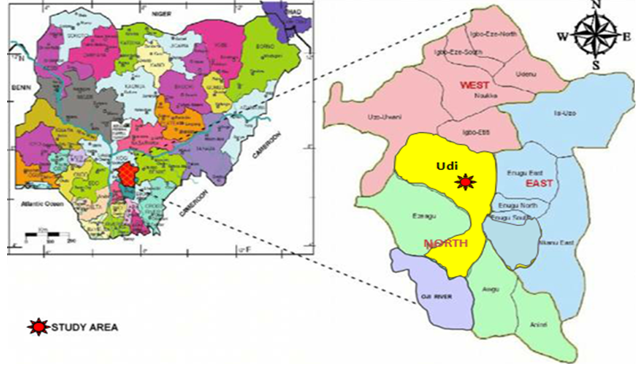
Geotechnical challenges associated with erosion in the Ajali Formation at Ngwo, Enugu State, southeastern Nigeria, were assessed by characterizing the particle-size distribution, Atterberg limits, and X-ray fluorescence (XRF) of soil samples collected from exposures of the formation in the study area. Twenty samples were collected and analyzed but only four samples were for Atterberg limit test due lack of plastic materials in the majority of the samples. Particle-size distribution tests were conducted on all samples, and the results show average sand and fines contents of 88.98% and 11.04%, respectively, with average coefficients of uniformity and curvature of 3.27 and 1.11, respectively. The soil samples have an average liquid limit of 31.8% and a plasticity index of 9.88%. XRF results indicate that silica (SiO2) dominates the elemental oxides, with relatively low concentrations of Al2O3 and Fe2O3. The soils are predominantly poorly graded and exhibit low to no plasticity and weak binding characteristics. The observed properties of the soils are indicative of high erosion susceptibility in the studied soils and, consequently, to the geotechnical challenges affecting engineering structures in the area.
References
1. N. Lu, J. W. Godt, Hydromechanical properties. In Hillslope Hydrology and Stability. Cambridge: University Press, 2013.
2. F.G. Bell, Engineering Geology, 2nd edition, New Delhi, India: Elsevier, 2011.
3. N. I. Mohammad, S. Ayesha, H. Md.Bela, R. Azrin, A. Md.Abdullah, “Effect of particle size on the shear strength behaviour of sands,” Australian Geomechanics, vol.46, no.3, pp.75 86, 2011.
4. G.Chaofan, C. Zhixiang, S. Xinwei, Z. Lingjie, Y. Shifang,” Effect of particle size on mechanical properties of coarse-grained soil,” IOP Conference Series, Earth Environmental Science, 2021, pp.1 6.
5. J. Kolbuszewski, M. R. Fredrick, “The significance of particle shape and size on the mechanical behaviour of granular materials,” European Conference on Soil Mechanics and Foundation Engineering (Wiesbaden) Sec.4 Paper9. pp.253-263, 1963.
6. K.R. Arora, Soil mechanics and foundation engineering (Geotechnical Engineering), 7th edition, NaiSarak, Delhi: Standard Publishers Distributors, 2008.
7. E. Zolkov, G. Wiseman, “Engineering properties of dune and beach sands and the influence of stress history,” Proc. Of Sixth Int. Conf. on SMFE, vol.1, pp.134-138, 1965.
8. M.E. Okiotor, R. Arumah, K. Ejairu, E. D. Ogueh,”Geotechnical properties of Ajali Sandstone in Enugu, Nigeria for engineering use,” Nigeria Journal of Technology, vol.38, no.2. pp. 294-301, 2019.
9. E. Akpofure, E. Oborie, “Estimation of petrophysical properties of Ajali Sandstone in Western Anambra Basin using granulometric analysis,” Geoscience and Remote Sensing, vol.2, pp. 1-24, 2019.
10. I. B. Duruojinnaka, O. C. Okeke, C. C. Amadi, “Geotechnical and geochemical characterization of lateritic soil deposit derived from Ajali Sandstone in Ihube-Okigwe, Southeastern Nigeria for road construction,” International Journal for Research in Mechanical and Civil Engineering, vol.2, no.3, pp.30-47, 2019.
11. C. C. Ezeh, “Hydrogeophysical studies for the delineation of potential groundwater in Enugu state, Nigeria,” Africa Journal of Geography and Regional Planning, vol.7, no. 9, pp.1-10, 2020.
12. O. Igwe, “The study of factors controlling rainfall-induced landslides at a failure-prone catchment area in Enugu, southeastern Nigeria using remote sensing data,” Landslides, vol.12, pp.1023-1033, 2015
13. R.A. Reyment, Aspect of the geology of Nigeria, University of Ibadan Press. 145pp. 1965.
14. C.M. Tattam, A Review of Nigeria Stratigraphy. Geological Survey of Nigeria Bulletin 24, pp.27-46, 1944.
15. A. Simpson, “The Nigeria coal field. The geology of Onitsha, Owerri and Benue provinces,” Geol. Surv. Nig BuIl. 24, 1954.
16. C.S. Nwajide, Cretaceous sedimentation and paleogeography of the Central Benue though. In: Ofoegbu, C.O; (Ed.), The Benue. Tough structure and Evolution International Monograph Series, Braunschweig, p. 19-38. 1990.
17. O. C. Ekwenye, G. J. Nichols, M. Collinson, C. S. Nwajide, G. C. Obi, “A paleogeographic model for the sandstone members of the Imo Shale, South Eastern Nigeria,” Journal of Africa Earth Science, vol.96, pp.190–211, 2014.
18. C. M. Igwenagu, “Trend analysis of rainfall pattern in Enugu State, Nigeria,” European Journal of Statistics and Probability, vol.3, no. 3, pp.12-18, 2015
19. C. Emeh, O. Igwe, “Variation in soils derived from on erodible sandstone formation and factors controlling susceptibility to erosion and landslide,” Journal Geological Society of India, vol.90, pp.1-9, 2017.
20. O. Igwe, W. Mode, O. Nnebedum, I. Okonkwo, I. Oha, “The analysis of rainfall induced slope failure at Iva Valley area of Enugu state, Nigeria,” Environmental Earth Sciences, vol.71. pp.5, 2014
21. British Standard Institution (BSI) 1377. Methods of testing soils for civil engineering purposes, London: British Standards Institution, 1990
22. C. H. Nnamani, “The chemical and mineralogical composition and their effects on strength parameters of cohesive soil developed over Enugu Shale,” European Journal of Environment and Earth Sciences, vol.3, no.1, pp.28-35, 2022.
23. M. W. O’neill, N. Poormoayed, “Methodology of foundation on expansive clays,” J. Geotechnical Engineering Division, American Society of Civil Engineers, vol.106, no.2, pp.1345-1367, 1980.
24. D. G. Rossiter, “Digital soil resources inventories: Status and prospects,” Soil Use Management, vol.20, no.3, pp.296-301, 200
Downloads
Published
Issue
Section
Categories
License
Copyright (c) 2026 Chidiebere Nnamani, Austin Chukwuemeka Okonkwo, Onyinye Lisa Eze

This work is licensed under a Creative Commons Attribution 4.0 International License.


