
Antimicrobial Resistance and Stewardship Perceptions Among Poultry Stakeholders in Abeokuta, Nigeria: A Cross-Sectional Survey
DOI:
https://doi.org/10.33003/fjs-2026-1017-5952Keywords:
Antimicrobial Resistance, Antimicrobial Stewardship, Poultry, Perceptions, FarmersAbstract
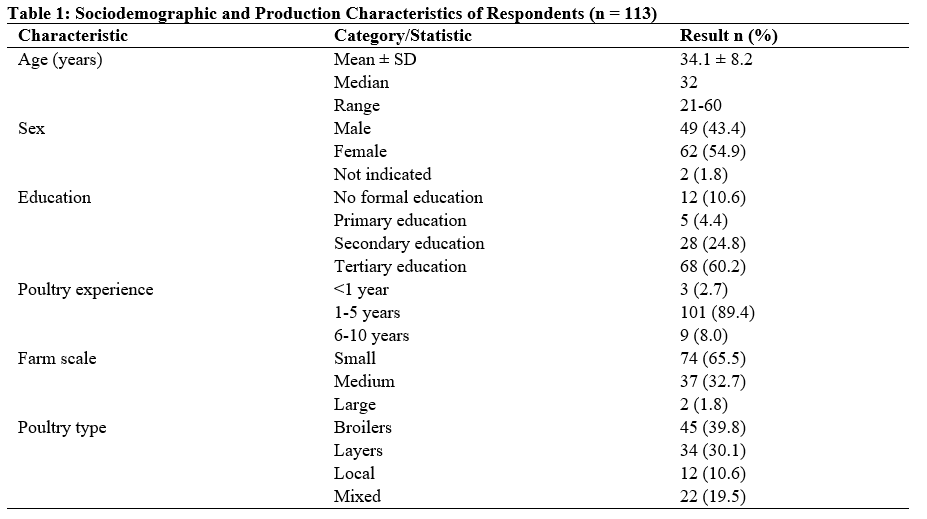
Antimicrobial resistance (AMR) threatens poultry production, food safety and public health. This cross-sectional survey evaluated poultry stakeholders' attitudes toward AMR and perceptions of antimicrobial stewardship in Abeokuta, Nigeria. Of 120 questionnaires returned, 113 and 111 complete questionnaires were analyzed descriptively and in multivariable regression, respectively. Seven stewardship-supportive statements (D2-D8), each scored from 1 (strongly disagree) to 5 (strongly agree), were averaged to form a perception scale; no items required reverse coding. Agreement proportions and 95% Wilson confidence intervals (CIs) were computed, and scale reliability was evaluated using Cronbach's alpha and associations with age, sex, tertiary education, poultry experience and farm size were investigated using multiple linear regression with HC3 robust standard errors. The mean age of respondents was 34.1 years (SD 8.2), 54.9% were female, and 60.2% had a tertiary education. Agreement was high that antimicrobial overuse contributes to AMR (78.8%; 95% CI 70.3-85.3), improper use contributes to multidrug resistance (87.6%; 95% CI 80.3-92.5), self-prescription should be discouraged (86.7%; 95% CI 79.2-91.8), and training farmers in non-antibiotic disease prevention is a priority (92.0%; 95% CI 85.6-95.8). The scale had acceptable internal consistency (alpha = 0.711; mean = 4.12/5, SD = 0.58). Each 10-year increase in age was associated with a 0.211-point lower score (beta = -0.211; 95% CI -0.388 to -0.034), while tertiary education was associated with 0.247-point higher score (beta = 0.247; 95% CI 0.011-0.483). These results reflect perceptions of stewardship, not actual antimicrobial-use patterns. Veterinary support, vaccination, biosecurity, diagnostics and farmer education could thus be considered intervention priorities.
References
Al Sattar, A., Chisty, N. N., Irin, N., Uddin, M. H., Hasib, F. M. Y., & Hoque, M. A. (2023). Knowledge and practice of antimicrobial usage and resistance among poultry farmers: A systematic review, meta-analysis, and meta-regression. Veterinary Research Communications, 47(3), 1047-1066. https://doi.org/10.1007/s11259-023-10082-5
Boateng, G. O., Neilands, T. B., Frongillo, E. A., Melgar-Quiñonez, H. R., & Young, S. L. (2018). Best practices for developing and validating scales for health, social, and behavioral research: A primer. Frontiers in Public Health, 6, 149. https://doi.org/10.3389/fpubh.2018.00149
Chah, J. M., Nwankwo, S. C., Uddin, I. O., & Chah, K. F. (2022). Knowledge and practices regarding antibiotic use among small-scale poultry farmers in Enugu State, Nigeria. Heliyon, 8(4), e09342. https://doi.org/10.1016/j.heliyon.2022.e09342
Ejikeugwu, C. P., Nwakaeze, E. A., Aniekwe, C. W., Onu, E. N., Adikwu, M. U., & Eze, P. M. (2025). Investigating the factors influencing antibiotic use practices and their association with antimicrobial resistance awareness among poultry farmers in Enugu State, Nigeria. Antimicrobial Stewardship & Healthcare Epidemiology, 5(1), e236. https://doi.org/10.1017/ash.2025.10141
Ezeh, G. C., Ogugua, A. J., Olaolu, M. O., & Nwanta, J. A. (2024). Knowledge and practices of poultry farmers contributing to antimicrobial resistance in Nsukka. Veterinary Sciences and Practices, 19(2), 59-71. https://doi.org/10.17094/vetsci.1471527
Federal Ministries of Agriculture and Food Security, Environment, & Health and Social Welfare. (2024). One Health antimicrobial resistance national action plan 2.0, 2024-2028. Nigeria Centre for Disease Control and Prevention. https://www.who.int/publications/m/item/nigeria--second-one-health-antimicrobial-resistance-national-action-plan-2024-2028
Hackman, H. K., Annison, L., Arhin, R. E., Aidoo, E. K., Wilberforce, E. A., Mensah, A. C., Appiah, L., Annison, S., & Ayim-Akonor, M. (2025). Awareness of antimicrobial resistance and antibiotic use among poultry farmers in Accra, Ghana: A cross-sectional survey. PLOS ONE, 20(12), e0337531. https://doi.org/10.1371/journal.pone.0337531
Moffo, F., Mouiche, M. M. M., Kochivi, F. L., Dongmo, J. B., Djomgang, H. K., Tombe, P., Mbah, C. K., Mapiefou, N. P., Mingoas, J.-P. K., & Awah-Ndukum, J. (2020). Knowledge, attitudes, practices and risk perception of rural poultry farmers in Cameroon to antimicrobial use and resistance. Preventive Veterinary Medicine, 182, 105087. https://doi.org/10.1016/j.prevetmed.2020.105087
Mokkink, L. B., Elsman, E. B. M., & Terwee, C. B. (2024). COSMIN guideline for systematic reviews of patient-reported outcome measures version 2.0. Quality of Life Research, 33(11), 2929-2939. https://doi.org/10.1007/s11136-024-03761-6
Ndahi, M. D., Hendriksen, R., Helwigh, B., Card, R. M., Fagbamila, I. O., Abiodun-Adewusi, O. O., Ekeng, E., Adetunji, V., Adebiyi, I., & Andersen, J. K. (2023). Determination of antimicrobial use in commercial poultry farms in Plateau and Oyo States, Nigeria. Antimicrobial Resistance & Infection Control, 12, 30. https://doi.org/10.1186/s13756-023-01235-x
Njoga, E. O., Ogugua, A. J., Nwankwo, I. O., Awoyomi, O. J., Okoli, C. E., Buba, D. M., Oyeleye, F. A., Ajibo, F. E., Azor, N., & Ogunniran, T. M. (2021). Antimicrobial drug usage pattern in poultry farms in Nigeria: Implications for food safety, public health and poultry disease management. Veterinaria Italiana, 57(1), 5-12. https://doi.org/10.12834/VetIt.2117.11956.1
Oloso, N. O., Odetokun, I. A., Ghali-Mohammed, I., Fasina, F. O., Olatoye, I. O., & Adetunji, V. O. (2022). Knowledge, attitudes, and risk perception of broiler grow-out farmers on antimicrobial use and resistance in Oyo State, Nigeria. Antibiotics, 11(5), 567. https://doi.org/10.3390/antibiotics11050567
Tavakol, M., & Dennick, R. (2011). Making sense of Cronbach's alpha. International Journal of Medical Education, 2, 53-55. https://doi.org/10.5116/ijme.4dfb.8dfd
World Health Organization. (2017). WHO guidelines on use of medically important antimicrobials in food-producing animals. https://www.who.int/publications/i/item/9789241550130
World Organisation for Animal Health. (2024). Terrestrial Animal Health Code: Chapter 6.10. Responsible and prudent use of antimicrobial agents in veterinary medicine. https://www.woah.org/fileadmin/Home/eng/Health_standards/tahc/2024/en_chapitre_antibio_use.htm
Yakubu, Y., Daneji, A. I., Mohammed, A. A., Jibril, A., Umaru, A., Aliyu, R. M., Garba, B., Lawal, N., Jibril, A. H., & Shuaibu, A. B. (2024). Understanding the awareness of antimicrobial resistance amongst commercial poultry farmers in northwestern Nigeria. Preventive Veterinary Medicine, 228, 106226. https://doi.org/10.1016/j.prevetmed.2024.106226
Downloads
Published
Issue
Section
Categories
License
Copyright (c) 2026 Thaddaeus Obaji Ariom, Olatunbosun Jonathan Soetan, Joseph Jonathan, Islamiyat Olajumoke Muh-Raji, Samuel Ayodele Famakinde, Iyabode Adekemi Kehinde, Kazeem Olajide Bello

This work is licensed under a Creative Commons Attribution 4.0 International License.


