
Phonon-Driven Limitations of AI-Predicted Stability in Li-Ion Anode Materials: A Computational Meta-Analysis of Vibrational Instabilities
DOI:
https://doi.org/10.33003/fjs-2026-1015-5931Keywords:
Phonon Instability, Li-Ion Anodes, Machine Learning Interatomic Potentials, Vibrational Analysis, Silicon Anode, Carbon AnodeAbstract
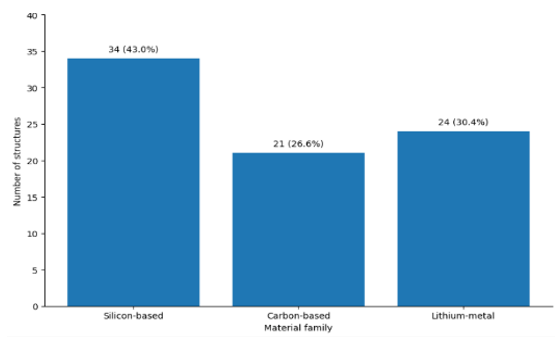
Machine learning interatomic potentials (MLIPs) and high-throughput density functional theory (DFT) screening have dramatically accelerated the discovery of Li-ion battery anode materials; however, a critical gap persists between computational stability predictions and real-world synthesis feasibility. This study presents a systematic computational meta-analysis of phonon-driven instability among 79 Li-ion anode candidate structures spanning silicon-based (n = 34), carbon-based (n = 21), and lithium-metal phases (n = 24), all predicted to be stable by the Materials Project AI-assisted DFT pipeline (energy above hull, Ehull < 0.05 eV atom⁻¹). Using the finite-displacement method implemented in Phonopy and an empirical Born–von Karman force-constant model sampled at four high-symmetry Brillouin-zone points, 49 of the 79 structures (62.0%) were classified as dynamically unstable within the adopted phonon-screening framework. Carbon-based anodes exhibited the highest failure rate (95.2%), followed by lithium-metal phases (70.8%) and silicon-based anodes (35.3%). Instabilities were overwhelmingly concentrated at the Gamma point (98.0% of unstable structures), identifying the zone center as the predominant location of phonon instabilities across all three anode families. Chi-squared analysis confirmed that failure rates differed significantly among material families (χ² = 20.94, df = 2, p < 0.0001). These findings highlight important limitations in current AI-based screening frameworks for anode materials and support the incorporation of phonon instability screening as an additional post-processing step in high-throughput materials-discovery workflows.
References
Ahuome, B. A., Aungwa, F., Adamu, M. A., & Ashezua, J. A. (2023). Computation of the cohesive energies of some selected ionic liquid crystals (NaCl and LiCl) using density functional theory FHI-AIMS code. FUDMA Journal of Sciences, 3(2), 15–28. https://doi.org/10.33003/fjs-2019-0302-1477
Born, M., & Huang, K. (1954). Dynamical theory of crystal lattices. Clarendon Press.
Di Leo, C. V., Rejovitzky, E., & Anand, L. (2015). Diffusion–deformation theory for amorphous silicon anodes: The role of plastic deformation on electrochemical performance. International Journal of Solids and Structures, 67–68, 283–296. https://doi.org/10.1016/j.ijsolstr.2015.04.028
Goodenough, J. B., & Park, K.-S. (2013). The Li-ion rechargeable battery: A perspective. Journal of the American Chemical Society, 135(4), 1167–1176. https://doi.org/10.1021/ja3091438
Grimme, S., Antony, J., Ehrlich, S., & Krieg, H. (2010). A consistent and accurate ab initio parametrization of density functional dispersion correction (DFT-D) for the 94 elements H–Pu. The Journal of Chemical Physics, 132(15), 154104. https://doi.org/10.1063/1.3382344
Isbill, S. B., Shields, A. E., Brubaker, Z. E., Miskowiec, A. J., & Niedziela, J. L. (2024). Strain-induced shifts in defective graphite phonon modes predicted by density functional theory. The Journal of Physical Chemistry C, 128(39), 16662–16671. https://doi.org/10.1021/acs.jpcc.4c03191
Jain, A., Ong, S. P., Hautier, G., Chen, W., Richards, W. D., Dacek, S., Cholia, S., Gunter, D., Skinner, D., Ceder, G., & Persson, K. A. (2013). Commentary: The Materials Project: A materials genome approach to accelerating materials innovation. APL Materials, 1(1), 011002. https://doi.org/10.1063/1.4812323
Kirklin, S., Meredig, B., & Wolverton, C. (2013). High-throughput computational screening of new Li-ion battery anode materials. Advanced Energy Materials, 3(7), 833–838. https://doi.org/10.1002/aenm.201200593
Merchant, A., Batzner, S., Schoenholz, S. S., Aykol, M., Cheon, G., & Cubuk, E. D. (2023). Scaling deep learning for materials discovery. Nature, 624(7990), 80–85. https://doi.org/10.1038/s41586-023-06735-9
Muy, S., Voss, J., Schlem, R., Koerver, R., Sedlmaier, S. J., Maglia, F., Lamp, P., Zeier, W. G., & Shao-Horn, Y. (2019). High-throughput screening of solid-state Li-ion conductors using lattice-dynamics descriptors. iScience, 16, 270–282. https://doi.org/10.1016/j.isci.2019.05.036
Nwachuku, D. N. (2025). First-principles investigation of the electronic structure and optical response of Ga₂S₃ and Ga₂Se₃ chalcogenides. FUDMA Journal of Sciences, 9(11), 27–31. https://doi.org/10.33003/fjs-2025-0911-4018
Togo, A., & Tanaka, I. (2015). First principles phonon calculations in materials science. Scripta Materialia, 108, 1–5. https://doi.org/10.1016/j.scriptamat.2015.07.021
Yu, S., Kim, S.-O., Kim, H.-S., & Choi, W. (2019a). Computational screening of anode materials for sodium-ion batteries. Journal of The Electrochemical Society, 166(10), A1915–A1923. https://doi.org/10.1149/2.0691910jes
Yu, S., Kim, S.-O., Kim, H.-S. & Choi, W. (2019b). Computational screening of anode materials for potassium-ion batteries. International Journal of Energy Research, 43(13), 7192–7205. https://doi.org/10.1002/er.4771
Downloads
Published
Issue
Section
Categories
License
Copyright (c) 2026 Hafsat Abubakar Garba, Abubakar Habib Idris, Hannatu Akanang, Olumuyiwa Oyekunle Akintola, John Dedah, Warji Muhammad Ibrahim, Jamila Ibrahim Shekarau

This work is licensed under a Creative Commons Attribution 4.0 International License.