
Maize Yield Prediction using Interval-Valued Fuzzy Sets as a Tool for Attaining Food-Security in Kaduna State
DOI:
https://doi.org/10.33003/fjs-2026-1018-5930Keywords:
Interval Value Fuzzy Set, Maize Yield Prediction, Kaduna StateAbstract
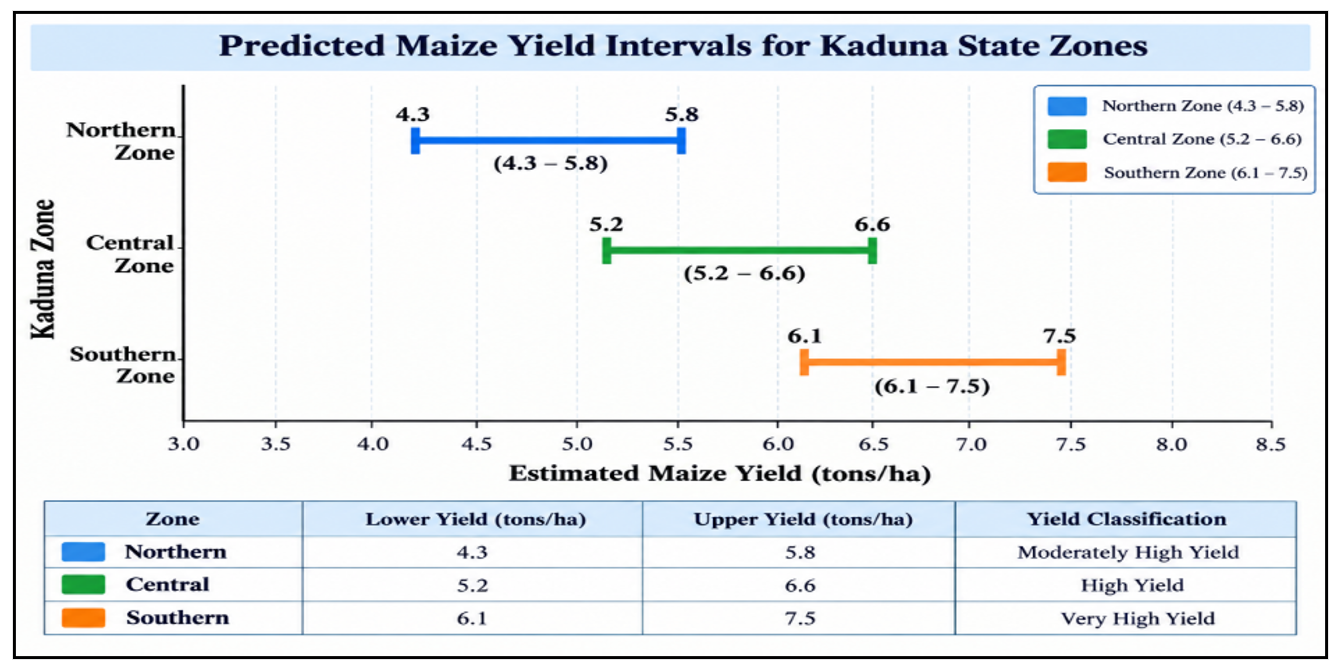
Crop yield prediction is one of the most important pillars that have the potential to increase productivity and improve food security. As Maize is the largest grain crop grown almost everywhere in Kaduna State, its accurate yield estimation using environmental data and growth data before harvest is critical for food security and agricultural policy development. In this paper, a Maize Yield Prediction model using Interval-Valued Fuzzy Sets (IVFS) is developed, which allows each factor to be represented by an interval membership value rather than a single crisp value, to predict maize yields in the northern, central and southern zones of Kaduna State. It is discovered that the southern zone has a very high yield potential with an estimated yield of 6.1-7.5 tons/ha, followed by the central zone with 5.2 - 6.6 tons/ha, then the northern zone having 4.3-5.8 tons/ha. It is shown that the northern zone is Suitable for drought-tolerant maize varieties while the southern zone is the most ecologically suitable zone for maize production, thereby making it the best for large-scale maize commercialization among all the three zones. It is demonstrated that the state experienced a north-to-south increase in predicted maize interval, with the Northern Zone having the lowest predicted range and the Southern Zone having the highest. This pattern reflects differences in climate and other factors, including soil, fertilizer, hybrid seed, herbicide, and mechanization. The IVFS model effectively represents yield as an interval, capturing possible productivity ranges and supporting zone-specific agricultural planning and resource allocation.
References
Abaje, I. B., & Oladipo, E. O. (2019). Recent changes in the temperature and rainfall conditions over Kaduna State, Nigeria, Ghana Journal of Geography, 11 (2) 127–157. https://doi.org/10.4314/gjg.v11i2.
Abdullahi, I. M., Jatbong, J. N., Baraza, S. A. and Gazara, H .A (2025). Adoption of Hybrid Maize Production Among Farmers In Sabon-Gari Local government Area, Kaduna State, Nigeria, Nigerian Journal of Agriculture and Agricultural Technology 5 (4A) 2811-1893.
Abdulbasit, A., Adewumi, S. E. and Yemi-Peters, V. (2023). Crop Yield Prediction in Nigeria Using Machine Learning Techniques: (A Case Study of Southern Part of Nigeria), UMYU Scientifica 2 (4) 31 – 38.
Aganbi, B., Ifeka, A., & Matini, J. L. (2021). Assessment of rainfall and temperature variability on maize production in Kaduna State, International Journal of Research Publications, 91 (1) 307–332. https://doi.org/10.47119/IJRP1009111220212617
Ahmad, M, Ahmed, A. M., Ariko, J. D. and Abdulkadir, H. (2025). Trends of Extreme Temperature and Rainfall Using Innovative Trend Analysis In Kaduna State, Nigeria, FUDMA Journal of Sciences (FJS) 9 (11) 407 – 420. DOI: https://doi.org/10.33003/fjs-2025-0911-3983
Ajeye, D. B., Dahiru, M. K., Ayiwulu, E. and Yusuf, G. (2025). Assessment of Physico Chemical Properties of Soils and Fertilizer Requirements in Southern Senatorial District in Kaduna State, Nigeria, British Journal of Environmental Sciences, 13 (3) 62-76.
Ammani, A. A., Ja’afaru, A. K., Aliyu, J. A. and Arab, A. I. (2012). Climate Change and Maize Production: Empirical Evidence from Kaduna State, Nigeria, Journal of Agricultural Extension 16 (1) 1-8. http://dx.doi.org/10.4314/jae.v16i1.1
Atiyong, B.R. and Michael, H.Y. (2022). Nature and Variation of Soil Properties under Different Land Management Practices in Southern Part of Kaduna, Kaduna State, Nigeria, Science World Journal 17 (1) 31-37.
Awwal Y.A. (2023). Influence of Topography on Pedologic Forms of Iron in Basement Complex Soils of Giwa Local Government Area, Kaduna State, Nigeria, Agro-Science Journal of Tropical Agriculture, Food, Environment and Extension 22 (3) 17 – 25.
Ayinde, T. B., Fola, A. J. and Ibrahim, U. (2011). Economic Advantage of Hybrid Maize over Open Pollinated Maize in Giwa Local Government Area of Kaduna State, American Journal of Experimental Agriculture 1 (3) 101-109.
Chigwada, T., Dzinomwa, M., Ndlovu, B., Sibanda, K. and Moyo, S. (2023). Maize Crop Yield Prediction Model Using Machine Learning, Proceedings of the 4th Asia Pacific Conference on Industrial Engineering and Operations Management Ho Chi Minh City, Vietnam, September 12-14, 106 – 113.
Danladi, E. B, Ntat, F. H. and Idakwo, D. A. (2021). Analysis of Factors Affecting Adoption of Premier Hybrid Seed Among Maize Farmers in Sabon-Gari Local Government Area of Kaduna State, Nigeria, FUDMA Journal of Agriculture and Agricultural Technology 7 (2) 67-75. doi: https://doi.org/10.33003/jaat.2021.0702.049
Esu, I. E., & Ojanuga, A. G. (1985). Morphological, physical and chemical characteristics of Alfisol in the Kaduna area of Nigeria, Samaru Journal of Agricultural Research 3 (1/2) 39 – 49.
Federal Department of Agricultural Land Resources (FDALR), Soil Survey Division. (1990), Soils Map of Nigeria, Kaduna, Nigeria.
Garba, Y. I., Danjuma, M. N., & Zakariya, M. (2023). Assessment of Soil Quality for Agro-Diversification in Kaduna State, Nigeria, UMYU Scientifica, 2 (4) 1 – 8. https://doi.org/10.56919/usci.2324.001
Goma, D. (2024). Analysis of rainfall and temperature changes on agricultural production in Kaduna State, Nigeria, Kashere Journal of Geography and Sustainable Environment 1 (1) 51-73.
Gorzalczany, M.B. (1987). A method of inference in approximate reasoning based on interval valued fuzzy sets, Fuzzy Sets and Systems, Elsevier, 21 (1) 1-17.
Hiikyaa, N. A. (2024). Assessment of Nutrient Flows in Maize-Based Farming System by Small holder Farmers for Sustainable Production in Ikara, Kaduna State, Science World Journal 19 (1) 9-12. https://dx.doi.org/10.4314/swj.v19i1.2
Ibrahim, J. A., Mbaya, A. L., Akande, D., Agaku, D. T., & Haruna, S. N. (2020). Impact of toposequence on soil properties and classification in Zaria, Kaduna State, Northern Guinea Savanna, Nigeria, EQA – International Journal of Environmental Quality (38) 48–58.
Isah, A. I. (2019). The Concept of α-Cuts in Multi Q-fuzzy sets, Science World Journal 14 (2) (2019) 42-44.
Isah, A. I. (2020). Multi-Fuzzy Set Relational Structures, FuDMA Journal of Sciences 4 (1) (2020) 662 –667.
Jagtab, S. S., Abamu, S. J., Kling, J. G. (1999). Long-term assessment of nitrogen and variety technologies on attainable maize yields in Nigeria using CERES-maize, Agricultural Systems, Science Direct, Elsevier, 60 (2) 77-86.
Jimoh, I. A., Aliyu, J., Sabo, A. T., & Yusuf, Y. O. (2018). Land suitability evaluation of Kubanni floodplain for rice production in Zaria, Kaduna State, Nigeria. Nigerian Journal of Basic and Applied Sciences, 26(1), 46–54.
Kang, Y., Ozdogan, M., Zhu, X., Ye, Z., Hain, C., and Anderson, M. (2020). Comparative assessment of environmental variables and machine learning algorithms for maize yield prediction in the US Midwest. Environ. Res. Lett. 15, 064005. https://10.1088/1748-9326/ab7df9
Khaki, S., and Wang, L. (2019). Crop yield prediction using deep neural networks. Front. Plant Sci. 10, 621. https://10.3389/fpls.2019.00621
NAERLS and FMARD, (2021). National Report of Wet Season Agricultural Performance in Nigeria. Nigeria, Zaria: NAERLS Press.
Suleiman. U. B., Abdulhamed, A. I., Musa, A. J. and Yelwa, S. A. (2019). Decadal Analysis and Estimation of Temperature Changes in Northern Senatorial Zone of Kaduna State-Nigeria, FUDMA Journal of Sciences 3 (3) 509 –518.
StatsClimat. (2025). Comprehensive climate report: Kaduna (Nigeria). StatsClimat Kaduna Climate Report.
Tadama, M. H. (2024). The Impact of Climate on Maize Yield in Chikun Local Government Area of Kaduna State, Nigeria, Kaduna Journal of Geography, 6 (1) 103-115.
Wang, K., Han, Y., Zhang, Y., Zhang, Y., Wang, S. Tang, F. Liu, C., Zhang, D., Lu, T., Zhang, L. and Liu, Z. (2024). Maize yield prediction with trait-missing data via bipartite graph neural network. Frontiers in Plant Science. 15:1433552. https://doi.org/10.3389/fpls.2024.1433552
Yang, X., Lin, T. Y., Yang, J., Lia, Y. and Yu, D. (2009). Combination of interval-valued fuzzy set and soft set, Computers and Mathematics with Applications (58) 521-527.
Zadeh, L. A. (1965). Fuzzy sets, Information and Control, 8, 338 - 353.
Zadeh, L.A. (1975). The concept of a linguistic variable and its application to approximate reasoning - I, Information Sciences, Elsevier, 8 (3) 199 - 249.
Zhang, Q., Zhao, X., Han, Y., Yang, F., Pan, S., Liu, Z., Wang, K. and Zao, C. (2023). Maize yield prediction using federated random forest, Computers and Electronics in Agriculture, Volume 210,
https://doi:10.1016/j.compag.2023.107930
Downloads
Published
Issue
Section
Categories
License
Copyright (c) 2026 Ahmed Ibrahim Isah, Yusuf Adamu, Muazu Ahmad

This work is licensed under a Creative Commons Attribution 4.0 International License.


