
Dynamical Analysis and Spatial Distribution of Field Strength Variability across Nineteen Locations in Nigeria: A Nonlinear Approach for Communication Planning
DOI:
https://doi.org/10.33003/fjs-2026-1016-5925Keywords:
Field Strength Variability, Hurst Exponent, Lyapunov Exponent, Nonlinear Dynamics, Radio RefractivityAbstract
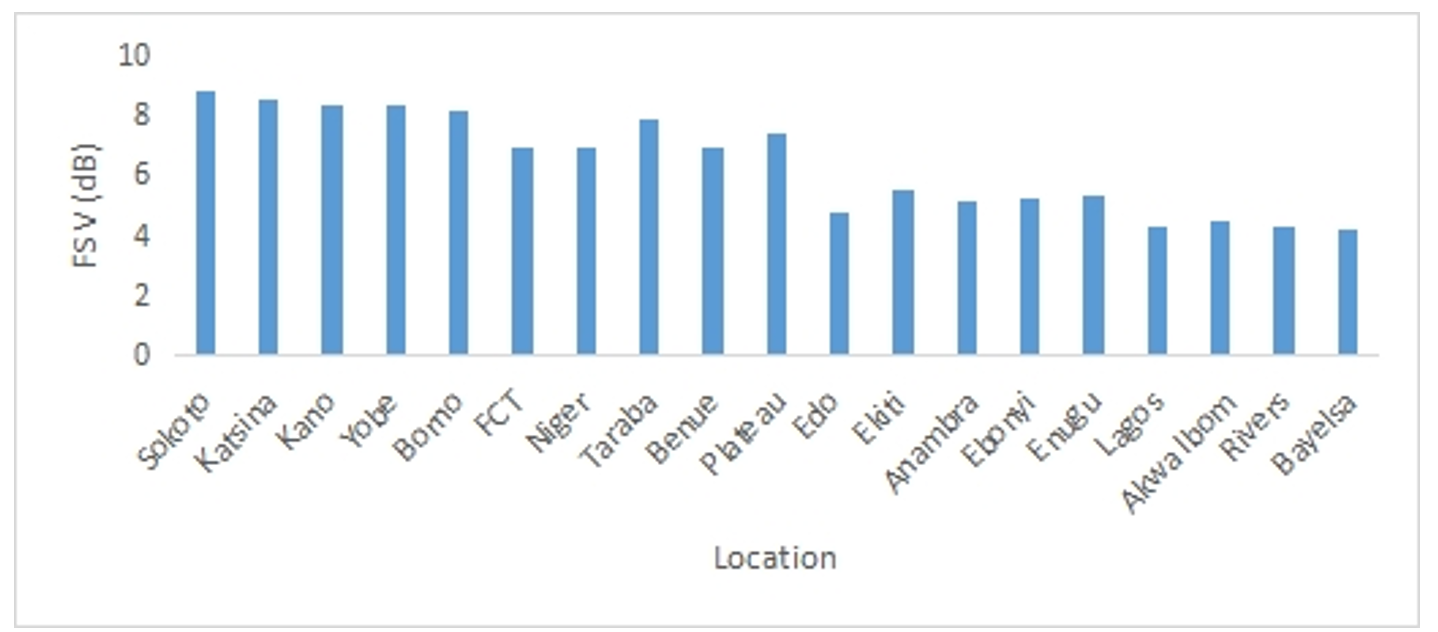
Field Strength Variability (FSV) is an important atmospheric propagation parameter that influences terrestrial and satellite communication performance through signal fading, ducting and multipath effects. This study presents a dynamical analysis and spatial distribution of FSV across nineteen locations in Nigeria using a nonlinear approach based on the Hurst Exponent (HE) and Lyapunov Exponent (LE). The selected locations represent the Sahel/Sudan Savanna, Guinea Savanna and Rainforest/Coastal climatic zones. Daily meteorological data obtained from the NASA Modern-Era Retrospective Analysis for Research and Applications, Version 2 (MERRA-2), covering 1982–2022, were used to compute radio refractivity and derive FSV. The spatial analysis revealed a clear north-to-south variation, with higher regional mean FSV values in the Sahel/Sudan Savanna (8.47 dB), decreasing through the Guinea Savanna (7.23 dB) to the Rainforest/Coastal region (4.81 dB). The nonlinear dynamical analysis showed that HE values ranged from 0.2544 to 0.3850, with all values below 0.5, indicating predominantly anti-persistent behaviour. The LE analysis revealed distinct regional dynamics, with positive values predominantly occurring in the Sahel/Sudan and Guinea Savanna regions, indicating sensitive dependence on initial conditions and chaotic behaviour, whereas predominantly negative values in the Rainforest/Coastal region indicated relatively more stable dynamics. The findings demonstrate that both the magnitude and nonlinear characteristics of FSV are strongly influenced by spatial and climatic variability across Nigeria. This study provides insight into the spatial distribution and dynamical behaviour of FSV in tropical environments and offers useful information for radio propagation assessment, communication planning and the development of region specific propagation strategies.
References
Abimbola, O. J., Bada, S. O., Folaiye A. O., Suam, Y. M., Otto, M. S and Muhammad, S (2021). Estimation of Radio Refractivity from Satellite Derived Meteorological Data over a Decade for West Africa. Scientific African Journal. Pg14. https://doi.org/10.1016/j.sciaf.2021.e01054
Adediji, A. T., & Ajewole, M. O. (2008). Microwave propagation studies and fading phenomena over a tropical station. Progress in Electromagnetics Research C, 5, 71–84.
Ajayi, G. O., & Ofoche, E. B. (1984). Diurnal and seasonal variations of surface refractivity in Nigeria. Journal of Atmospheric and Terrestrial Physics, 46(6–7), 463–470.
Akpootu, D. O., Aminu, Z., Yusuf, A., Nouhou, I., Kola, T. A., Agidi, O. E., Salifu, S. I., Idris, M., Aliyu, M. A., & Aruna, S. (2024). Investigation of tropospheric radio refractivity and other relevant parameters using meteorological variables over Bauchi, Nigeria. FUDMA Journal of Sciences, 8(2), 306–314. https://doi.org/10.33003/fjs-2024-0802-2366.
Alagbe, G. A. (2025). Investigation of diurnal and seasonal variation of radio refractivity and field strength over Ogbomoso, South Western Nigeria. In Proceedings of the 8th URSI-NG Annual Conference (URSI-NG 2024), Advances in Physics Research. https://doi.org/10.2991/978-94-6463-644-4_7
Ashidi, A. G. (2024). Autoregressive modelling of tropospheric radio refractivity over selected locations in tropical Nigeria using artificial neural network. Earth Science Informatics, Vol 17, page 5913–5922. https://doi.org/10.1007/s12145-024-01489-y.
Bello, G., Akpootu, D. O., Muhammad, J., Na-Allah, M., Balarabe, M., Babagana, A., & Idris, M. (2025). Investigation of field strength variability at ultra-high frequency and maximum angle of incidence in the Guinea and Coastal regions of Nigeria. Saudi Journal of Engineering and Technology, 10(10), 522–530. https://doi.org/10.36348/sjet.2025.v10i10.004
Bichi, J. A., Tijjani, B. I., & Tikyaa, E. V. (2026). Analysis of spatial and temporal variation of deterministic chaos in tropospheric radio refractivity across twelve locations in Nigeria using recurrence quantification analysis. Theoretical and Applied Climatology, 157, 360. https://doi.org/10.1007/s00704-026-06281-0
Echi, P. C., Udo, S. O., & Ewetumo, T. M. (2015). Chaotic behaviour of daily rainfall and temperature in Makurdi, Nigeria. Theoretical and Applied Climatology, 121(3–4), 581–589.
Fawupe, J. A., Ojo, S. O., & Olusola, J. O. (2016). Spatial analysis of deterministic chaos in rainfall and temperature over Nigeria. Atmospheric Research, 182, 135–145.
Gelaro, R., McCarty, W., Suárez, M. J., Todling, R., Molod, A., Takacs, L., Randles, C. A., Darmenov, A., Bosilovich, M. G., Reichle, R., Wargan, K., Coy, L., Cullather, R., Draper, C., Akella, S., Buchard, V., Conaty, A., da Silva, A. M., Gu, W., Zhao, B. (2017). The Modern-Era Retrospective Analysis for Research and Applications, Version 2 (MERRA-2). Journal of Climate, Vol 30(14), page 5419–5454. https://doi.org/10.1175/JCLI-D-16-0758.1
Hurst, H. E. (1951). Long-term storage capacity of reservoirs. Transactions of the American Society of Civil Engineers, 116, 770–799.
Ibrahim, U., Bawa, M., & Lawal, M. (2024). Estimating the variability of tropospheric radio refractivity and field strength over Enugu, South-East Nigeria. International Journal of Science for Global Sustainability, 10(2), 251–257. https://doi.org/10.57233/ijsgs.v10i2.678
International Telecommunication Union. (2019). The radio refractive index: Its formula and refractivity data (Recommendation ITU-R P.453-14). ITU.
ITU-R. (2023). Recommendation P.453-15. The radio refractive index: Its formula and refractivity data. International Telecommunication Union, Geneva.
Kantelhardt, J. W., Koscielny-Bunde, E., Rego, H. H. A., Havlin, S., & Bunde, A. (2002). Detecting long-range correlations with detrended fluctuation analysis. Physica A: Statistical Mechanics and its Applications, 295(3–4), 441–454.
National Aeronautics and Space Administration (NASA). (2024). MERRA-2 data products. NASA Global Modeling and Assimilation Office (GMAO). Retrieved from https://gmao.gsfc.nasa.gov/reanalysis/MERRA-2/
Odafe Akpootu, D., Bello, G., Garba, I. I., Na-Allah, M., Muhammad, J., Balarabe, M., Aina, A. O., & Babagana, A. (2025). Analysis of field strength variability at ultra-high frequency and maximum angle of incidence across the Sahelian and Midland regions of Nigeria. Arid-zone Journal of Basic & Applied Research. https://doi.org/10.55639/607.02010071
Rasoul, A., Modarres, R., & Eslamian, S. (2014). Nonlinear dynamics and chaotic behaviour of rainfall in Ramsar, Iran. Hydrological Sciences Journal, 59(8), 1512–1523.
Rosenstein, M. T., Collins, J. J., & De Luca, C. J. (1993). A practical method for calculating largest Lyapunov exponents from small data sets. Physica D: Nonlinear Phenomena, 65(1–2), 117–134.
Sánchez-Granero, M. A., Trinidad Segovia, J. E., & García Pérez, J. (2008). Some comments on Hurst exponent and the long memory processes on capital markets. Physica A: Statistical Mechanics and its Applications, Vol.387 (22), 5543–5551. https://doi.org/10.1016/j.physa.2008.05.053.
Sánchez-Granero, M. A., Trinidad Segovia, J. E., & García Pérez, J. (2008). Some comments on Hurst exponent and the long memory processes on capital markets. Physica A: Statistical Mechanics and its Applications, 387(21), 5543–5551.
Tanko M, Akinbola A, M S Liman, J S Ojo. (2018). Assessment Tropospheric Variation of Radio Refractivity and Field Strength Variability over Some Selected Stations in Northern Nigeria. Physical Science International Journal Vol, 18(1); page 1-19. Article no. PSIJ.41320. ISSN: 2348-0130. DOI: https://doi.org/10.9734/PSIJ//2018/41320.
Tanko M, M. U. Sarki, U. Rilwan and I. S. Adeshina (2025). Tropospheric Radio Refractivity Mapping of Nigeria from satellite Data. Nexus of Advanced Environmental Research. 1(2025) pg 1-9. https://noaerjournal.com.
Tanko, M. M., Liman, M. S., Lumbi, W. L., Aliyu, U. S., & Sarki, M. U. (2022). Field strength variability mapping of Nigeria. Journal of the Nigerian Society of Physical Sciences, 4(3), 746. https://doi.org/10.46481/jnsps.2022.746
Tanko, M. M., Sarki, M.U and Bilya, M.A (2019). Seasonal Variation of Radio Refractivity of Some Selected Stations in Northern Nigeria. Current Journal of Applied Science and Technology. Vol. 32(1): page 1-12. https://doi.org/10.9734/cjast/2019/45326.
Tanko, M., Akinbobola, A., Liman, M. S., & Ojo, J. S. (2018). Assessment of tropospheric variation of radio refractivity and field strength variability over some selected stations in Northern Nigeria. Physical Science International Journal, 18(1), 1–19. https://doi.org/10.9734/PSIJ/2018/41320
Wolf, A., Swift, J. B., Swinney, H. L., & Vastano, J. A. (1985). Determining Lyapunov exponents from a time series. Physica D: Nonlinear Phenomena, 16(3), 285–317. https://doi.org/10.1016/0167-2789(85)90011-9
Xavier, A. K., Demaeyer, J., & Vannitsem, S. (2024). Variability and predictability of a reduced-order land–atmosphere coupled model. Earth System Dynamics, 15, 893–912. https://doi.org/10.5194/esd-15-893-2024
Zhang, M., Ding, R., Zhong, Q., Li, J., & Lu, D. (2024). Application of the conditional nonlinear local Lyapunov exponent to second-kind predictability. Advances in Atmospheric Sciences, 41(9), 1769–1786. https://doi.org/10.1007/s00376-024-3297-5
Downloads
Published
Issue
Section
Categories
License
Copyright (c) 2026 Jamila Abdullahi Bichi

This work is licensed under a Creative Commons Attribution 4.0 International License.


