
Evaluation of Spatial Layout and Accessibility Performance of Selected High Court Buildings in Southwest Nigeria
DOI:
https://doi.org/10.33003/fjs-2026-1018-5915Keywords:
Courthouse design, Spatial Layout, Accessibility, Universal Design, High Courts, Judicial FacilitiesAbstract
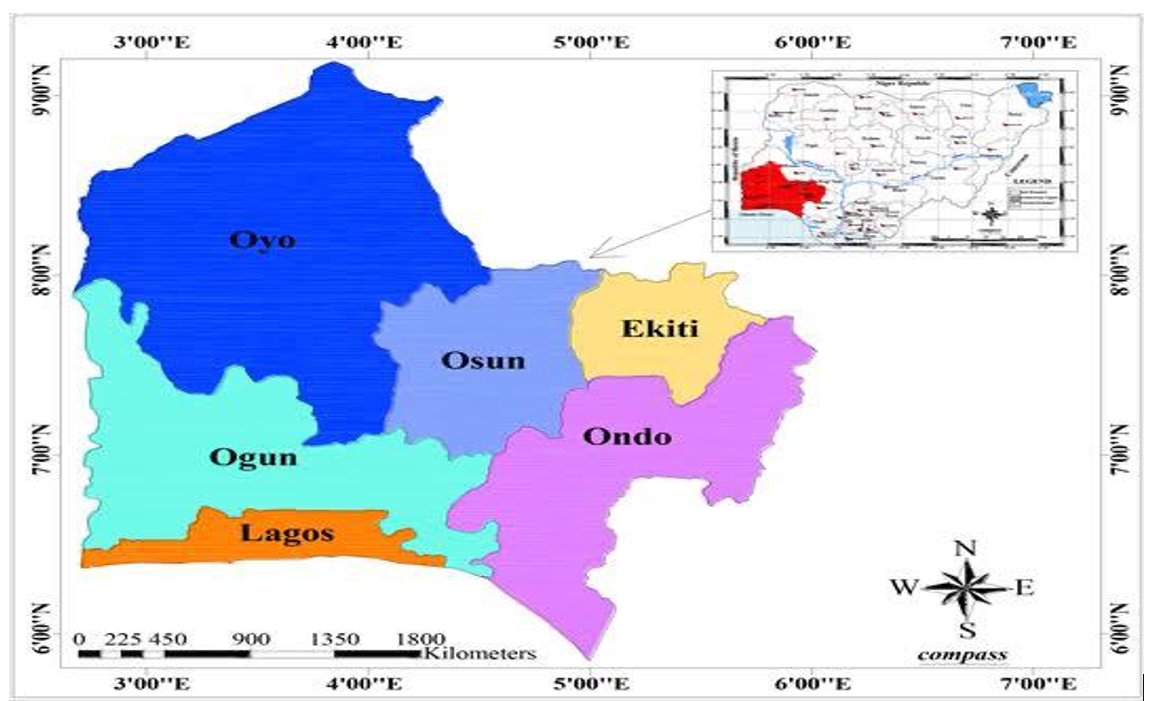
Courthouse design plays an important role in supporting efficient judicial processes, safe movement, and equitable access to justice. However, spatial and accessibility deficiencies remain evident in many Nigerian court facilities. This study evaluates the spatial layout and accessibility of selected High Court facilities in Southwest Nigeria, focusing on zoning, circulation, functional relationships, and accessibility provisions. A descriptive research design with a mixed-method approach was adopted across six High Court facilities in Ekiti, Lagos, Ogun, Ondo, Osun, and Oyo States. Primary data were obtained through questionnaires, field observations, interviews, and spatial assessments, while 237 valid questionnaire responses were analysed using descriptive statistics and mean weighted values (MWV). Findings indicate a generally moderate-to-low performance in spatial layout, with an overall MWV of 2.43. Accessibility performance was similarly low, with an overall MWV of 2.39. Ramps (MWV = 2.55), accessible service counters (2.54), and toilets (2.52) recorded the highest accessibility ratings, while court entrances (2.21), adequate door widths (2.24), and emergency alarms for users with sensory impairments (2.19) recorded the lowest. The findings demonstrate that accessibility is largely provided through isolated features rather than being integrated into the overall spatial and circulation system. The study concludes that improved court design should integrate functional zoning, efficient circulation, barrier-free access, wayfinding, and inclusive safety provisions to enhance the functionality, safety, dignity, and equitable use of judicial facilities in Southwest Nigeria.
References
Adenaike, O. A., Amatobi, D. A., & Ogadah, C. M. (2022). Consideration of accessibility challenges of persons with disabilities in public buildings within Akanu Ibiam Federal Polytechnic Unwana, Ebonyi State. African Journal of Integrated Knowledge and Technology, 2(1), 113-27.
Aduwo, E. B., & Olu-Oseh, V. O. (2026). Universal design compliance in selected cultural centres in South-west and South-South Nigeria. Frontiers in Built Environment, 12. https://doi.org/10.3389/fbuil.2026.1840989
Akinbogun, S. P., & Oloruntoyin, P. (2020). Accessibility for the disabled in public buildings: The case of a Nigerian university. International Journal of Civil and Architectural Engineering, 14(10).
Aruma, C. U., & Emusa, H. (2023). Provision of accessible buildings for people with disabilities (PWD) in Nigerian public universities. Archiculture, 5(3), 129–137.
Ayoola, A. R., Ayinla, A. K., Makinde, O. O., Ajayi, O. O. (2026). Socioeconomic and Physical Determinants of Place Performance in Green-Certified Buildings in Lagos, Nigeria. FUDMA Journal of Sciences (FJS), ISSN online: 2616-370. ISSN print: 2645 – 2944. Vol. 10 No. 8, pp 85 – 96, https://doi.org/10.33003/fjs-2026-1008-5059
Babalola, O. D., Eke, W. N., Opoko, A. P., Izobo-Martins, O. O., Ediae, O. J., & Akinola, A. O. (2020). Appraisal of ferry terminals design compliance to guidelines for universal accessibility in Lagos State Nigeria. International Journal of Recent Technology and Engineering, 8(6), 2153–2167. https://doi.org/10.35940/ijrte.B2278.038620
Branco, P. (2023). Analysing courthouses’ spaces, places and architecture: Some methodological outlines. Oñati Socio-Legal Series, 13(S1), S278–S298. https://doi.org/10.35295/osls.iisl.1692
Paul, O., Akinbogun, S. P., & Akinbogun, O. T. (2021). Assessment of compliance with accessibility policies for wheelchair users in public buildings: The case of a Nigerian university. Journal of Environmental Design, 16(1), 8–16.
Chidiac, R., Reda, M., & Marjaba, G. (2024). Inclusive built environment: Evaluating accessibility frameworks in public architecture. Journal of Urban Design and Development, 30(1), 44–62.
Elekanachi, RU; Shikako, K; Snider, L, Dahan-Oliel, NA (2023). Portrait of the rights of children with disabilities in Nigeria: a policy review. International Journal of Environmental Research and Public Health, 20(6996). https://doi.org/10.3390/ijerph20216996
Emiri, D. A. (2021). Assessment of accessibility and disability planning in Nigerian construction industry. ASRIC Journal on Engineering Sciences, 1(2), 32–39.
Jatau-Yeshua, T. S., Kagai, K. J., & Adah, C. A. (2019). Exploring the discrimination faced by persons with disability from the design and construction of the Nigerian built environment. Archiculture, Vol. 2 (2), pp. 36-43, ISSN (Print): 2636-6747
Federal Republic of Nigeria. (2018). Discrimination against Persons with Disabilities (Prohibition) Act, 2018.
Hamzat, T. K., & Dada, O. O. (2005). Wheelchair accessibility of public buildings in Ibadan, Nigeria. Asia Pacific Disability Rehabilitation Journal, 16(2), 119–124.
Bumma, F. N., Ayagere, S. A., Amakiri-Whyte, B. H., & Ubani, P. (2020). Urban public buildings and accessibility challenges in Nigeria. International Journal of Research and Scientific Innovation (IJRSI), 7(5), 209-215. https://rsisinternational.org/virtual-library/papers/urban-public-buildings-and-accessibility-challenges-in-nigeria/
Sholanke, A. B., & Adisa, O. S. (2025). Adequacy of the National Building Code (2006) in promoting Universal Design practices in Nigeria. Journal of Accessibility and Design for All, 15(2), 117–136. https://doi.org/10.17411/jacces.v15i2.630
https://nigerianstat.gov.ng/download/1241422
Makinde, O. O. (2020). Spatial and security organisation of court buildings: An assessment of selected High Court buildings in Nigeria. Green Building & Construction Economics, 1(1), 69–95. https://doi.org/10.37256/gbce.112020539
Makinde, O.O, (2013). Spatial Organisation of High Court Buildings in South Western Nigeria; LAP LAMBERT Academic Publishing GmbH & Co. ISBN-13: 978-3-659-30885-7, ISBN-10:3659308854, Category: Architecture. https://www.morebooks.de/store/gb/book/spatial-organisation-of-high-court-buildings-in- south-western-nigeria/isbn/978-3-659-30885-7
Makinde, O. O., Hassan, O. K. (2025). Evaluation of Circulation Efficiency, Flow Patterns and User Satisfaction with Circulation Systems in Health Care Facilities in Osun State. Iconic Research and Engineering Journals. Vol. 9 Issue 2, ISSN: 2456-8880.
Mosca, E. I., & Capolongo, S. (2018). Towards a Universal Design evaluation for assessing the performance of the built environment. Studies in Health Technology and Informatics, 256, 771–779. https://doi.org/10.3233/978-1-61499-923-2-771
Mulcahy, L. (2011). Legal Architecture: Justice, Due Process and the Place of Law. Routledge. https://doi.org/10.4324/9780203819247
National Bureau of Statistics (NBC) (2022). Demographic Statistical Bulletin 2022.
National Commission for Persons with Disabilities (NCPWD) (2020). Accessibility guidelines for public buildings and facilities. Abuja: NCPWD. https://ncpwd.gov.ng/Apps/Web/accessibility
Oyeniyi, B., Alagbe, T., Akande, I., & Oyedele, O. (2022). A study of Universal Design strategies in selected public buildings in Lagos State. Iconic Research and Engineering Journals, 6(4), 1–6
Resnik, J., Curtis, D. E., & Tait, A. A. (2013). Constructing courts: Architecture, the ideology of judging, and the public sphere. In R. K. Sherwin & A. Wagner (Eds.), Law, culture and visual studies (pp. 515–545). Springer. https://doi.org/10.2139/ssrn.2447895
Sholanke, A, and Adisa, O. (2025). Adequacy of the national building code (2006) in promoting Universal Design practices in Nigeria. Journal of Accessibility and Design for All, 15(2), 117-136. https://doi.org/10.17411/jacces.v15i2.630
Spaulding, N. W. (2012). The Enclosure of Justice: Courthouse Architecture, Due Process, and the Dead Metaphor of Trial. Yale Journal of Law & the Humanities / Stanford Legal Studies. 24, 311
Ugah, U. K., Sholanke, A. B., Dimuna, K. O., Akinola, A. O., Ene, V. O., & Nduka-Kalu, I. C. (2024). Universal Design compliance in South-west Nigeria's Federal Universities' Faculty of Environmental Science Buildings. Civil Engineering and Architecture, 12(6), 4277–4292. https://doi.org/10.13189/cea.2024.120636
United Nation Nigeria, (2023). Situational Analysis on the Rights of Persons with Disabilities in Nigeria. https://globaldisabilityfund.org/new/wp-content/uploads/2025/05/SITAN-Nigeria.pdf
Watchorn, V., Hitch, D., Tucker, R., Frawley, P., Aedy, K., & Grant, C. (2022). Evaluating universal design of built environments: an empirical study of stakeholder practice and perceptions. Journal of Housing and the Built Environment, 38(3), 1491-1510.
Downloads
Published
Issue
Section
Categories
License
Copyright (c) 2026 Olusola Oladapio Makinde, Oluwaseun Abimbola Gbiri, Olubukunmi Temitope Makinde

This work is licensed under a Creative Commons Attribution 4.0 International License.