
An Algebraic Trioid Model for Biological Regulatory Network
DOI:
https://doi.org/10.33003/fjs-2026-1017-5910Keywords:
Trioid, Gene Regulatory Network, Algebraic Biology, Congruence Lattice, ESN Correspondence, Representation Theory, Network Motif, Systems Biology, Rota-Baxter Operator, Hopf AlgebraAbstract
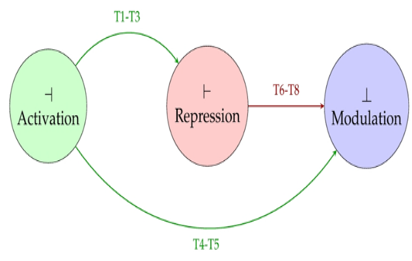
Gene regulatory networks govern cellular behaviour through three fundamental interaction types: activation, repression, and modulation. Existing modelling approaches—directed graphs, Boolean networks, differential equations, and motif statistics—each capture important aspects of regulatory dynamics, but none provides a compositional algebraic framework in which the three interaction types appear as primitive operations subject to explicit compatibility laws. Building on the trioid axioms of Loday and Ronco and the set-theoretic theory developed by Zhuchok, this paper makes four original contributions. First, we establish a systematic biological interpretation of the three trioid operations as activation, repression and modulation, and we show that the eight trioid axioms encode biologically meaningful consistency conditions. Second, we develop the congruence theory of trioids as a formalism for functional modularity, identifying the least semilattice congruence with regulatory module decomposition and s-simple trioids with irreducible network motifs. Third, we establish an Ehresmann–Schein–Nambooripad (ESN) correspondence for ⊥-regular trioids, proving an equivalence of categories between ⊥-regular trioids and inductive dimonoid groupoids; under this correspondence, groupoid objects correspond to attractors and morphisms to regulatory transitions. Fourth, we develop the representation theory of trioid modules over free trioids and classify irreducible modules as elementary regulatory circuits. We report preliminary computational enumeration of trioids of orders 1 through 3 using a backtracking search with canonical-form pruning; complete operation tables and executable code are provided as supplementary material. We propose, but do not execute, laboratory validation protocols based on perturbation and time-series expression experiments. The biological interpretations advanced here are theoretical; experimental confirmation remains an open problem.
Downloads
Published
Issue
Section
Categories
License
Copyright (c) 2026 David Adeyemi Oluyori, Richmond Emuohwo Edugbo, Tijjani Mustapha

This work is licensed under a Creative Commons Attribution 4.0 International License.