
Development and Stability Analysis of the SEIR-Epi-Mod-QR/Alt Model for Smart Campus Management of Student Stress and Academic Misconduct
DOI:
https://doi.org/10.33003/fjs-2026-1018-5896Keywords:
SEIR model, student stress, academic misconduct, smart campus, QR Technology, Stability AnalysisAbstract
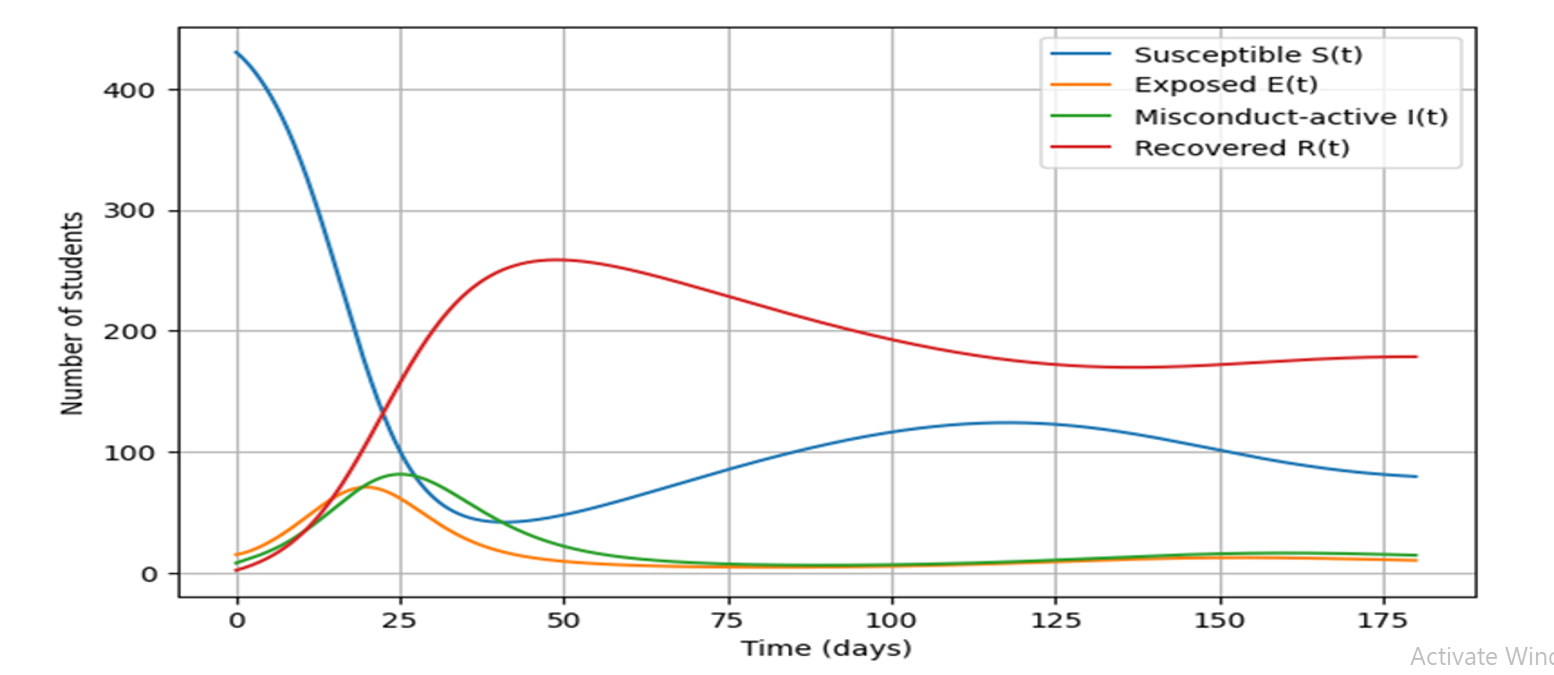
Student stress and academic misconduct remain major concerns in higher education institutions, particularly in technology-mediated learning environments. Many existing monitoring systems focus on record-keeping and are largely reactive, offering limited predictive insight for early intervention. Based on the role of early detection and intervention, a hybrid epidemiological model SEIR–Epi-Mod–QR/Alt is developed in this paper, which describes the dynamic interaction between student stress, academic misconduct, and smart campus monitoring. This model categorizes students as susceptible, exposed, misconduct-active, and recovered, and includes QR/Alt enabled early detection and mitigation. The existence, uniqueness, positivity, boundedness, equilibrium states, and local and global stability of the model are obtained through basic mathematical analysis. The numerical simulations of over a 180- day school term reveal that the threshold for stress reproduction drops from around 1.505 to 0.755 by increasing the QR/Alt-enabled early detection and mitigation rate from 0.05 to 0.20 per day, which in turn results in lower peak levels of misconduct-active students and shorter misconduct persistence. The simulations also illustrate that higher stress relapse can result in a higher likelihood that misconduct-active students will remain misconducted over time even with good early detection. The results indicate that within the model context, early detection, counselling, and ongoing academic support may be helpful in reducing academic dishonesty related to stress among students. The research establishes a mathematical framework to assess the effectiveness of early intervention plans for student support and academic integrity on a smart campus.
References
Adebayo, A. A., &Osamoka, S. S. (2024). Menace of examination malpractices in tertiary institutions: A study of selected universities in Ekiti State, Nigeria. FUOYE Journal of Criminology and Security Studies, 3(1). https://fjcss.fuoye.edu.ng/index.php/fjcss/article/view/91
Adnan, M., Habib, A., Ashraf, J., Mussadiq, S., Raza, A. A., Abid, M., Bashir, M., & Khan, S. U. (2021). Predicting at-risk students at different percentages of course length for early intervention using machine learning models. IEEE Access, 9, 7519–7539. https://doi.org/10.1109/ACCESS.2021.3049446
Aithal, P. S., Prabhu, S., & Aithal, S. (2024). Future of higher education through technology prediction and forecasting. Poornaprajna International Journal of Management, Education, and Social Science (PIJMESS), 1(1), 1–50. https://doi.org/10.64818/PIJMESS.3107.4626.0001
Aldhafeeri, F. M., & Alotaibi, A. A. (2022). Effectiveness of digital education shifting model on high school students' engagement. Education and Information Technologies, 27(5), 6869–6891. https://doi.org/10.1007/s10639-021-10879-4
Alam, A. (2023). Improving learning outcomes through predictive analytics: Enhancing teaching and learning with educational data mining. In 2023 7th International Conference on Intelligent Computing and Control Systems (ICICCS) (pp. 249–257). IEEE. https://doi.org/10.1109/ICICCS56967.2023.10142392
AlNajdi, S. M. (2022). The effectiveness of using augmented reality (AR) to enhance student performance: Using quick response (QR) codes in student textbooks in the Saudi education system. Educational Technology Research and Development, 70(3), 1105–1124. https://doi.org/10.1007/s11423-022-10100-4
Bellaj, M., Bendahmane, A., Younes, A., Boudra, S., &Ennakra, M. (2024). A systematic review of smart campus technologies to improve students' educational experiences. In 2024 Mediterranean Smart Cities Conference (MSCC) (pp. 1–7). IEEE. https://doi.org/10.1109/MSCC62288.2024.10697051
Dauda, U. M., &Ja’afaru, L. (2025). Spectral analysis and stability of wave equations with dispersive nonlinearity. FUDMA Journal of Sciences, 9(3), 294–301. https://doi.org/10.33003/fjs-2025-0903-3239
Eaton, S. E., Pethrick, H., & Turner, K. L. (2023). Academic integrity and student mental well-being: A rapid review. Canadian Perspectives on Academic Integrity, 5(2), 34–58. https://doi.org/10.55016/ojs/cpai.v5i2.73748
Edeki, S. O., & Azu-Nwosu, V. E. (2024). Deposit insurance modeling based on standard power option payoff using Picard–Lindelöf iteration. Annals of Financial Economics, 19(3), 2450013. https://doi.org/10.1142/S2010495224500131
Edeki, S. O., Adinya, I., Adeosun, M. E., & Ezekiel, I. D. (2020). Mathematical analysis of the global COVID-19 spread in Nigeria and Spain based on SEIRD model. Communications in Mathematical Biology and Neuroscience, 2020, 84. https://doi.org/10.28919/cmbn/4860.
Edeki, S. O., Ogundile, O. P., Akinlabi, G. O., Imaga, O. F., Zelibe, S. C., Odo, C. E., &Nzeh, M. Y. (2021). SIR modeling of a disease spread with a detectable and undetectable infectious syndrome. Journal of Physics: Conference Series, 1734, 012056. https://doi.org/10.1088/1742-6596/1734/1/012056.
El Siedy, E., Alkharaz, S. H., Alabdullah, M. T., & Adel, Y. (2025). Optimized strategies for open-loop Nash equilibrium in differential games using the Picard iteration method. Nonlinear Functional Analysis and Applications, 30(1), 215–235. https://doi.org/10.22771/nfaa.2025.30.01.13
Gross, G., Ling, R., Richardson, B., & Quan, N. (2023). In-person or virtual training: Comparing the effectiveness of community-based training. American Journal of Distance Education, 37(1), 66–77. https://doi.org/10.1080/08923647.2022.2029090
Han, J., Hu, W., Long, J., & Zhao, Y. (2026). Deep Picard iteration for high-dimensional nonlinear PDEs. SIAM Journal on Scientific Computing, 48(1), C1–C24. https://doi.org/10.1137/24M169312X
Magani, J. K., Ogundile, O. P., &Edeki, S. O. (2022). A numerical technique for solving infectious disease model. Journal of Physics: Conference Series, 2199, 012006. https://doi.org/10.1088/1742-6596/2199/1/012006.
Nkomo, L. M., Daniel, B. K., & Butson, R. J. (2021). Synthesis of student engagement with digital technologies: A systematic review of the literature. International Journal of Educational Technology in Higher Education, 18, Article 34. https://doi.org/10.1186/s41239-021-00270-1
Ogala, J. O., &Okeoghene, O. B. (2024). Computer simulations as a tool for enhancing algebra retention in junior secondary schools: An analysis. FUDMA Journal of Sciences, 8(4), 96–99. https://doi.org/10.33003/fjs-2024-0804-2618
Ogundile, O. P., Edeki, S. O., & Adewale, S. O. (2018). A modelling technique for controlling the spread of tuberculosis. International Journal of Biology and Biomedical Engineering, 12, 131–136.
Singh, J., Steele, K., & Singh, L. (2021). Combining the best of online and face-to-face learning: Hybrid and blended learning approach for COVID-19, post-vaccine, & post-pandemic world. Journal of Educational Technology Systems, 50(2), 140–171. https://doi.org/10.1177/00472395211047865
Verhoef, A. H., &Coetser, Y. M. (2021). Academic integrity of university students during emergency remote online assessment: An exploration of student voices. Transformation in Higher Education, 6, a132. https://doi.org/10.4102/the.v6i0.132
Vialatte, L., Pereira, B., Guillin, A., Miallaret, S., Baker, J. S., Colin-Chevalier, R., Yao-Lafourcade, A.-F., Azzaoui, N., Clinchamps, M., Bouillon-Minois, J.-B., et al. (2022). Mathematical modeling of the evolution of absenteeism in a university hospital over 12 years. International Journal of Environmental Research and Public Health, 19(14), 8236. https://doi.org/10.3390/ijerph19148236
Virtanen, T. E., Räikkönen, E., Engels, M. C., Vasalampi, K., &Lerkkanen, M.-K. (2021). Student engagement, truancy, and cynicism: A longitudinal study from primary school to upper secondary education. Learning and Individual Differences, 86, 101972. https://doi.org/10.1016/j.lindif.2021.101972
Zhang, Y., Yip, C., Lu, E., & Dong, Z. Y. (2022). A systematic review on technologies and applications in smart campus: A human-centered case study. IEEE Access, 10, 16134–16149. https://doi.org/10.1109/ACCESS.2022.3148735
Zhao, M., Zhao, G., & Qu, M. (2022). College smart classroom attendance management system based on Internet of Things. Computational Intelligence and Neuroscience, 2022, 4953721. https://doi.org/10.1155/2022/4953721
Downloads
Published
Issue
Section
Categories
License
Copyright (c) 2026 Sunday Edeki, Tega Okor

This work is licensed under a Creative Commons Attribution 4.0 International License.


