
Modeling the Dynamics of the Marburg Virus Disease
DOI:
https://doi.org/10.33003/fjs-2026-1020-5893Keywords:
Marburg Virus, SEIQR, Quarantine, Stability, Sensitivity, Bifurcation, Basic Reproduction Number, SimulationAbstract
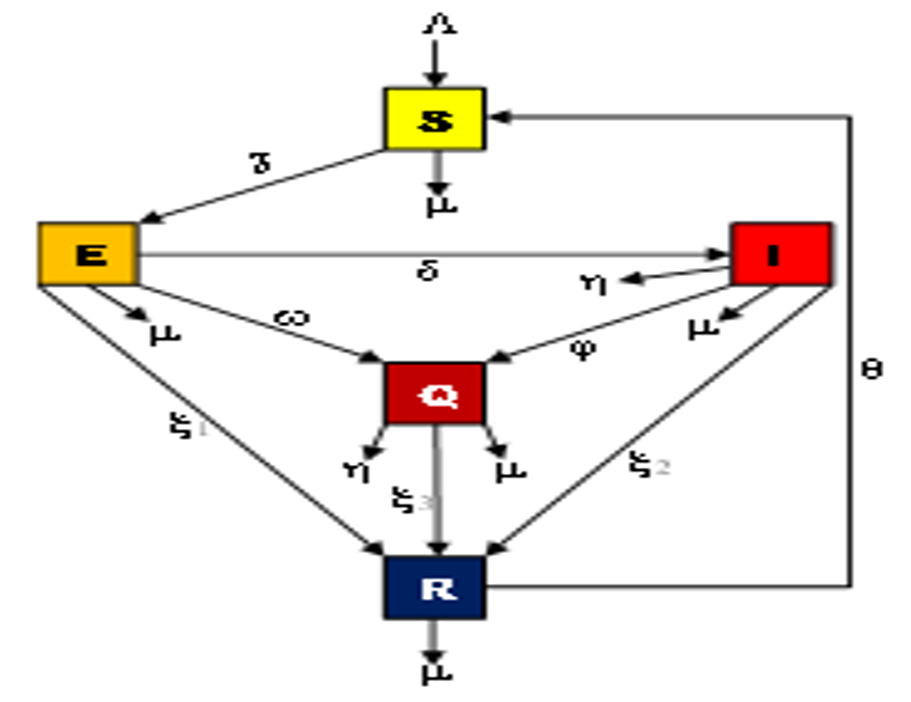
This work models the infection dynamics of the Marburg Virus Disease using the SEIQR model. It is a five-compartment model. We investigated the non-negativity of solutions, invariant region and boundedness, equilibrium points, basic reproduction number, sensitivity, equilibrium points’ stability, and bifurcation of the model. For all time and positive initial conditions, we observed that the model has non-negative solutions. The invariant region of the model is established, revealing the population size is bounded. The sensitivity analysis shows that the contact rate, the probability of effective contact and the rate at which exposed individuals become infectious have positive sensitivity indices, while the quarantine rates for the exposed and infectious classes, the death rates, and the recovery rates for the exposed and infectious classes have negative sensitivity indices. We established that the non-negativity of the residual vector , resulting from the difference between the rate of change of infected individuals and the Metzler matrix, stops the existence of several endemic equilibria for . Thus, no critical value exists, and there is an extension of local stability of the disease-free equilibrium to global stability on the entire domain. The bifurcation analysis reveals a forward bifurcation and the bifurcation plot confirms that for effective management and eradication the disease, the basic reproduction number must satisfy , where is a critical value. The mathematical analysis also reveals that the disease-free equilibrium is globally asymptotically stable. The effects of some sensitive parameters on the infectious class are shown via numerical simulations.
References
Addai, E., Adeniji, A., Ngungu, M., Tawiah, G.K., Marinda, E., Asamoah, J.K.K., Khan, M.A. (2023). A nonlinear fractional epidemic model for the Marburg virus transmission with public health education. Sci. Rep. 13(1), 19292. https://doi.org/10.1038/s41598-023-46127-7
Ajelli, M., Merler, S. (2012). Transmission potential and design of adequate control measures for Marburg hemorrhagic fever. PLoS ONE 7(12), e50948. https://doi.org/10.1371/journal.pone.0050948
Amoah-Mensah, J., Opoku, N. K. O., Borkor, R. N., Boateng, F. O., Bonsu, K., Afosaa, V. &Afutu, R. (2024). Mathematical modelling of the transmission dynamics of Marburg virus disease with optimal control and cost-effectiveness analysis based on lessons from Ebola virus disease. Advances in Continuous and DiscreteModels, 48, 1-29. https://doi.org/10.1186/s13662-024-03833-4
Castillo-Chavez, C. and Song, B. (2004). Dynamical models of tuberculosis and their applications. Mathematical Biosciences and Engineering. 1. 361-404. https://doi.org/10.3934/mbe.2004.1.361
Kizito, M., and Tumwiine, J. (2018). A mathematical model of treatment and vaccination interventions of pneumococcal pneumonia infection dynamics. Journal of Applied Mathematics. https://doi.org/10.1155/2018/2539465
Marcus, O. I., Augustine, A., & Jonathan, T. (2024). A Co-infection Model for Monkeypox and HIV/AIDS: Sensitivity and Bifurcation Analyses. Journal of Scientific Research and Reports, 30(5), 351-368. https://doi.org/10.9734/jsrr/2024/v30i52668
Marcus, O. I., Augustine, A., Jonathan, T., &Ighomaro, O. N. (2024). Mathematical Formulation of a Co-infection Model and its Analyses for Monkeypox and HIV/AIDS Infections. Asian Research Journal of Mathematics, 20(3), 12-39. https://doi.org/10.9734/arjom/2024/v20i3788
Marcus, O. I., Ighomaro, O. N., &Sarduana, A. J. (2024). Mathematical Modeling of Intra-Communal Violence and Risk-Level Analysis. Case Study: Obiaruku Community in Delta State, Nigeria. Asian Journal of Probability and Statistics, 26(3), 44-66. https://doi.org/10.9734/ajpas/2024/v26i3599
McCabe, R., et al. (2024). Marburg virus disease outbreaks, mathematical models, and disease parameters: a systematic review. The Lancet Infectious Diseases, 24(3), e150-e161. https://doi.org/10.1016/S1473-3099(23)00515-7
Oladele, J. O., Durowoju, H. O., & Adeniyi, E. S. (2025). Leveraging Multi-Component Control Strategies for Marburg Virus Suppression: A Mathematical Modeling Approach. Journal for Research in Applied Sciences and Biotechnology, 4(3), 49–58. https://doi.org/10.55544/jrasb.4.3.7
Ossaiugbo, M. I., & Okposo, N. I. (2021). Mathematical modeling and analysis of pneumonia infection dynamics. Science world journal, 16(2), 73-80. https://www.ajol.info/index.php/swj/article/view/212361.
Qian, G. Y., Edmunds, W. J., Bausch, D. G., et al. (2023). A mathematical model of Marburg virus disease outbreaks and the potential role of vaccination in control. BMC Medicine, 21, 439. https://doi.org/10.1186/s12916-023-03108-x
Tsetimi, J., Ossaiugbo, M. I., &Atonuje, A. (2022a). On Optimal Control Analysis of Pneumonia. Universal Journal of Public Health, 10(2): 168-175. https://doi.org/10.13189/ujph.2022.100203
Tsetimi, J., Ossaiugbo, M. I., &Atonuje, A. (2022b). A Mathematical Model and Analysis for the COVID-19 Infection. Journal of Mathematics and Statistics, 18(1), 49-64. https://doi.org/10.3844/jmssp.2022.49.64
Tsetimi, J., Ossaiugbo, M. I., &Atonuje, A. (2022c). Bifurcation Analysis of a Mathematical Model for the Covid-19 Infection among Pregnant and Non-Pregnant Women. European Journal of Pure and Applied Mathematics, 15(2), 537-556. https://doi.org/10.3844/ejpam.v15i2.4312
Washachi, J. D., Amoka, J. A., &Orapine, H. O. (2024). Mathematical modelling of transmission dynamics of Marburg virus with effective quarantine approach. CaJoST, 5(3), 264–272. https://doi.org/10.4314/cajost.v5i3.3
World Health Organization (2025). Marburg Virus Disease. https://www.who.int/news-room/fact-sheets/detail/marburg-virus-disease Accessed January, 2026.
Downloads
Published
Issue
Section
Categories
License
Copyright (c) 2026 Marcus Ifeanyi Ossaiugbo, Chukunalu Mgbomene, Ozioma Ogoegbulem

This work is licensed under a Creative Commons Attribution 4.0 International License.