
Speciation and Potential Mobility of Lead and Cadmium in Sediments of River Jama’are, Bauchi State, Nigeria
DOI:
https://doi.org/10.33003/fjs-2026-1018-5887Keywords:
Metal speciation, Mobility factor, River Jama’are, Sediment, Sequential extractionAbstract
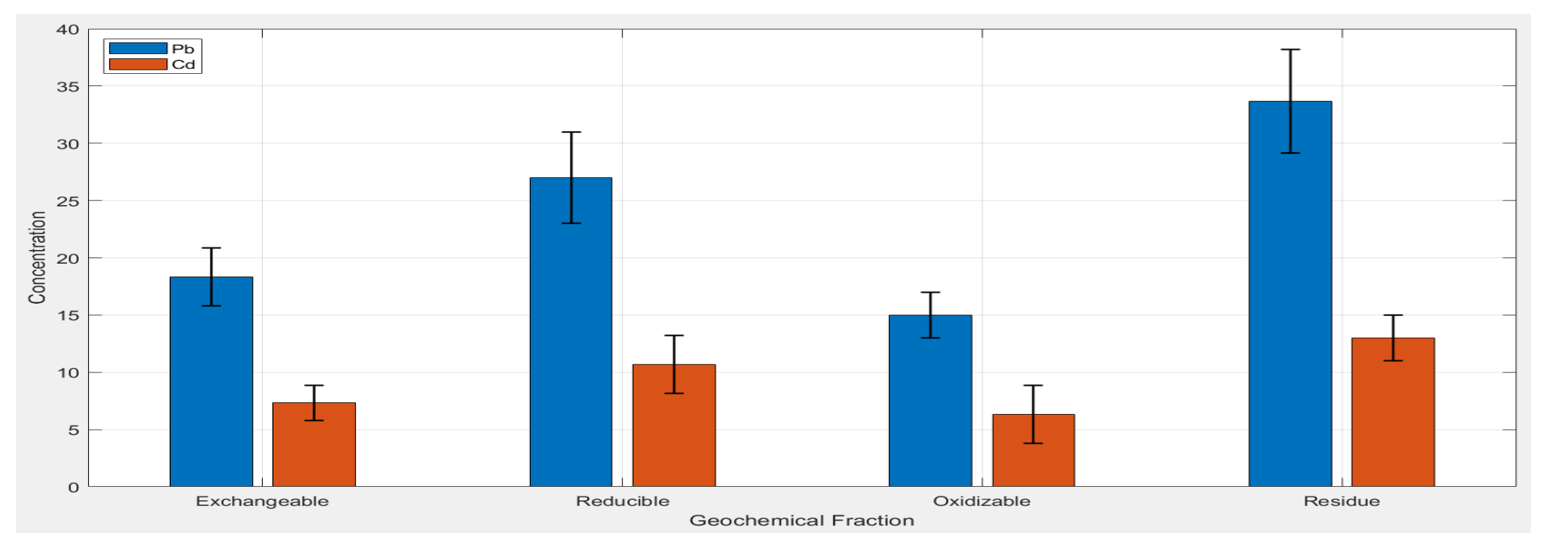
The speciation and potential mobility of lead (Pb) and cadmium (Cd) in sediments are important for assessing their environmental behaviour and potential remobilization. This study investigated the geochemical fractionation and potential mobility of Pb and Cd in sediments of River Jama’are, Bauchi State, Nigeria, using sequential extraction and mobility-factor assessment. A single composite sediment sample formed from five sampling points was fractionated into exchangeable, reducible, oxidizable, and residual fractions, and Pb and Cd concentrations were determined by atomic absorption spectrophotometry (AAS). Both metals were predominantly associated with the residual fraction, followed by the reducible, exchangeable, and oxidizable fractions, indicating relatively stable retention within the sediment. However, their occurrence in non-residual fractions indicated potential susceptibility to remobilization under changing environmental conditions. The mobility factors of Pb and Cd were 19.5% and 19.6%, respectively, classifying both metals as presenting medium potential mobility risk. The comparable mobility factors suggest similar potential mobility despite differences in their fractionation patterns. Overall, River Jama’are sediments may function as relatively stable sinks for Pb and Cd under prevailing conditions but could become secondary sources if environmental conditions promote remobilization. Continued monitoring of metal speciation and relevant sediment physicochemical properties is recommended to improve assessment of their long-term environmental behaviour.
References
Aggarwal, M., Anand, P., Varshney, D., & Ates, B. (2025). Carriers of contamination: heavy metals in Ganga River suspended particles. Environmental Research Communications, 7(11), 115015. https://doi.org/10.1088/2515-7620/ae1c03
Aggarwal, M., Anbukumar, S., & Vijaya Kumar, T. (2026). Assessment and insights into heavy metal contamination in sediments of the Ganga River, India: sources, trends and ecological implications. Soil and Sediment Contamination: An International Journal, 35(5), 750-777. https://doi.org/10.1080/15320383.2025.2553105.
Ali, H., Khan, E., & Ilahi, I. (2019). Environmental chemistry and ecotoxicology of hazardous heavy metals: environmental persistence, toxicity, and bioaccumulation. Journal of chemistry, 2019(1), 6730305. https://doi.org/10.1155/2019/6730305.
Ali, J., Tuzen, M., Jatoi, W. B., Feng, X., Sun, G., & Saleh, T. A. (2024). A review of sequential extraction methods for fractionation analysis of toxic metals in solid environmental matrices. TrAC Trends in Analytical Chemistry, 173, 117639. https://doi.org/10.1016/j.trac.2024.117639.
Derstila, A., Stamatakis, A., Minos, T., & Golia, E. E. (2026). Mechanisms and Effectiveness of Biochar, Zeolite and Attapulgite for Heavy Metal Immobilization in Soils: A Comparative Review. Environments, 13(7), 375. https://doi.org/10.3390/environments13070375.
Duan, G., Yu, S., Feng, R., Wang, C., & Lu, Q. (2026). Spatial enrichment, chemical speciation-based ecological risk assessment, and source apportionment of toxic metal (loid) s in surface and core sediments from a drinking-water reservoir, Southeast China. Environmental Geochemistry and Health, 48(10), 448. https://doi.org/10.1007/s10653-026-03326-1.
Edo, G. I., Samuel, P. O., Oloni, G. O., Ezekiel, G. O., Ikpekoro, V. O., Obasohan, P., ... & Agbo, J. J. (2024). Environmental persistence, bioaccumulation, and ecotoxicology of heavy metals. Chemistry and Ecology, 40(3), 322-349. https://doi.org/10.1080/02757540.2024.2306839 .
Fathollahzadeh, H., Kaczala, F., Bhatnagar, A., & Hogland, W. (2014). Speciation of metals in contaminated sediments from Oskarshamn Harbor, Oskarshamn, Sweden. Environmental Science and Pollution Research, 21(4), 2455-2464. https://doi.org/10.1007/s11356-013-2173-0.
Gao, L., Lu, J., Xu, D., Wan, X., & Gao, B. (2022). Partitioning behavior and ecological risk of arsenic and antimony in the sediment-porewater profile system in the Three Gorges Reservoir, China. Chemosphere, 300, 134409. https://doi.org/10.1016/j.chemosphere.2022.134409.
Garba, S., Abdulhameed, A., Ahmad, A., Aliyu, M., & Nuhu, A. (2026). Speciation and Potential Mobility of Mn, Cd, Cr, Pb, and Ni in Soil from Selected Farmland in Gadau, Bauchi State, Nigeria. Journal of Applied Sciences & Environmental Management, 30(5), 1626–1632. https://doi.org/10.4314/jasem.v30i5.27.
Garcia-Ordiales, E., Barral, N., Higueras, P., Cienfuegos, P., & Barquero, J. I. (2026). Geochemical fractionation of mercury and trace metals in river sediments of the Almadén mining district (Spain): implications for ecological risk. Environmental Research, 125064. https://doi.org/10.1016/j.envres.2026.125064.
Geng, N., Xia, Y., Li, D., Bai, F., & Xu, C. (2024). Migration and transformation of heavy metal and its fate in intertidal sediments: a review. Processes, 12(2), 311. https://doi.org/10.3390/pr12020311.
Goswami, A.P., Kalamdhad, A.S. (2023) Mobility and risk assessment of heavy metals in benthic sediments using contamination factors, positive matrix factorisation (PMF) receptor model, and human health risk assessment. Environ Sci Pollut Res 30, 7056–7074. https://doi.org/10.1007/s11356-022-22707-4.
Heo, J., Kim, T., Park, H., Ha, T. J., Jeon, N., & Yang, M. (2026). Irrigation-mediated transfer of geogenic manganese to paddy soils and rice grain in a mine-influenced catchment: a screening-level dietary exposure assessment. Environmental Geochemistry and Health, 48(11), 473. https://doi.org/10.1007/s10653-026-03366-7.
Hou, D., He, J., Lü, C., Ren, L., Fan, Q., Wang, J., & Xie, Z. (2013). Distribution characteristics and potential ecological risk assessment of heavy metals (Cu, Pb, Zn, Cd) in water and sediments from Lake Dalinouer, China. Ecotoxicology and environmental safety, 93, 135-144. https://doi.org/10.1016/j.ecoenv.2013.03.012.
Jahangir, S., Liu, Y., Noureen, M., Cui, J., & Wei, Z. (2023). Is there future of sequential chemical extraction for speciation analysis of metal (loid) s in plants?. Environmental Pollutants and Bioavailability, 35(1), 2263641. https://doi.org/10.1080/26395940.2023.2263641.
Kumar, A., Somani, M., Benamar, A., & Farooq, S. H. (2026). Geoenvironmental characterization and speciation-driven risk assessment of gold mining tailings. Environmental Monitoring and Assessment, 198(6), 590. https://doi.org/10.1016/j.chemosphere.2009.12.064.
Makangila, M., Maseka, K. K., Hara, Y. R., Hamilton, E., Watts, M., Nabuyanda, M. M., & Harimana, J. (2026). Elemental Speciation and Fractionation of Potentially Toxic Elements in Copper Mine Waste and its Implications for Metal Recovery. Chemistry Africa, 9(6), 285. https://link.springer.com/article/10.1007/s42250-026-01798-3 .
Maqsood, A., & Łobos-Moysa, E. (2025). Bottom sediments as dynamic arenas for anthropogenic pollutants: profiling sources, unraveling fate mechanisms, and assessing ecological consequences. International Journal of Molecular Sciences, 26(20), 10219. https://doi.org/10.3390/ijms262010219.
Nijeje, E., Sahan, S. J., & Senyonjo, A. (2023). Understanding the fate of heavy metals in the aquatic environment: Implications for pollution control and remediation. Environmental Pollution and Health, 1(1), 20. https://doi.org/10.61148/EPH/003.
Passos A, E., Alves, J. C., dos Santos, I. S., Alves, J. D. P. H., Garcia, C. A. B., & Costa, A. C. S. (2010). Assessment of trace metals contamination in estuarine sediments using a sequential extraction technique and principal component analysis. Microchemical Journal, 96(1), 50-57. https://doi.org/10.1016/j.microc.2010.01.018.
Rao, C.R.M., Sahuquillo, A. & Lopez Sanchez, J.F. (2008). A Review of the Different Methods Applied in Environmental Geochemistry For Single and Sequential Extraction of Trace Elements in Soils and Related Materials. Water Air Soil Pollut 189, 291–333. https://doi.org/10.1007/s11270-007-9564-0.
Rauret, G., F. López-Sánchez, J., Sahuquillo, A., Rubio, R., Davidson, C., Ure, A., & Quevauviller, P. (1999). Improvement of the BCR three step sequential extraction procedure prior to the certification of new sediment and soil reference materials. Journal of environmental monitoring, 1(1), 57-61. https://doi.org/10.1039/a807854h.
Rauret, G., López-Sánchez, J. F., Sahuquillo, A., Barahona, E., Lachica, M., Ure, A. M., & Quevauviller, P. (2000). Application of a modified BCR sequential extraction (three-step) procedure for the determination of extractable trace metal contents in a sewage sludge amended soil reference material (CRM 483), complemented by a three-year stability study of acetic acid and EDTA extractable metal content. Journal of environmental monitoring, 2(3), 228-233. https://doi.org/10.1039/b001496f.
Sharma, M., Kant, R., Sharma, A. K., & Sharma, A. K. (2025). Exploring the impact of heavy metals toxicity in the aquatic ecosystem. International Journal of Energy and Water Resources, 9(1), 267-280. https://doi.org/10.1007/s42108-024-00284-1.
Shi, Y., Li, L., Tu, H., Li, X., & Wu, P. (2026). Decoupling of antimony and arsenic migration in a deep neutral legacy Technosol profile with implications for remediation. Journal of Environmental Sciences. https://doi.org/10.1016/j.jes.2026.03.007.
Świetlik, R., & Trojanowska, M. (2022). Chemical fractionation in environmental studies of potentially toxic particulate-bound elements in urban air: A critical review. Toxics, 10(3), 124. https://doi.org/10.3390/toxics10030124 .
Tessier, APGC; Campbell, PG; Bisson, MJAC (1979). Sequential extraction procedure for the speciation of particulate trace metals. Analytical Chemistry 51(7), 844-851. https://doi.org/10.1021/ac50043a017.
Vdović, N., Lučić, M., Mikac, N., & Bačić, N. (2021). Partitioning of metal contaminants between bulk and fine-grained fraction in freshwater sediments: A critical appraisal. Minerals, 11(6), 603. https://doi.org/10.3390/min11060603.
Wang, J., Jiang, Y., Sun, J., She, J., Yin, M., Fang, F., ... & Liu, J. (2020a). Geochemical transfer of cadmium in river sediments near a lead-zinc smelter. Ecotoxicology and Environmental Safety, 196, 110529. https://doi.org/10.1016/j.ecoenv.2020.110529.
Wang, J., Zeng, X., Xu, D., Gao, L., Li, Y., & Gao, B. (2020b). Chemical fractions, diffusion flux and risk assessment of potentially toxic elements in sediments of Baiyangdian Lake, China. Science of the Total Environment, 724, 138046. https://doi.org/10.1016/j.scitotenv.2020.138046.
Yuan, X., Zhang, L., Li, J., Wang, C., & Ji, J. (2014). Sediment properties and heavy metal pollution assessment in the river, estuary and lake environments of a fluvial plain, China. Catena, 119, 52-60. https://doi.org/10.1016/j.catena.2014.03.008.
Zhu, L., Wang, T., Liu, J. et al. (2019). Metal distribution in sediments of a drinking water reservoir: influence of reservoir morphometry and hydrodynamics. Environ Sci Pollut Res 26, 9599–9609. https://doi.org/10.1007/s11356-019-04424-7.
Downloads
Published
Issue
Section
Categories
License
Copyright (c) 2026 Sani Garba, Ibrahim Salihu Yunusa, Isah Suleiman, Babangida Muhammad Lele, Mohammed Sani Yakubu

This work is licensed under a Creative Commons Attribution 4.0 International License.


