
A Personalized, Adaptive Learning Platform for Tertiary Education
DOI:
https://doi.org/10.33003/Keywords:
Adaptive Learning, Personalized Learning, Bayesian Knowledge Tracing, Recommendation Engine, Learning Analytics, Educational Technology, Tertiary EducationAbstract
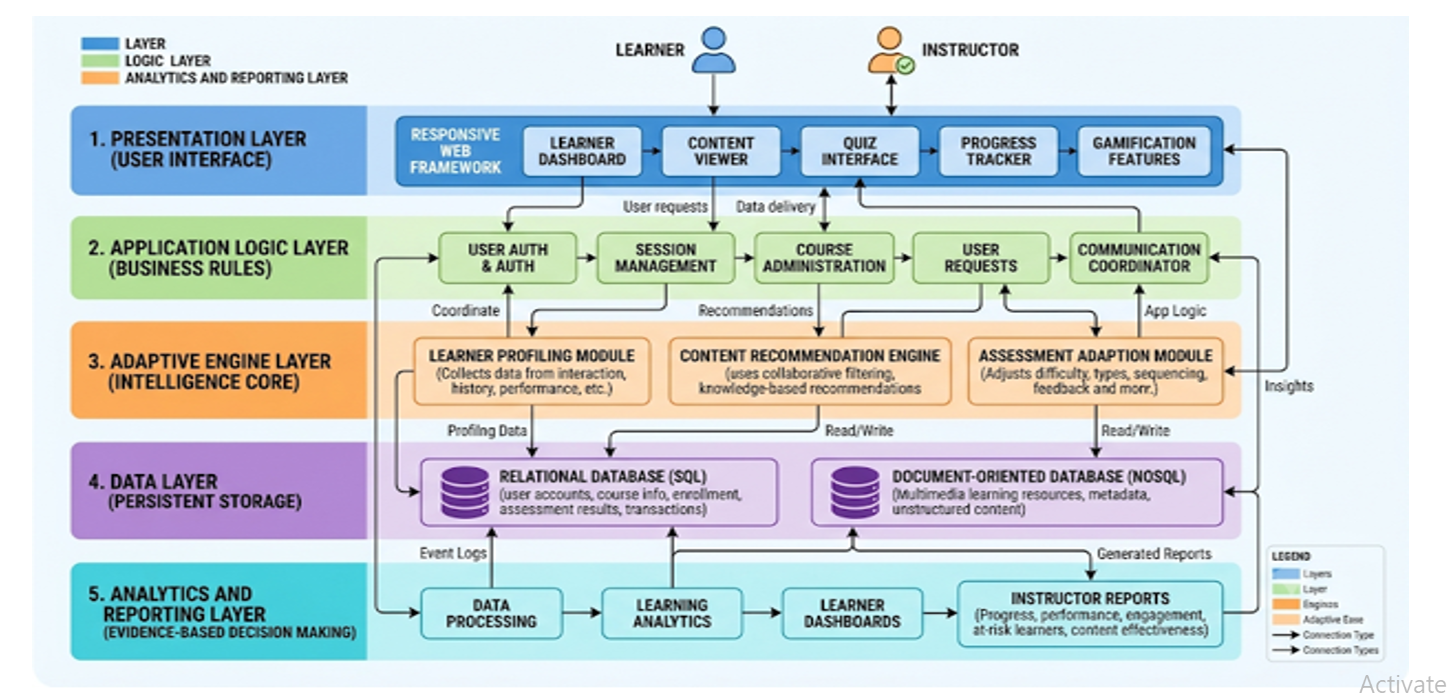
The continuous increase of digital education has exposed the limitations of traditional, uniform learning models that fail to account for individual learner differences. A Personalised Learning Platform with Adaptive Content (PLPAC), which is AI-driven, was developed to deliver tailored learning experiences through real-time adaptation. The system incorporates the mathematical Bayesian Knowledge Tracing (BKT) model, a hybrid collaborative and content-based recommendation engine, and mastery-based progression, adjusting content difficulty, format, sequence, and assessment in response to each learner's evolving profile. The system was built using a five-layer, multi-tier architecture across six two-week Agile sprints, and was then evaluated using a 12-week, mixed-methods, quasi-experimental design involving 250 tertiary-level students (125 in the PLPAC experimental group, 125 in a conventional Learning Management System control group). Results showed statistically significant gains across all four evaluated dimensions: large normalized learning gains for PLPAC (Hake's g = 0.43) relative to the control group (g = 0.20), with a large effect size (Cohen's d = 1.76); a 42% higher module completion rate (χ²(1) = 38.47, p < .001); substantially higher engagement across six behavioural metrics (77%–225% increases); and a disproportionately larger gain for the lowest-performing quartile of learners, which narrowed the gap in learning gains (though not the absolute post-test score gap) between low- and high-achieving learners relative to the control group. User satisfaction averaged 4.27 out of 5, exceeding the System Usability Scale benchmark.
References
Chen, L., Chen, P., and Lin, Z. (2025). Artificial intelligence in education: A review. IEEE Access, 8, 75264–75278.
Corbett, A. T., and Anderson, J. R. (1994). Knowledge tracing: Modeling the acquisition of procedural knowledge. User Modeling and User-Adapted Interaction, 4(4), 253–278.
Creswell, J. W., and Creswell, J. D. (2018). Research design: Qualitative, quantitative, and mixed methods approaches (5th Ed.). Sage.
Deci, E. L., and Ryan, R. M. (2000). The 'what' and 'why' of goal pursuits: Human needs and the self-determination of behavior. Psychological Inquiry, 11(4), 227–268.
Du Plooy, A. (2024). A meta-analysis of adaptive learning technologies in higher education (2015–2024). Computers and Education, 185, Article 104529.
Gligorea, I., Grosseck, G., and Andone, D. (2023). Adaptive learning systems in higher education: A European perspective. Education Sciences, 13(2), Article 112.
Hariyanto, E. (2025). Adaptive virtual laboratories in higher education: A Southeast Asian perspective. Journal of Computer Assisted Learning, 41(1), 55–70.
Hernández-Herrera, C. (2026). Generative AI tutors in higher education: A pilot study. Computers & Education: Artificial Intelligence, 5, Article 100145.
Hevner, A. R., March, S. T., Park, J., and Ram, S. (2004). Design science in information systems research. MIS Quarterly, 28(1), 75–105.
Kabudi, T., Pappas, I., and Olsen, D. H. (2021). AI-enabled adaptive learning systems: A systematic mapping of the literature. Computers and Education: Artificial Intelligence, 2, Article 100017.
Kizilcec, R. F., Pérez-Sanagustín, M., and Maldonado, J. J. (2017). Self-regulated learning strategies predict learner behaviour and goal attainment in massive open online courses. Computers in Human Behavior, 66, 17–29.
Lagos-Castillo, K., et al. (2025). AI-powered personalised learning systems using GPT-based architectures. Computers and Education, 200, Article 104800.
Ma, W., Adesope, O. O., Nesbit, J. C., and Liu, Q. (2014). Intelligent tutoring systems and learning outcomes: A meta-analysis. Journal of Educational Psychology, 106(4), 901–918.
Martin, F., Sun, T., and Westine, C. D. (2020). A systematic review of adaptive learning systems. Educational Technology Research and Development, 68, 1909–1939.
Mustapha, A. (2025). Adaptive learning in Nigerian tertiary institutions: Challenges and opportunities. African Journal of Educational Technology, 15(1), 23–39.
Shelle, G., Earnest, D., Pilkinton-Pihko, D., and Ponton, M. (2018). Adaptive learning technologies in higher education. International Journal of Information and Education Technology, 8(2), 146–152.
Sommerville, I. (2016). Software engineering (10th ed.). Pearson.
Soofi, A. A., and Ahmed, M. (2019). A systematic review of adaptive e-learning systems. Education and Information Technologies, 24(1), 1–28.
Steenbergen-Hu, S., and Cooper, H. (2014). A meta-analysis of intelligent tutoring systems. Review of Educational Research, 84(4), 531–563.
Tan, S., Wang, Y., and Li, H. (2025). Machine learning approaches for adaptive learning systems. Computers and Education, 198, Article 104720.
Tashakkori, A., and Teddlie, C. (Eds.). (2010). SAGE handbook of mixed methods in social and behavioral research (2nd ed.). Sage.
Twyman, J. S. (2018). Getting more out of adaptive learning technology. Every Learner Everywhere Report.
Urh, M., Vukovic, G., Jereb, E., and Pintar, R. (2015). The model for gamification of e-learning. Procedia – Social and Behavioral Sciences, 197, 388–397.
VanLehn, K. (2011). The relative effectiveness of human tutoring and intelligent tutoring systems. Educational Psychologist, 46(4), 197–221.
Viberg, O., Khalil, M., and Baars, M. (2018). Self-regulated learning and learning analytics in online learning environments: A review of empirical research. Computers and Education, 143, Article 103683.
Downloads
Published
Issue
Section
Categories
License
Copyright (c) 2026 Iriagbonse Amanda Inyang, Orie Cynthia Eloho

This work is licensed under a Creative Commons Attribution 4.0 International License.


