
Storage Fungal Load, Community Diversity, and Mycotoxigenic Risk in Stored Groundnut Seeds Across Niger State, Nigeria
DOI:
https://doi.org/10.33003/fjs-2026-1018-5863Keywords:
Groundnut, diversity, mycoflora, aflatoxin, toxigenic fungi, food safety, Niger StateAbstract
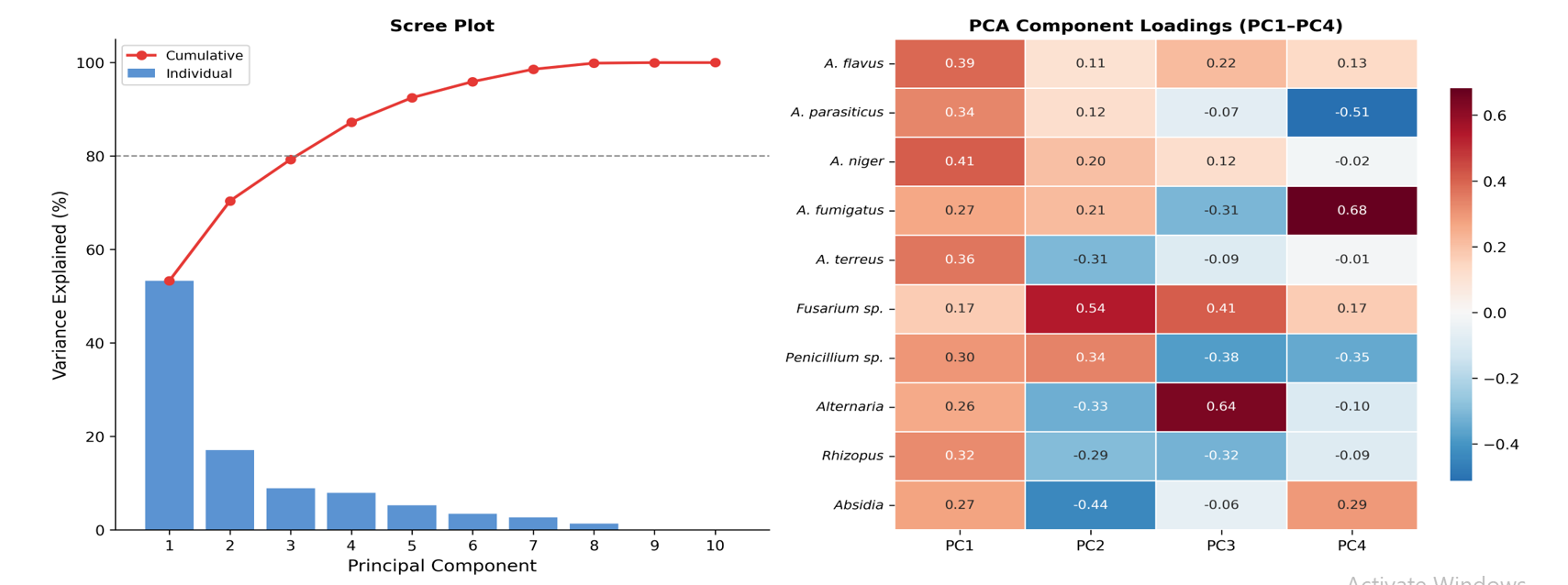
Postharvest losses in stored groundnut remain high across Niger State, Nigeria, driven substantially by fungal colonization under the region's humid, high-temperature storage conditions. This study assessed fungal load, mycoflora community structure, and qualitative toxigenic potential across twelve Local Government Areas (LGAs) spanning three agro-ecological zones, using 98 seed samples analyzed by standard microbiological isolation and toxigenic screening on Coconut Agar Medium under UV fluorescence (365 nm). Fungal load ranged from 11 × 10³ CFU/g (Chanchaga) to 28 × 10³ CFU/g (Mokwa), with the highest-burden LGAs concentrated in the wetter south-western storage belt. A total of 346 isolates spanning six genera were recovered, dominated by Aspergillus spp. (67.4%; principally A. niger, A. flavus, A. fumigatus), and 58.0% (n = 201) of isolates showed potential for mycotoxin production. Multivariate community analysis (PCA, hierarchical clustering) and diversity indices (mean H' = 2.02, J' = 0.92) resolved three geographically coherent storage-risk zones, extending prior isolate-frequency surveys of Nigerian stored groundnut mycoflora by linking community structure directly to spatial storage risk. These findings support targeted, zone-specific postharvest management to reduce losses and consumer exposure to mycotoxins.
References
Abdullahi, M. A., Yusuf, A. U., & Ibrahim, S. (2023). Postharvest fungal contamination of oilseed crops in northern Nigeria. Journal of Stored Products Research, 104, Article 102145. https://doi.org/10.1016/j.jspr.2023.102145
Abdullahi, N., & Dandago, M. A. (2022). Aflatoxins In Food Grains: Contamination, Dangers And Control. FUDMA Journal of Sciences, 5(4), 22–29. https://doi.org/10.33003/fjs-2021-0504-776
Adebiyi, J. A., Atehnkeng, J., & Katerere, D. (2024). Emerging concerns of aflatoxin contamination in staple foods in West Africa. Food Control, 158, Article 110245. https://doi.org/10.1016/j.foodcont.2024.110245
Adebola, M. O., Bello, T. S., Oyelade, M. J., Aremu, M. B., Egubagi, M. & Umar, S. M. (2020). Fungicidal activities of methanolic plant extracts on mycelia growth of Fusarium oxysporum associated with sweet orange (Citrus sinensis (L.) Osbeck). Bioscience Research Journal, 32(1), 1–8.
Adeleke, R. A., Babalola, O. O., & Ogunjobi, A. A. (2023). Prevalence and molecular characterization of aflatoxigenic Aspergillus species in Nigerian groundnuts. Journal of Food Safety, 43(2), Article e12987. https://doi.org/10.1111/jfs.12987
Adetunji, C., Akinola, M., Nleya, S. N., & Mulunda, M. (2021). Nutrient composition and aflatoxin contamination of African sourced peanuts and cashew nuts: Its implications on health. In Mycotoxins – Detection methods, management, public health and agricultural economy. IntechOpen. https://doi.org/10.5772/intechopen.95082
Amaechi, C. N., Atanda, O. O., & Ezekiel, C. N. (2021). Distribution of aflatoxigenic fungi and aflatoxins in groundnut-based products in Nigerian markets. Journal of Food Safety, 41(3), Article e12899. https://doi.org/10.1111/jfs.12899
Atehnkeng, J., Donner, M., Ojiambo, P. S., & Bandyopadhyay, R. (2021). Distribution and toxigenicity of Aspergillus species associated with groundnut storage in sub-Saharan Africa. Mycopathologia, 186(4), 567–581. https://doi.org/10.1007/s11046-021-00567-z
Awuchi, C. G., Nwankwo, E. O., Eze, C. U., & Okeke, C. E. (2023). Occurrence and health risks of mycotoxin in foods in Africa. Food Control, 147, Article 109537. https://doi.org/10.1016/j.foodcont.2023.109537
Bakoye, O., Baoua, I., Sitou, L., Moctar, M. R., Amadou, L., Njoroge, A. W., Murdock, L. L., & Baributsa, D. (2019). Groundnut production and storage in the Sahel: Challenges and opportunities in the Maradi and Zinder regions of Niger. Journal of Agricultural Science, 11(4), 25–38. https://doi.org/10.5539/jas.v11n4p25
Çiftçi, S., & Suna, G. (2022). Functional components of peanuts (Arachis hypogaea L.) and health benefits: A review. Future Foods, 5, Article 100140. https://doi.org/10.1016/j.fufo.2022.100140
Darwish, W. S., Ikenaka, Y., Nakayama, S. M. M., & Ishizuka, M. (2020). An overview on mycotoxin contamination of foods in Africa. Journal of Veterinary Medical Science, 82(5), 671–684. https://doi.org/10.1292/jvms.19-0567
Ezekiel, C. N., Sulyok, M., Warth, B., & Krska, R. (2022). Mycotoxin risks in groundnut value chain in West Africa. World Mycotoxin Journal, 15(1), 45–60. https://doi.org/10.3920/WMJ2021.2719
Gambo, U., Obansa, A., & Whong, C. (2025). Detection of aflatoxigenic molds and aflatoxin levels in groundnuts marketed in Zaria, Kaduna State, Nigeria. Research Square. https://doi.org/10.21203/rs.3.rs-7290071/v1
Gbashi, S., Njobeh, P. B., Madala, N. E., De Boevre, M., Kagot, V., & De Saeger, S. (2020). Parallel validation of a green-solvent extraction method and quantitative estimation of multi-mycotoxins in staple cereals using LC-MS/MS. Scientific Reports, 10(1), Article 10334. https://doi.org/10.1038/s41598-020-66787-z
Gide, S., Abdulkarim, S. M., & Danjuma, L. (2025). Screening for Aflatoxigenic Fungi in Stored and Open Market Grains in Potiskum, Northeast Nigeria. FUDMA Journal of Sciences, 9(1), 106–117. https://doi.org/10.33003/fjs-2025-0901-2916
International Agency for Research on Cancer. (2023). Aflatoxins. IARC Monographs on the Evaluation of Carcinogenic Risks to Humans. https://monographs.iarc.who.int/monographs-available
Kortei, N. K., Tetteh, R. A., Wiafe-Kwagyan, M., Amon, D. N. K., Odamtten, G. T. (2022). Mycobiota profile, phenology, and potential toxicogenic and pathogenic species associated with stored groundnuts (Arachis hypogaea L.) from the Volta Region, Ghana. Food Science & Nutrition, 10(3), 888–902. https://doi.org/10.1002/fsn3.2719
Koudokpon, H., Lègba, B., Sintondji, K., Kissira, I., Kounou, A., Guindo, I., Koné, K. M., Abdou, M., Koné, A., Sambou, C., Bankolé, H., Yadouleton, A., & Dougnon, V. (2024). Empowering public health: Building advanced molecular surveillance in resource-limited settings through collaboration and capacity-building. Frontiers in Health Services, 4, Article 1289394. https://doi.org/10.3389/frhs.2024.1289394
Kumar, P., Mahato, D. K., Kamle, M., Mohanta, T. K., & Kang, S. G. (2022). Aflatoxins: A global concern for food safety, human health and their management. Frontiers in Microbiology, 13, Article 897345. https://doi.org/10.3389/fmicb.2022.897345
Mahato, D. K., Lee, K. E., Kamle, M., Devi, S., Dewangan, K. N., Kumar, P., & Kang, S. G. (2019). Aflatoxins in food and feed: An overview on prevalence, detection and control strategies. Frontiers in Microbiology, 10, Article 2266. https://doi.org/10.3389/fmicb.2019.02266
Martínez-Culebras, P. V., Gandía, M., Garrigues, S., Marcos, J. F., & Manzanares, P. (2021). Antifungal peptides and proteins to control toxigenic fungi and mycotoxin biosynthesis. International Journal of Molecular Sciences, 22(24), Article 13261. https://doi.org/10.3390/ijms222413261
Mojena, R. (1977). Hierarchical grouping methods and stopping rules: An evaluation. Computer Journal, 20(4), 359–363. https://doi.org/10.1093/comjnl/20.4.359
Mwanza, M., Nyirenda, H., & Mlalazi, B. (2021). Mycotoxin contamination in legumes and oilseeds: Public health implications and management strategies. Toxins, 13(11), Article 812. https://doi.org/10.3390/toxins13110812
Najjar, A. A. (2023). Managing major foodborne mycotoxins: A therapeutic approach for safety and health. World Journal of Environmental Biosciences, 12(4), 46–53. https://doi.org/10.51847/fhNKVgnWUR
Naveen, K. H., & Vidyasagar, G. M. (2021). A coconut agar medium for rapid detection of aflatoxin production by Aspergillus spp. Journal of Mycology and Plant Pathology, 51(2), 164–172.
Odeniyi, O., Ojo, C., Adebayo-Tayo, B., & Olasehinde, K. (2019). Mycological, toxigenic, and nutritional characteristics of some vended groundnut and groundnut products from three northern Nigerian ecological zones. African Journal of Biomedical Research, 22, 65–71.
Olukosi, J., & Yusuf, A. (2021). Challenges and opportunities in groundnut production in Nigeria: A review. Nigerian Journal of Economic and Social Studies, 63(1), 15–30.
Pedregosa, F., Varoquaux, G., Gramfort, A., Michel, V., Thirion, B., Grisel, O., Blondel, M., Prettenhofer, P., Weiss, R., Dubourg, V., Vanderplas, J., Passos, A., Cournapeau, D., Brucher, M., Perrot, M., & Duchesnay, E. (2011). Scikit-learn: Machine learning in Python. Journal of Machine Learning Research, 12, 2825–2830.
Pedro, A., Aleruchi, C., John, M., Bashir, S., Hannah, E. N., & Victor, K. F. (2022). Fungal biodiversity associated with groundnuts stored in Nasarawa State. GSC Biological and Pharmaceutical Sciences, 18(3), 023–029. https://doi.org/10.30574/gscbps.2022.18.3.0087
Pitt, J. I., & Hocking, A. D. (2022). Ecology of fungal food spoilage. In Fungi and food spoilage (pp. 1–25). Springer.
Robertson, K. M., Simonson, E., Ramirez-Bullon, N. R., & others. (2023). Effects of spatial resolution, mapping window size, and spectral species clustering on remote sensing of plant beta diversity using biodivMapR and hyperspectral imagery. Journal of Geophysical Research: Biogeosciences, 128(7), Article e2022JG007350. https://doi.org/10.1029/2022JG007350
Saleh, I., Zeidan, R., & Abu-Dieyeh, M. (2024). The characteristics, occurrence, and toxicological effects of alternariol: A mycotoxin. Archives of Toxicology, 98(6), 1659–1683. https://doi.org/10.1007/s00204-024-03743-0
Sarah, K., Catriona, H., Helen, A., & David, E. (2016). Descriptions of medical fungi (3rd ed., revised November 2016). http://www.mycology.adelaide.edu.au
Sowmya, K. L., & Ramalingappa, B. (2024). Rapid detection of aflatoxin production by Aspergillus flavus using coconut agar medium. Food Science & Nutrition Technology, 9(3), 000352–000357. https://doi.org/10.29328/journal.fsnut.1001035
Suleiman, M. N., & Atehnkeng, J. (2022). Occurrence of aflatoxigenic fungi in stored grains and nuts in Nigeria. African Journal of Microbiology Research, 16(7), 301–312. https://doi.org/10.5897/AJMR.2022.9501
Tobin-West, M. D., & Baraka, R. E. (2018). Effects of methods of processing groundnut (Arachis hypogaea L.) on the nutritional composition and storage life of the seed. International Journal of Agriculture and Earth Science, 6, 2489–0081.
Ward, J. H. (1963). Hierarchical grouping to optimize an objective function. Journal of the American Statistical Association, 58(301), 236–244. https://doi.org/10.1080/01621459.1963.10500845
Yakubu, M. N., Ladan, M. A., & Deba, F. A. (2022). Biodiversity and virulence characterization of entomopathogenic fungi isolated from soils in different regions of Nigeria. Egyptian Journal of Biological Pest Control, 32, Article 93. https://doi.org/10.1186/s41938-022-00593-9
Downloads
Published
Issue
Section
Categories
License
Copyright (c) 2026 Musa Muhammad Liman, Adebola Matthew Omoniyi, Hadiza Lami Muhammad, Bello Ismail Muhaamad, Mariam Bukola Aremu, Maryam Alfa Kabaraini, Aisha Muhammad Ishaq

This work is licensed under a Creative Commons Attribution 4.0 International License.