
Monte Carlo Investigation of the Attenuation Characteristics of Granite Doped with Palm Kernel Shell Ash
DOI:
https://doi.org/10.33003/fjs-2026-1016-5862Keywords:
Granite, Palm Kernel Shell Ash, Gamma-Ray Attenuation, Monte Carlo Simulation, TOPAS, Radiation ShieldingAbstract
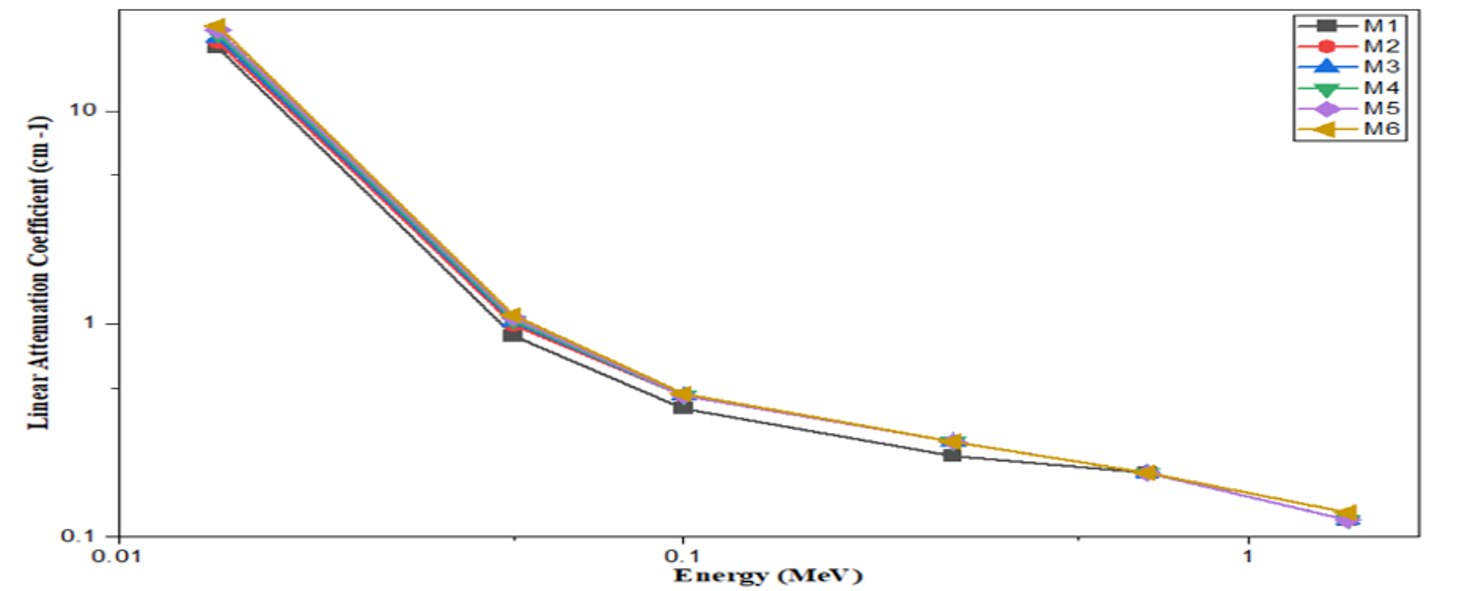
Radiation shielding materials that combine effective attenuations with environmental sustainability are increasingly being investigated as alternatives to conventional shielding materials. This study investigates the gamma-ray attenuation characteristics of granite doped with palm kernel shell ash (PKSA) using Monte Carlo simulation with the Tool for Particle Simulation (TOPAS), based on the Geant4 platform. Six composite samples (M1–M6), containing 0, 20, 40, 60, 80, and 100 wt.% PKSA, were investigated at photon energies of 0.015, 0.050, 0.100, 0.300, 0.662, and 1.500 MeV, with 1,000,000 photon histories used for each simulation. The linear attenuation coefficient (LAC) and mass attenuation coefficient (MAC) were calculated from the Beer–Lambert relation. Both LAC and MAC decreased noticeably with increasing photon energy for all samples, with the largest reduction occurring between 0.015 and 0.050 MeV. This behaviour mainly reflects the strong contribution of the photoelectric effect at low photon energies, while Compton scattering becomes increasingly important at higher energies. The attenuation coefficients generally increased with increasing PKSA content, with M6 exhibiting the highest LAC and MAC values, particularly at low photon energies. The differences among the composites became smaller at higher photon energies. The results indicates that PKSA incorporation can gradually improves the photon attenuation characteristics of granite-based composites, particularly at low photon energies.
References
Ajayi A. S., Oluwoye J., Olutoge F. A., & Coker A. O. (2019). “impact of palm kernel shell ash (pksa) on the strength and water absorption properties of earth blocks.” ASJ International Journal of Advances in Scientific Research and Reviews (IJASRR) 04(03), 129-135. https://www.researchgate.net/publication/383125451
Annadurai, G., Chaiphaksa, W., Mutuwong, C., Yonphan, S., Ruangtaweep, Y., Cheewasukhanont, W., Intachai, N., Tungjai, M., Kothan, S., Kim, H. J., & Kaewkhao, J. (2026). Lead-free glass for radiation shielding application by utilizing agricultural waste material: Organ-specific effective dose rate estimation. Radiation Physics and Chemistry, 238, 113137. https://doi.org/10.1016/j.radphyschem.2025.113137
Berger, M. J., Hubbell, J. H., Seltzer, S. M., Chang, J., Coursey, J. S., Sukumar, R., Zucker, D. S. & Olsen, K. (2010) XCOM: Photon cross sections database (Version 1.5). National Institute of Standards and Technology. https://doi.org/10.18434/T48G6X
Elsafi, M., Alrashedi, M. F., Sayyed, M. I., Al-Hamarneh, I. F., El-Nahal, M. A., El-Khatib, M., Khandaker, M. U., Osman, H., & Askary, A. E. (2021). The Potentials of Egyptian and Indian Granites for Protection of Ionizing Radiation. Materials, 14(14), 3928. https://doi.org/10.3390/ma14143928
Faddegon, B., Ramos-Méndez, J., Schuemann, J., McNamara, A., Shin, J., Perl, J., & Paganetti, H. (2020). The TOPAS tool for particle simulation, a Monte Carlo simulation tool for physics, biology and clinical research. Physica Medica, 72, 114–121. https://doi.org/10.1016/j.ejmp.2020.03.019
Farokhzad, R., Dadashi, A., & Sohrabi, A. (2021). Ferrophosphorus aggregates shielding properties on heavy concrete exposed to gamma rays from a caesium-137 source. Cement Wapno Beton, 26(4), 307–322. https://doi.org/10.32047/CWB.2021.26.4.4
Geidam, I. G., & Abdulsalam, H. (2026). Simulation of gamma radiation shielding parameters of borosilicate glass using Phy-X/PSD software. FUDMA Journal of Sciences, 10(13), 49–54. https://doi.org/10.33003/fjs-2026-1013-5561
Mansouri, E., Mesbahi, A., Malekzadeh, R., & Mansouri, A. (2020). Shielding characteristics of nanocomposites for protection against X- and gamma rays in medical applications: Effect of particle size, photon energy and nano-particle concentration. Radiation and Environmental Biophysics, 59(4), 583–600. https://doi.org/10.1007/s00411-020-00865-8
Najam, L. A., Hashim, A. K., Ahmed, H. A., & Hassan, I. M. (2016). Study the Attenuation Coefficient of Granite to Use It as Shields against Gamma Ray. Detection, 04(02), 33–39. https://doi.org/10.4236/detection.2016.42005
Perl, J., Shin, J., Schümann, J., Faddegon, B., & Paganetti, H. (2012). TOPAS: An innovative proton Monte Carlo platform for research and clinical applications. Medical Physics, 39(11), 6818–6837. https://doi.org/10.1118/1.4758060
Schümann, J., Paganetti, H., Shin, J., Faddegon, B., & Perl, J. (2012). Efficient voxel navigation for proton therapy dose calculation in TOPAS and Geant4. Physics in Medicine and Biology, 57(11), 3281–3293. https://doi.org/10.1088/0031-9155/57/11/3281
Ugbe, F. C., Adiela, U.-P., & Ebegbare, U. C. (2016). Major and Trace Element Geochemistry of Granites in Koji, Kogi State, Nigeria. Research Journal of Environmental and Earth Sciences, 8(1), 8–12. https://doi.org/10.19026/rjees.8.2697
Zadeh, K. M., Al-Ejji, M., Ponnamma, D., Abdulmalik, D. A., Iqbal, F., Hasnawi, D., Azoz, A., & Irshidat, M. (2025). Valorizations of recycled polymers/bottom ash composite for gamma attenuation and radiation shielding application. Scientific Reports, 15, 40817. https://doi.org/10.1038/s41598-025-24552-0
Zeng, C., Kang, Q., Duan, Z., Qin, B., Feng, X., Lu, H., & Lin, Y. (2023). Development of Polymer Composites in Radiation Shielding Applications: A Review. Journal of Inorganic and Organometallic Polymers and Materials, 33(8), 2191–2239. https://doi.org/10.1007/s10904-023-02725-6
Downloads
Published
Issue
Section
Categories
License
Copyright (c) 2026 Bethel Abako, Abdullahi Abubakar Mundi, Mohammed Mustapha Idris

This work is licensed under a Creative Commons Attribution 4.0 International License.


