
Phenotypic Detection and Prevalence of Plasmid-Mediated and Inducible -Lactamases in Gram-Negative Uropathogens from Kano State, Nigeria
DOI:
https://doi.org/10.33003/Keywords:
AmpC, Urinary tract infection, Gram-negative bacteria, uropathogensAbstract
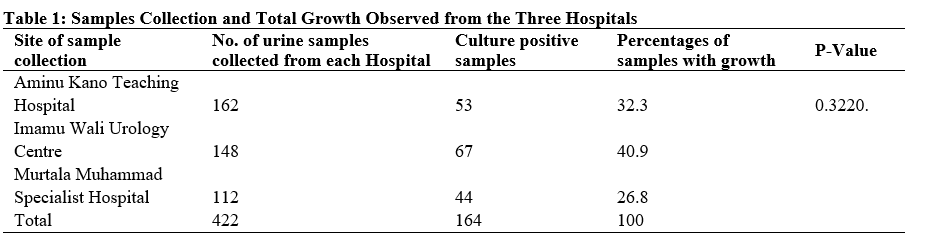
AmpC βlactamases inactivate cephamycin, cephalosporins, aminopenicillins, and monobactams; but are less inhibited by clavulanic acids. This study aimed to determine prevalence of Plasmid mediated AmpC and inducible AmpC producing Gram‑negative bacteria in urinary tract infected patients from Kano State, Nigeria. A cross-sectional study was conducted from Febuary to July 2026 at three hospitals in Kano (Aminu Kano Teaching Hospital, Imamu Wali urology centre and Murtala Muhammad Specialist Hospital, Kano) Nigeria.Urine samples were collected from 422 urinary tract infection (UTI) patients. Bacteria were isolated and identified using cultural and biochemical techniques. Plasmid mediated AmpC and Inducible AmpC β-lactamases production were detected using AmpC disc test and disc antagonism test respectively. A total of 164 (38.9%) Gram-negative uropathogens were isolated from the study participants. The age groups of the study participants ranged from 4 to 80 years and comprised of 68 male and 98 female. The most frequently isolated Gram-negative uropathogen was Escherichia coli with total occurrence of 50 (30.5%) while the least occurring was Acinetobacter baumanni with 1(0.6%). Plasmid mediated AmpC and inducible AmpC β-lactamases were seen in 29 (18.0%) and 7 (4.3%) of the total isolates respectively. This research highlights the high prevalence of Plasmid mediated AmpC and inducible AmpC producing bacteria in urinary tract infection in Kano, Nigeria. The findings underscore the need for effective infection control measures.
References
Abdus, S., Yusuf, A., Moushumi, T. S., Jogendra, S. P., Naseem, A., Ali, A. R., Mohammed, A . A. (2023). Antimicrobial Resistance: A Growing Serious Threat for Global Public Health. JournalsHealthcareVolume 11Issue 13 10.3390/healthcare11131946
Amina, A. R., Adamu, R. T., Abdulwahid, I. A., Yakubu, A. B., Yasir, A.M., Ibrahim, A. K and Tasiu, M (2026). Detection of Antibiotic Resistance in Gram-Negative Uropathogens Isolated from Urinary Tract Infected Patients in Kano State, Nigeria. Dutse Journal of Pure and Applied Sciences Vol. 12 (1a ): 44-53.
Ashok, A. K., Jaryal, S. C. , Thakur, K. , Sood, A. , Gupta, P. K., Thakur, S. (2016). Detection of Inducible and Non-inducible (constitutive) AmpC β-lactamaseproducing Gram-Negative Bacteria among Family Enterobacteriaceae by Two Phenotypic Methods-Disk Antagonism Test (DAT) and AmpC disk Test at a Tertiary Care Hospital, Himachal Pradesh, India. International Journal of Current Microbiology and Applied Sciences 5 (4): 133-139
Bergamin, P.A., Kiosoglous, A.J. (2017). Non-surgical management of recurrent urinary tract infections in women. Translational Andrology and Urology; 6( 2): S142-S152.
Black, J. A., Moland, E.S., Thomson, K.S. (2005). AmpC Disk Test for Detection of Plasmid-Mediated AmpC β -Lactamases in Enterobacteriaceae Lacking Chromosomal AmpC β -Lactamases. Journal of Clinical Microbiology. 43(7). 3110–3113.
Castanheira, M., Simner, P.J., Bradford, P.A. (2021). Extended-spectrum β-lactamases: An update on their characteristics, epidemiology and detection. JAC Antimicrobial Resistance.3 (3):dlab092. doi: 10.1093/jacamr/dlab092.
Cheesbrough, M. (2010). District Laboratory Practice in Tropical Countries. 2nd Edition, Cambridge University Press, Cambridge, United Kingdom: PP 96-115
Clinical laboratory standard institute (CLSI). (2024). Performance Standards for Antimicrobial Susceptibility Testing; Twenty-six Informational Supplement. CLSI document M100-S26. Clinical and Laboratory Standards Institute, 940 West Valley Road, Suite 1400, Wayne, Pennsylvania 19087 USA.
Daniel, W.W., Cross, C.L. (2013). Biostatistics: A foundation for analysis in the health sciences. 10th ed. New York: John Wiley & Sons: pp 185-187
Drekonja, D. (2024). Approach to the patient with urinary tract infection. In: Goldman L, Cooney KA, eds. Goldman-Cecil Medicine. 27th ed. Philadelphia, PA: Elsevier; :chap 263
Gupta, G., Tak, V., Mathur, P .(2014) Detection of AmpC β lactamases in gram-negative bacteria. Journal of Laboratory Physicians 6 ( Issue 1):7-11 https://doi.org/10.4103/0974-2727.12908
Hassan, A. O., Adebimpe, W.O., Fadeju,O. J., Ojo, T., Omisakin, A.O.(2018). Causative agents of Urinary Tract Infection and their antibiotic susceptibility pattern in a tertiary health institution. International Journal of Medicine and Biomedical Research 7(Issue 1): 40-51
Krzysztof , C., Magdalena, B., Justyna, T. (2021). Urinary tract infection in women. Menopause Review 20(1): 40-47. DOI: https://doi.org/10.5114/pm.2021.105382
Leber, A. L. (2016). Clinical microbiology procedures handbook (Fourth edition). Washington, DC: ASM Press 1752 N St., N.W.
McCann, E., Sung, A.H., Ye , G., Vankeepuram, L., Tabak, Y.P. (2020). Contributing Factors to the Clinical and Economic Burden of Patients with Laboratory-Confirmed Carbapenem-Nonsusceptible Gram-Negative Urinary Tract Infections. Clinical Outcomes Research. . 12:191–200.
Mulatu , G., Melkamu , B., Sisay . B,, Gebre , K., Lule , T., Yonas , Y., (2022). Emergence of high drug resistant bacterial isolates from patients with health care associated infections at Jimma University medical center: a cross sectional study. Antimicrobial Resistance & Infection Control volume 7, Article number: 138
Rajal, D. and Abhijeet, J. (2025). Occurrence of ESBL, AmpC-ESBL, and Carbapenemase Producer Organisms in Clinical Specimens: An Observational Prospective Study. J Pure Appl Microbiol. 2025;19(2):1541-1550. https://doi.org/10.22207/JPAM.19.2.59
Rao, M.J., Harle, S., Padmavathy, M. (2018). Prevalence of Extended Spectrum Beta-lactamases and AmpC beta-lactamases in clinical isolates of gram-negative bacilli at a tertiary care hospital. J Evol Med Dent. 2018;7 (39):2278-4748.
Satish, R. P., Karande, G.S., Ravindra, V. S., Satyajeet, K. P. (2025). Gram-negative uropathogens in diabetic patients: A study of ampicillinase cephalosporinase, extended-spectrum beta-lactamases, and metallo beta-lactamases producing phenotypes. Journal of pharmaceutical Bioallied Science 17( 3):S2569–S2571. doi: 10.4103/jpbs.jpbs_914_25
Serwecińska, L., Kiedrzyńska, E.. Kiedrzyński, M. (2021). A catchment-scale assessment of the sanitary condition of treated wastewater and river water based on fecal indicators and carbapenem-resistant Acinetobacter spp. Sci. Total Environ. 2021, 750, 142266
Soma, M., Avijit , M., Abhijit, B. (2023) . Detection of extended spectrum beta-lactamase producing organisms and its antibiotic resistance pattern among Enterobacteriaceae isolates in a teaching hospital of Eastern India. International Journal of Science and Technology, 04(01), 065–072
Wagenlehner, F.M., Bjerklund, J. T., Cai, T, Koves. B., Kranz, J., Pilatz, A., Tandogdu, Z. (2020). Epidemiology, definition and treatment of complicated urinary tract infections. Nat Rev Urol. 17(10): 586-600
WHO. (2026). Antimicrobial resistance. Available on https://www.who.int/news-room/fact-sheets/detail/antimicrobial-resistance.Retrieved on (16 July, 2026)
Yakubu, H., Muhammed, B., Mukhtar, M. D. and Kalgo, Z. M. (2022). Prevalence of extended-spectrum beta lactamase and ampc producing enterobacteriaceae among diabetic patients in Bauchi State, Nigeria. Bayero Journal of Pure and Applied Sciences, 13(1): 546 - 553
Downloads
Published
Issue
Section
Categories
License
Copyright (c) 2026 Adamu Rabiu Tsakuwa, Muhammad, Dauda Mukhtar, Magaji Magshi Abdulkadir, Isah Adamu Abdulwahid, Farida El. Hassan, Nura Sani Mujahid, Adamu Karfi Ibrahim, Isyaku Jamilu, Mahmud Tasiu

This work is licensed under a Creative Commons Attribution 4.0 International License.


