
Comparative Survival Analysis of HIV-Infected Patients across Gombe, Borno, and Taraba States, North-Eastern Nigeria
DOI:
https://doi.org/10.33003/fjs-2026-1016-5852Keywords:
Cox Regression, HIV/AIDS, Kaplan–Meier Estimator, Log-Rank Test, Survival AnalysisAbstract
HIV remains a major public-health concern in Nigeria, with survival outcomes potentially varying across states because of differences in access to care, treatment adherence, and follow-up services. However, limited evidence exists on comparative HIV/AIDS survival in Borno, Gombe, and Taraba States, North-Eastern Nigeria. This study assessed survival duration among patients with confirmed HIV/AIDS-related deaths across the three states and identified factors associated with earlier mortality.
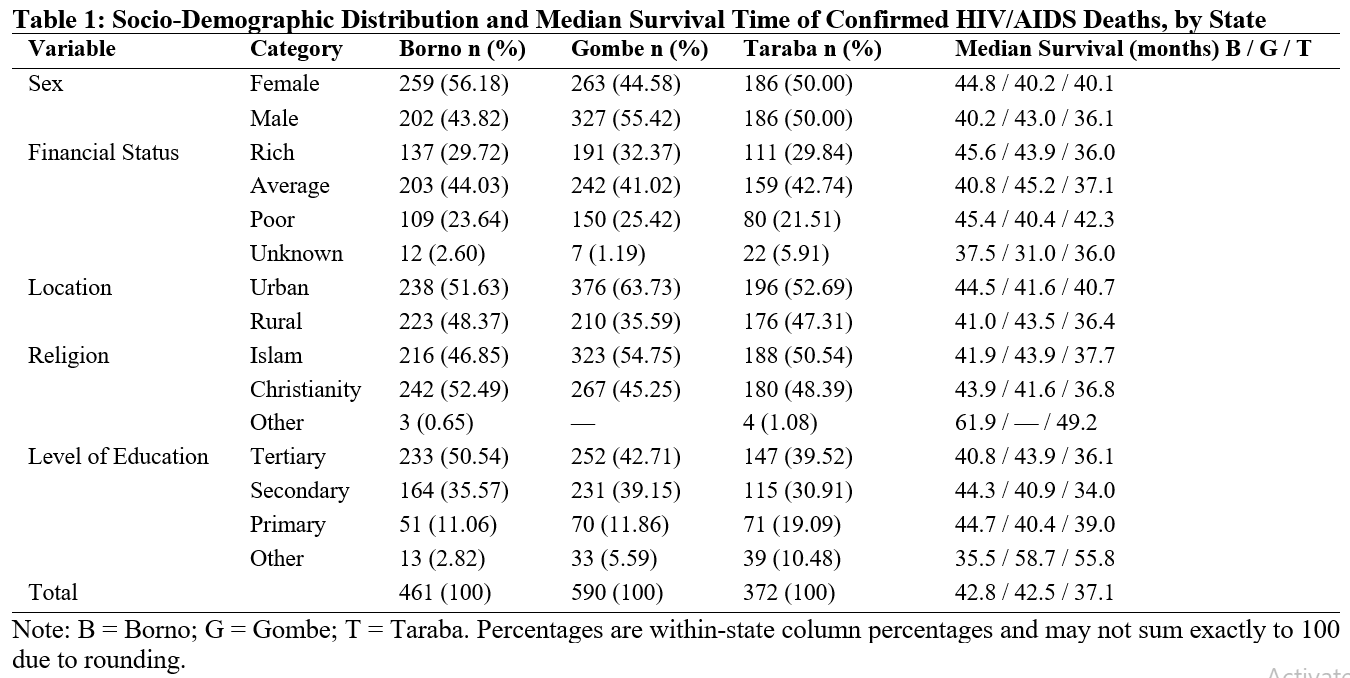
A retrospective study was conducted using health-facility records of 1,423 patients, comprising 461 from Borno, 590 from Gombe, and 372 from Taraba. Kaplan–Meier survival estimates, log-rank tests, and multivariable Cox proportional-hazards models were employed to estimate survival, compare survival patterns across states, and assess the effects of age, sex, financial status, residence, religion, and education.
Median survival times were 42.8 months in Borno, 42.5 months in Gombe, and 37.1 months in Taraba. Survival differed significantly among the three states (p < 0.001). In Borno, male patients had a significantly higher risk of death than females (p = 0.004). In Gombe, patients with secondary education had a significantly higher risk of death than those with tertiary education (p = 0.010). None of the variables included in the model significantly predicted survival in Taraba.
The findings demonstrate substantial differences in HIV/AIDS survival across the three states. State-specific interventions are recommended, including strengthened ART-adherence support in Taraba, targeted support for vulnerable groups, and improved documentation of patient outcomes to enhance HIV care and survival in North-Eastern Nigeria. These measures may help reduce preventable mortality and improve treatment outcomes.
References
Collett, D. (2015). Modelling survival data in medical research (3rd Ed.). CRC Press.
Cox, D. R. (1972). Regression models and life-tables. Journal of the Royal Statistical Society: Series B (Methodological), 34(2), 187–220.
Eguzo, K. N., Lawal, A. K., Eseigbe, C. E., & Umezurike, C. C. (2014). Determinants of mortality among adult HIV-infected patients on antiretroviral therapy in a rural hospital in Southeastern Nigeria: A 5-year cohort study. AIDS Research and Treatment, 2014, Article 867827. https://doi.org/10.1155/2014/867827
Hosmer, D. W., Lemeshow, S., & May, S. (2008). Applied survival analysis: Regression modeling of time-to-event data (2nd Ed.). John Wiley & Sons.
Kaplan, E. L., & Meier, P. (1958). Nonparametric estimation from incomplete observations. Journal of the American Statistical Association, 53(282), 457–481. https://doi.org/10.1080/01621459.1958.10501452
Kleinbaum, D. G., & Klein, M. (2012). Survival analysis: A self-learning text (3rd Ed.). Springer.
Maria, F., Ligia, R. Rosa, S., & Marcondes, C. (2001). Survival of adult AIDS patients in a reference referral hospital of a metropolitan area in Brazil. Revista de Saúde Pública, 36(3), 278–284. https://doi.org/10.1590/S0034-89102002000300004
Mohammed, M. B., Umar, A. M., Sauta, A. S., & Sanusi, A. A. (2026). Statistical analysis of time spent by HIV/AIDS patients from infection to death in North-Eastern Nigeria. The Egyptian Statistical Journal, 70(1), 34–47. https://doi.org/10.21608/esju.2026.420707.1124
Sieleunou, I., Souleymanou, A. M., Schönenberger, J., Menten, J., & Boelaer, M. (2009). Determinants of survival in AIDS patients on antiretroviral therapy in a rural centre in the Far-North Province, Cameroon. Tropical Medicine and International Health, 14(1), 36–43. https://doi.org/10.1111/j.1365-3156.2008.02183.x
Todd, S. R., McNally, M. M., Holcomb, J. B., Kozar, R. A., Kao, L. S., Gonzalez, E. A., Cocanour, C. S., Vercruysse, G. A., Lygas, M. H., Brasseaux, B. K., & Moore, F. A. (2006). A multidisciplinary clinical pathway decreases rib fracture-associated infectious morbidity and mortality in high-risk trauma patients. American Journal of Surgery, 192(6), 806–811. https://doi.org/10.1016/j.amjsurg.2006.08.048
Udoh, E. E., Musa, A. Z., Olowolafe, T. A., Obi, C. O., Fajemisin, O., & Jaiyeola, T. M. (2025). Antiretroviral treatment outcomes and survival pattern of people living with HIV in Bauchi State, Nigeria. PLOS ONE, 20(9), Article e0333106. https://doi.org/10.1371/journal.pone.0333106
UNAIDS. (2023). Global HIV & AIDS statistics — Fact sheet. https://www.unaids.org
World Health Organization. (2022). Guidelines for managing advanced HIV disease and rapid initiation of antiretroviral therapy. https://www.who.int
Downloads
Published
Issue
Section
Categories
License
Copyright (c) 2026 Mohammed Bappah Mohammed, Adamu Mustapha Umar, Abdulkadir Sa’idu Sauta, Abdulmuahymin Abiola Sanusi, Aliyu Muhammad

This work is licensed under a Creative Commons Attribution 4.0 International License.


