
DNA Barcoding of Amaranthus Hybridus Using Rpoc1 Chloroplast DNA Region
DOI:
https://doi.org/10.33003/fjs-2026-1016-5851Keywords:
Amaranthus hybridus;, Molecular identification, Phylogeny, DNA barcoding, rpoC1Abstract
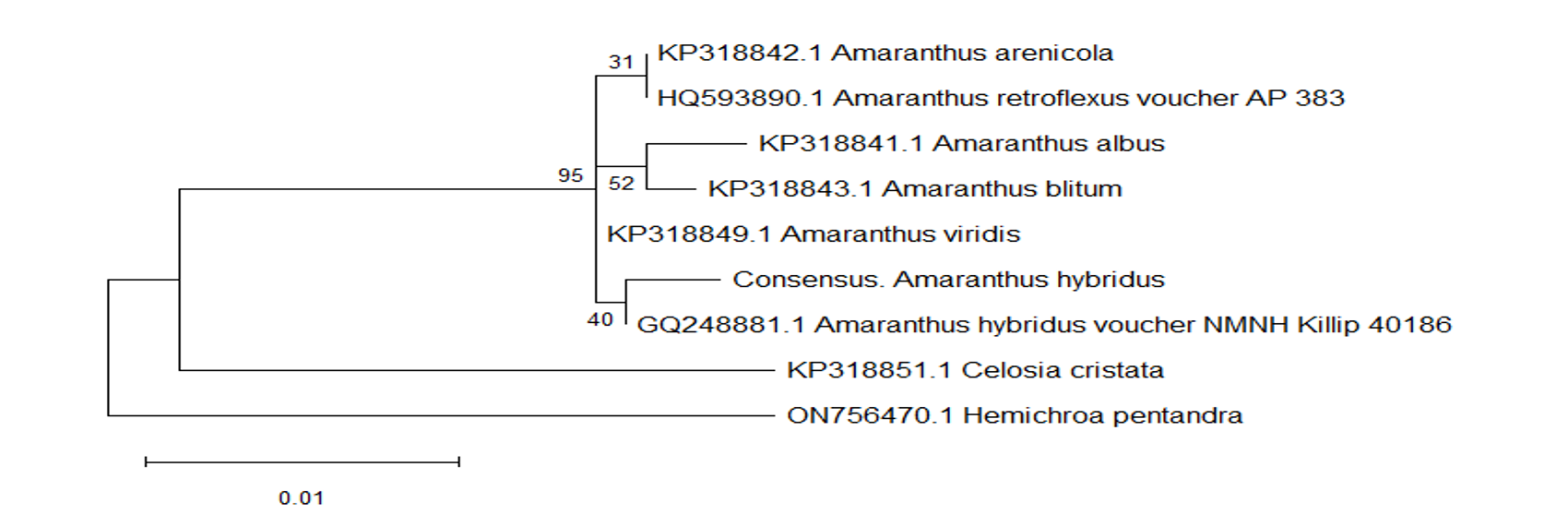
Amaranthus hybridus L. (green amaranth) is an important leafy vegetable widely consumed in Nigeria and valued for its nutritional and medicinal purposes. However, accurate identification of the species can be difficult because of its morphological similarity to other Amaranthus species. This study employed DNA barcoding to identify and characterize A. hybridus using the chloroplast rpoC1 gene region. Young leaf samples were collected from A. hydridus grown at the department of Plant Biology, University of Ilorin, from seeds obtained from NACGRAB,Ibadan. Genomic DNA was extracted using the ZymoBIOMICS DNA Miniprep Kit and the rpoC1 region was amplified using universal rpoC1F and rpoC1R primers. The amplified products were sequenced using the Sanger sequencing method. The resulting sequences were edited and assembled using SeqTrace while BLAST analysis was performed against sequences in the NCBI GenBank database. Phylogenetic analysis was conducted using the Maximum Likelihood method in MEGA 12. A consensus sequence of 531 bp was obtained. BLAST analysis showed100% sequence identity with a reference A. hybridus sequence (GQ248881.1) confirming the identity of the sample. The phylogenetic analysis also placed the study sample with the reference A. hybridus sequence with a strongly supported Amaranthusi clade (96% bootstrap support). The study confirms the usefulness of the rpoC1 gene region for identifying A.hydridus and provides additional molecular data for species. The findings may support plant identification and biodiversity documentation of Amaranthus based products. Further studies using multiple barcode regions are recommended to improve discrimination among closely related species.
References
Abdulkareem, K.A., Abdullateef, R., Bello, A., Sidiq, K.O., Tsoho, S.B., Kareem, I., Audu, M.A.I., Kolo, J.T., & Koiki, O.A. (2025A). DNA barcoding of Solanum melongena using RBCL gene region. Agriculture and Forestry Journal, 9(1): 40–47. https://doi.org/10.46325/afj.v9i1.183
Abdulkareem, K.A., Ajibade, Y.A., Yusuff, R.A., Bello, A., Sidiq, K.O., Olayinka, B.U., Lateef, A.A., Kareem, I., & Danzaki, M.M. (2025B). DNA barcoding of Adansonia digitata using multi-loci gene regions (ITS, rbcL, rpoC1 and psbA-trnH). Science Journal of University of Zakho, 13(3): 302–314. https://doi.org/10.25271/sjuoz.2025.13.3.1511
Abdulkareem, K.A., Elebiyo, P.T., Olayinka, B.U., Tiamiyu, B.B., Kareem, I., Danzaki, M.M., & Mustapha, O.T. (2023). DNA barcoding of Vernonia amygdalina using ITS and rpoC1 multi loci gene regions. Savanna Journal of Basic and Applied Sciences, 5(2): 143–156.
Achigan-Dako, E.G., Sogbohossou, O.E.D., & Maundu, P. (2014). Current knowledge on Amaranthus spp.: research avenues for improved nutritional value and yield in leafy amaranths in sub-Saharan Africa. Euphytica, 197(3): 303–317.
Aderibigbe, O.R., Ezekiel, O.O., Owolade, S.O., Korese, J.K., Sturm, B., & Hensel, O. (2021). Exploring the potentials of underutilized grain amaranth (Amaranthus spp.) along the value chain for food and nutrition security: A review. Critical Reviews in Food Science and Nutrition, 62(3): 656–669. https://doi.org/10.1080/10408398.2020.1825323
Ali, M.A., Gyulai, G., Hidvegi, N., Kerti, B., Al Hemaid, F.M.A., Pandey, A.K., & Lee, J. (2014). The changing epitome of species identification DNA barcoding. Saudi Journal of Biological Sciences, 21(3): 204–231. https://doi.org/10.1016/j.sjbs.2014.03.003
Bharali, R., Ramchiary, N., & Singh, M. (2021). Amaranthus hybridus L.: an emerging food plant with nutraceutical importance in human health management. In: Nutritional Value of Amaranth, IntechOpen. https://doi.org/10.5772/intechopen.97000
CBOL Plant Working Group. (2009). A DNA barcode for land plants. Proceedings of the National Academy of Sciences, 106(31): 12794–12797. https://doi.org/10.1073/pnas.0905845106
Dong, W., Liu, J., Yu, J., Wang, L., & Zhou, S. (2012). Highly variable chloroplast markers for evaluating plant phylogeny at low taxonomic levels and for DNA barcoding. PLoS ONE, 7(4): e35071. https://doi.org/10.1371/journal.pone.0035071
Fazekas, A.J., Kesanakurti, P.R., Burgess, K.S., Percy, D.M., Graham, S.W., Barrett, S.C.H., Newmaster, S.G., Hajibabaei, M., & Husband, B.C. (2012). Are plant species inherently harder to discriminate than animal species using DNA barcoding markers? Molecular Ecology Resources, 9(s1): 130–139. https://doi.org/10.1111/j.1755-0998.2009.02652
Hebert, P.D.N., Cywinska, A., Ball, S.L., & deWaard, J.R. (2003). Biological identifications through DNA barcodes. Proceedings of the Royal Society B: Biological Sciences, 270(1512): 313–321. https://doi.org/10.1098/rspb.2002.2218
Jimoh, M.O., & Oladiji, A.T. (2022). Proximate, mineral and phytochemical composition of Amaranthus hybridus L. and Amaranthus cruentus L. leaf vegetables from Nigeria. Food Science and Nutrition, 10(4): 1121–1132. https://doi.org/10.1002/fsn3.2756
Kress, W.J., & Erickson, D.L. (2007). A two-locus global DNA barcode for land plants: the coding rbcL gene complements the non-coding trnH-psbA spacer region. PLoS ONE, 2(6): e508. https://doi.org/10.1371/journal.pone.0000508
Kumar, S., Stecher, G., Suleski, M., Sanderford, M., Sharma, S., & Tamura, K. (2024). Molecular Evolutionary Genetics Analysis Version 12 for adaptive and green computing. Molecular Biology and Evolution, 41: 1–9. https://doi.org/10.1093/molbev/msae263
Linh, N.N., Hang, P.L.B., Hue, H.T.T., Ha, N.H., Hanh, H.H., Ton, N.D., & Hien, L.T.T. (2022). Species discrimination of novel chloroplast DNA barcodes and their application for identification of Panax (Aralioideae, Araliaceae). PhytoKeys, 188: 1–18. https://doi.org/10.3897/phytokeys.188.75937
Moghaddam, S.M., Sato, S., Jaeger, S., Bhattacharya, C., Dorn, K.M., Liu, J., & Bhattacharya, S. (2023). Amaranthus hybridus: a review of its importance as food, feed and medicine in different countries. Frontiers in Sustainable Food Systems, 7: 1152531. https://doi.org/10.3389/fsufs.2023.1152531
Stetter, M.G., & Schmid, K.J. (2017). Analysis of phylogenetic relationships and genome size evolution of the Amaranthus genus using GBS indicates the ancestors of an ancient crop. Molecular Phylogenetics and Evolution, 109: 80–92. https://doi.org/10.1016/j.ympev.2016.12.029
Tamura, K., & Nei, M. (1993). Estimation of the number of nucleotide substitutions in the control region of mitochondrial DNA in humans and chimpanzees. Molecular Biology and Evolution, 10(3): 512–526.
Tiamiyu, B.B., Lateef, A.A., Sagaya, A., AbdulKareem, K.A., Olayinka, B.U., Ayinla, A., Adeyemi, S.B., Amenu, S.G., AbdulRahaman, A.A., & Mustapha, O.T. (2024). Phylogenetic position of Nigerian species of Curcuma longa (Zingiberaceae) in the current infrageneric classification. Fountain Journal of Natural and Applied Sciences, 13(1): 15–22.
Xu, H., Guo, Y., Xia, M., Yu, J., Chi, X., Han, Y., Li, X., & Zhang, F. (2024). An updated phylogeny and adaptive evolution within Amaranthaceae s.l. inferred from multiple phylogenomic datasets. Ecology and Evolution, 14: e70013. https://doi.org/10.1002/ece3.70013
Downloads
Published
Issue
Section
Categories
License
Copyright (c) 2026 Khadijah Abdulkareem, Ayantayo Precious, Shehu Tsoho, Khalilrahman Sidiq, Abdultoyyib Bello, Koiki Abdulrasheed, Oba Mustapha

This work is licensed under a Creative Commons Attribution 4.0 International License.


