
ATRAS: An Adaptive Traffic- and Security-Aware Resource Allocation Scheme for eMBB, URLLC, and mMTC Coexistence in 5G Heterogeneous Networks
DOI:
https://doi.org/10.33003/fjs-2026-1016-5850Keywords:
5G heterogeneous networks, traffic-aware scheduling, security-aware resource allocation, average delay, packet drop ratio, Qos-Spoofing And Flooding DetectionAbstract
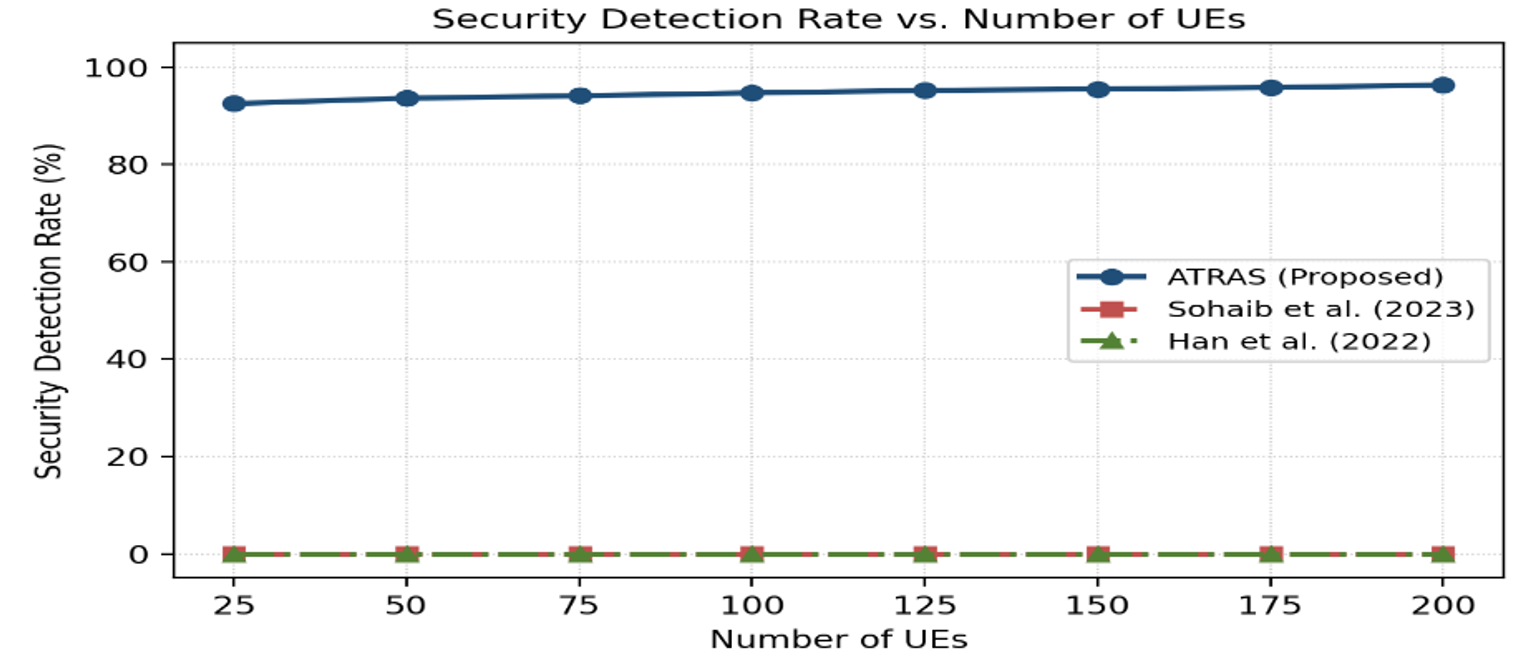
Most existing 5G resource allocation schemes address only one or two of the eMBB, URLLC, and mMTC use cases, apply static, service-level prioritization that favours one class over the others, and assume every UE reports its traffic class and congestion state truthfully, an assumption that leaves adaptive, priority-based allocation open to UEs that spoof a higher-priority QoS class or flood the network with false delay signals to trigger unwarranted resource pre-emption. This paper proposes the Adaptive Traffic- and Security-Aware Resource Allocation Scheme (ATRAS), an inter-use-case scheme that assigns resource blocks to eMBB, URLLC, and mMTC by priority weight, dynamically pre-empts a bounded share from the lowest-priority use case only when the URLLC delay budget is genuinely at risk, and screens every pre-emption trigger against the requesting UE's authenticated QoS class and its recent triggering history before acting, rejecting requests that look spoofed or flood-induced. ATRAS was evaluated through MATLAB-based simulation under a mission-critical industrial traffic mix and benchmarked against two recent eMBB–URLLC schemes, neither security-aware, using average delay, packet drop ratio, nor a new security detection rate across loads of 25 to 200 UEs. Results show ATRAS sustains lower delay and drop ratio than both benchmarks, with the margin reaching roughly 32% and 42% at 200 UEs, while correctly detecting over 90% of spoofed or flood-induced pre-emption attempts at every load tested.
References
Ahmad, A., Paul, A., Khan, M., Jabbar, S., Rathore, M. N., Chilamkurti, N., & Min-Allah, N. (2017). Energy-efficient hierarchical management for mobile cloud computing. IEEE Transactions on Sustainable Computing, 2(2), 100–112.
Alencar, D., Both, C., Antunes, R., Oliveira, H., Cerqueira, E., & Rosário, D. (2021). Dynamic microservice allocation for virtual reality distribution with QoE support. IEEE Transactions on Network and Service Management, 19(1), 729–740.
Benmadani, E. H., Azni, M., Essa Alharbi, T., Alzaidi, M. S., & Tounsi, M. (2025). Deep reinforcement learning-based dynamic scheduling for real-time applications in LTE and RAN slicing for eMBB in 5G. IEEE Access, 13, 33555–33570. https://doi.org/10.1109/access.2025.3541531
Beshley, H., Beshley, M., Medvestskyi, M., & Pyrih, J. (2021). QoS-aware optimal radio resource allocation method for machine-type communications in 5G LTE and beyond cellular networks. Wireless Communications and Mobile Computing, 2021, 1–18.
Chen, M., Liang, B., & Dong, M. (2018). Multi-user multi-task offloading and resource allocation in mobile cloud systems. IEEE Transactions on Wireless Communications, 17(10), 6790–6805.
Desogus, C., Anedda, A., Murroni, M., & Muntean, G. (2019). A traffic type-based differentiated reputation algorithm for radio resource allocation during multi-service content delivery in a 5G heterogeneous scenario. IEEE Access, 7, 27720–27735.
Fu, X., Shen, Q., Yang, B., & Gao, X. (2024). Dynamic provisioning of random-access capacity in mMTC slice based on beam splitting/merging. IEEE Internet of Things Journal, 11(2), 3331–3347. https://doi.org/10.1109/jiot.2023.3296148
Ghanem, W. R., Jamali, V., Sun, Y., & Schober, R. (2020). Resource allocation for multi-user downlink MISO OFDMA-URLLC systems. IEEE Transactions on Communications, 68(11), 1–18.
Guo, J., Durrani, S., Zhou, X., & Yanikomeroglu, H. (2017). Massive machine type communication with data aggregation and resource scheduling. IEEE Transactions on Communications, 65(9), 4012–4026.
Gupta, R. K., Kumar, S., & Misra, R. (2022). Resource allocation for UAV-assisted 5G mMTC slicing networks using deep reinforcement learning. Telecommunication Systems, 82(1), 141–159. https://doi.org/10.1007/s11235-022-00974-3
Han, X., Xiao, K., Liu, R., Liu, X., Alexandropoulos, G. C., & Jin, S. (2022). Dynamic resource allocation schemes for eMBB and URLLC services in 5G wireless networks. Intelligent and Converged Networks, 3(2), 145–160.
Han, Y., Elayoubi, S. E., Serrano, A. G., Varma, V. S., & Messai, M. (2018). Periodic radio resource allocation to meet latency and reliability requirements in 5G networks. Proceedings of the 87th IEEE Vehicular Technology Conference (VTC), Porto, Portugal, 1–6.
Huang, R., Wushao, W., Zhi, Z., Chongwu, D., & Xu, C. (2025). MEC-enabled task replication with resource allocation for reliability-sensitive services in 5G mMTC networks. IEEE Transactions on Services Computing, 18(1), 253–269.
Ibrahim, S., Younis, Y. S., Hamza, K. S., & Ashour, M. M. (2025). Improving resource allocation in 5G networks using traffic segmentation based on machine learning techniques. International Journal of Telecommunications, 5(1), 1–15. https://doi.org/10.21608/ijt.2025.372415.1095
Khadidos, A. O., Manoharan, H., Selvarajan, S., Khadidos, A. O., Alshareef, A. M., & Altwijri, M. (2024). Distribution of resources beyond 5G networks with heterogeneous parallel processing and graph optimization algorithms. Cluster Computing, 27(6), 8269–8287. https://doi.org/10.1007/s10586-024-04367-w
Kumar, R., Sinwar, D., & Singh, V. (2024). QoS aware resource allocation for coexistence mechanisms between eMBB and URLLC: Issues, challenges, and future directions in 5G. Computer Communications, 213, 208–235. https://doi.org/10.1016/j.comcom.2023.10.024
Madi, N. K. M., Nasrallah, M. M., & Hanapi, Z. M. (2022). Delay-based resource allocation with fairness guarantee and minimal loss for eMBB in 5G heterogeneous networks. IEEE Access, 10, 75619–75636.
Mamane, A., Fattah, M., Ghazi, M., Bekkali, M., Balboul, Y., & Mazer, S. (2022). Scheduling algorithms for 5G networks and beyond: Classification and survey. IEEE Access, 10, 51643–51661.
Nasir, A. A., Tuan, H. D., Nguyen, H. H., Debbah, M., & Poor, H. V. (2021). Resource allocation and beamforming design in short blocklength regime for URLLC. IEEE Transactions on Wireless Communications, 20(2), 1321–1335.
Ren, H., Pan, C., Deng, Y., Elkashlan, M., & Nallanathan, A. (2019). Resource allocation for URLLC in 5G mission-critical IoT networks. Proceedings of the 2019 IEEE International Conference on Communications (ICC), Shanghai, China, 1–6.
Scalise, P., Boeding, M., Hempel, M., Sharif, H., Delloiacovo, J., & Reed, J. (2024). A systematic survey on 5G and 6G security considerations, challenges, trends, and research areas. Future Internet, 16(3), 67. https://doi.org/10.3390/fi16030067
Shekhar, C., & Singh, P. (2024). Optimization of resource allocation in 5G networks: A network slicing approach with hybrid NOMA for enhanced uRLLC and eMBB coexistence. International Journal of Communication Systems, 2024(3), 1–24. https://doi.org/10.21203/rs.3.rs-4275233/v1
Shirvani Moghaddam, S. (2024). The past, present, and future of the internet: A statistical, technical, and functional comparison of wired/wireless fixed/mobile internet. Electronics, 13, 1986. https://doi.org/10.20944/preprints202404.1855.v1
Sohaib, R. M., Onireti, O., Sambo, Y., Swash, R., Ansari, S., & Imran, M. A. (2023). Intelligent resource management for eMBB and URLLC in 5G and beyond wireless networks. IEEE Access, 11, 65205–65221. https://doi.org/10.1109/access.2023.3288698
Souza, C., Falcão, M., Balieiro, A., Alves, E., & Taleb, T. (2025). Dynamic resource allocation for URLLC and eMBB in MEC-NFV 5G networks. Computer Networks, 260, 111127. https://doi.org/10.1016/j.comnet.2025.111127
Sufyan, A., Khan, K. B., Khashan, O. A., Mir, T., & Mir, U. (2023). From 5G to beyond 5G: A comprehensive survey of wireless network evolution, challenges, and promising technologies. Electronics, 12(10), 2200. https://doi.org/10.3390/electronics12102200
Weerasinghe, T. N., Casares-Giner, V., Balapuwaduge, I. A. M., & Li, F. Y. (2021). Priority enabled grant-free access with dynamic slot allocation for heterogeneous mMTC traffic in 5G NR network. IEEE Transactions on Communications, 69(5), 3192–3206.
Wu, Q., Wang, W., Fan, P., Fan, Q., Wang, J., & Letaief, K. B. (2024). URLLC-aware resource allocation for heterogeneous vehicular edge computing. IEEE Transactions on Vehicular Technology, 73(8), 11789–11805. https://doi.org/10.1109/tvt.2024.3370196
Downloads
Published
Issue
Section
Categories
License
Copyright (c) 2026 Maniru Malami Umar, Abdulhakeem Abdulazeez, Sadiq Aliyu Ahmad

This work is licensed under a Creative Commons Attribution 4.0 International License.


