
Numerical Investigation of Seasonal Performance of an Indirect Solar Dryer Using CFD
DOI:
https://doi.org/10.33003/fjs-2026-1015-5848Keywords:
Indirect Solar Dryer, Numerical Simulation, Seasonal Performance, Flow Velocity, Temperature DistributionsAbstract
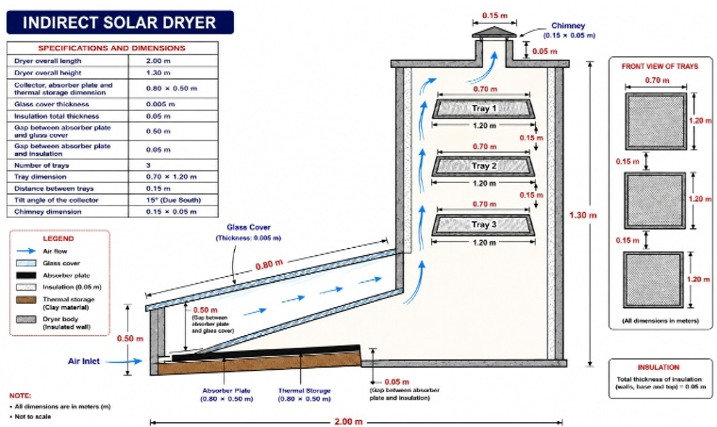
This study presents a numerical investigation of the seasonal performance of an indirect solar dryer using computational fluid dynamics (CFD) in COMSOL Multiphysics 5.6. The simulated dryer was evaluated for the dry, harmattan and rainy seasons in Kano, Northwestern Nigeria using outlet air velocity and temperature distribution as the principal performance indicators. At 35 min of simulation time, the predicted maximum outlet velocities were 27.9 m/s, 23.5 m/s and 22.8 m/s for the dry, harmattan and rainy seasons respectively. The corresponding seasonal ambient temperatures used as simulation inputs were 36.0 °C, 31.75 °C and 32.0 °C. The simulations produced maximum temperature values of 416.71 K, 399.19 K and 388.15 K for the dry, harmattan and rainy seasons respectively. These peak values are the maximum velocity outlet and temperature distribution predicted by the CFD model and the results indicate that seasonal environmental conditions substantially influence the predicted airflow and thermal fields of the dryer with the dry season producing the highest outlet velocity and temperature values. The study demonstrates the usefulness of CFD for assessing seasonal airflow and thermal behaviour of an indirect solar dryer before physical construction.
References
Agyeman, Emmanuel Kwadwo Kale; Duret, Steven; Flick, Denis; Laguerre, Onrawee; Moureh, Jean. (2023). Computational Modelling of Airflow and Heat Transfer during Cooling of Stacked Tomatoes: Optimal Crate Design. Energies, 16, 2048. https://doi.org/10.3390/en16042048.
Alvarado-Rodríguez, Carlos Eduardo; Díaz-Damacillo, Lamberto; Plaza, Eric; & Di G. Sigalotti, Leonardo. (2023). Smoothed particle hydrodynamics simulations of porous medium flow using Ergun’s fixed-bed equation. Water, 15(13), 2358. https://doi.org/10.3390/w15132358.
Aukah, J., Muvengei, M., Ndiritu, H., & Onyango, C. (2020). Prediction of airflow and temperature distribution in hybrid solar-biomass dryer using computational fluid dynamics. Journal of Sustainable Research in Engineering, 4(3), 76–89.
Beyene, T. (2017). Design and Simulation of Forced Solar Coffee Dryer Using Computational Fluid Dynamics (CFD). Journal of Science, Technology and Arts Research, 6(3), 1–17. https://doi.org/10.20372/star.v6i3.406
Demissie, P., Mesele, H., Amanuel, K., Hailesilassie, A., Gebrehiwot, M., & Vanierschot, M. (2019). Design, development and CFD modeling of indirect solar food dryer. Energy Procedia, 158, 1128–1134. https://doi.org/10.1016/j.egypro.2019.01.278.
Desmond Adair and Martin Jaeger (2019) An Efficient Strategy to Deliver Understanding of Both Numerical and Practical Aspects When Using Navier-Stokes Equations to Solve Fluid Mechanics Problems. Fluids, 4(4), 178. DOI: DOI: https://doi.org/10.3390/fluids4040178
Halefom Kidane, Istvan Farkas, Janos Buzás (2025) Modeling airflow dynamics in solar drying chambers: a comprehensive review of CFD applications. Discover Applied Sciences, DOI: https://doi.org/10.1007/s42452-025-06894-6.
Li, Xin; Zhong, Wei; Liao, Yuxuan; Xu, Ke; Tao, Guoliang; & Kagawa, Toshiharu. (2016). Determination of pressure drop for air flow through sintered metal porous media using a modified Ergun equation. Advanced Powder Technology, 27(4), 1134–1140. https://doi.org/10.1016/j.apt.2016.03.024.
Marcato, A., Boccardo, G., & Marchisio, D. (2022). From computational fluid dynamics to structure interpretation via neural networks: An application to flow and transport in porous media. Industrial & Engineering Chemistry Research, 61(24), 8530–8541. https://doi.org/10.1021/acs.iecr.1c04760.
Muhammad Aqil Afham Rahmat, Adnan Ibrahim, Muhammad Amir Aziat Ishak, Ubaidah Syafiq, Khaled M. Al-Aribe (2025). Numerical investigation of thermal and airflow profiles in diverse solar dryer chamber configurations. Case Studies in Thermal Engineering, 73, 106612. https://doi.org/10.1016/j.csite.2025.106612.
Müller, L. C. (2024). Enhancing post-harvest preservation through improved and even solar drying: A case study in Bhutan. Department of Energy Sciences, Lund University. https://doi.org/10.1093/fqsafe/fyy010.
Olabode, O.H., Musa, J.G., Musa, H., & Samuel, A.A. (2023) Assessing the Influence of Agro-climatic Factors on Solar Dryer Performance: Review Study of Zaria Kaduna State, Nigeria. International Journal of Academic Multidisciplinary Research, 7(11), 109–125.
Patterson, J. (2018). Effect of drying technologies on the biochemical properties of Stolephorus commersonnii. Food Quality and Safety, 2(3), 153–158.
Zhong, Wei; Li, Xin; Tao, Guoliang; & Kagawa, Toshiharu. (2015). Measurement and determination of friction characteristic of air flow through porous media. Metals, 5(1), 336–349. https://doi.org/10.3390/met5010336
Downloads
Published
Issue
Section
Categories
License
Copyright (c) 2026 Nomau Sabiyel Anas, Muhammad Gana Umar

This work is licensed under a Creative Commons Attribution 4.0 International License.


