
Smart Single-Phase Energy Metering With Multi-User Unit-Sharing: A Systematic Literature Review
DOI:
https://doi.org/10.33003/fjs-2026-1016-5843Keywords:
Smart Metering, Multi-User Allocation, Prepaid Electricity Meter, Electricity Equity, Systematic ReviewvAbstract
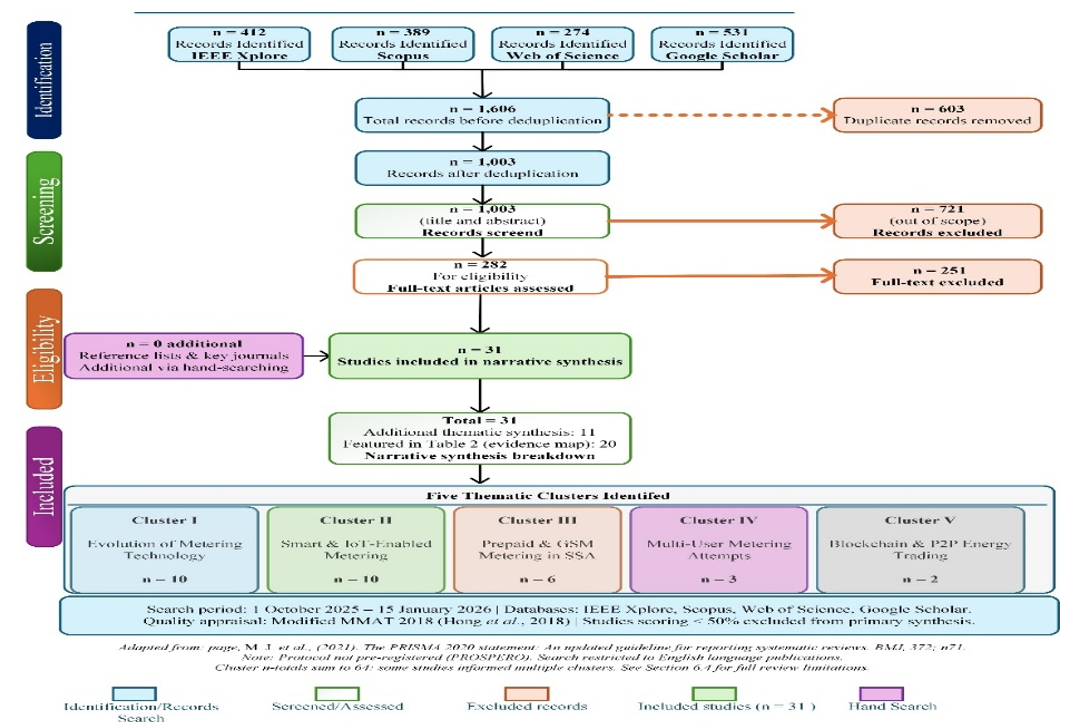
Key issue with multi-tenant residential systems is the inability to fairly and accurately measure electricity use with a prepaid meter in developing economies. Prepaid meters measure electricity consumption at the individual household unit level, but cannot divide up the electricity consumed by multiple independent household units fairly and accurately. Recent advances are coupled with new smart and Internet of Things (IoT) technologies, Global System for Mobile Communications (GSM) and smart metering applications. Consequently, there is a need to discuss the applicability of the new solutions to address problems of multi-user allocation, cost, connectivity and electricity equity. Many studies were searched based on PRISMA 2020 guidelines using IEEE Xplore, Scopus, Web of Science and Google Scholar. A full-text screening was completed for 1003 records and a narrative synthesis of 31 peer-reviewed studies. Quality appraisal was done using a modified MMAT 2018, and the scores were then summarised in five thematic clusters: metering evolution, smart and IoT metering, prepaid/GSM systems, multi-user metering and Blockchain (peer-to-peer energy trading). The review found that though smart and prepaid meters can provide good improvements, there is no low-cost single-phase meter with the ability to provide an independent user disconnection. Furthermore, realtime individual feedback and an equitable per-user unit allocation, which satisfies the accuracy requirements of IEC 62053-21:2020 were explored. The outcome was a huge techno-social issue that need the development of a Smart Single-Phase Energy Meter with Multi-Unit-Sharing Capability for shared residential environment in developing economies.
References
Adebisi, O. I., Adejumobi, I. A., Matthew, S., & Abdulsalam, A. A. (2022). Development of a web-based single-phase load monitoring and auditing system. International Journal of Electrical and Computer Engineering, 12(6): 6785–6795. http://doi.org/10.11591/ijece.v12i6.pp6785-6795
Akasoro, O. I., Ige-Adeyeye, A. A., Coker, J. O., Ogunji, A. B., Atilade, A. O. & Salaam, M. A. (2023). Design and construction of a multi-user prepaid meter. Nigerian Journal of Theoretical and Environmental Physics, 1(1): 51–59. https://doi.org/10.62292/njtep.v1i1.2023.10
Amhenrior, H. E., Oloma, I. & Ikharo, B. A. (2022). Design and implementation of a GSM and Wi-Fi based low cost smart prepaid energy meter. In: Proceedings of the 2022 5th Information Technology for Education and Development Conference (ITED), Abuja, Nigeria. https://doi.org/10.1109/ITED56637.2022.10051577
Arshi, O., Rai, A., Gupta, G., Pandey, J. K. & Mondal, S. (2024). IoT in energy: A comprehensive review of technologies, applications, and future directions. Peer-to-Peer Networking and Applications, 17(5): 2830–2869. https://doi.org/10.1007/s12083-024-01725-8
Ayamba, K., Ofori-Boateng, C. & Mensah, P. (2025). Exploring community acceptance of electricity smart metering in urban slums in Ghana. Advances in Engineering Research, 286: 112–124. https://doi.org/10.2991/978-94-6463-970-4_27
Cetina, Q., Roscoe, R. A. J. & Wright, P. S. (2017). Challenges for smart electricity meters due to dynamic power quality conditions of the grid: A review. In: Proceedings of the 2017 IEEE International Workshop on Applied Measurements for Power Systems (AMPS), Liverpool, UK. https://doi.org/10.1109/AMPS.2017.8078345
Clean Air Task Force (CATF) (2025). Reimagining utility reform in a post-aid Africa: Key insights from the 2025 Utility Roundtable. Clean Air Task Force. Available at: https://www.catf.us/resource/reimagining-utility-reform-post-aid-africa [Accessed 20 January 2026].
ERCOT (Electric Reliability Council of Texas) (2023). Smart metering data collection and reporting standards. ERCOT Technical Report. Available at: https://www.ercot.com/services/comm/metering [Accessed 15 January 2026].
Erkin, Z., Troncoso-Pastoriza, J. R., Lagendijk, R. L. & Pérez-González, F. (2013). Privacy-preserving data aggregation in smart metering systems: An overview. IEEE Signal Processing Magazine, 30(2): 75-86. https://doi.org/10.1109/MSP.2012.2228343
Garcia, F. D., Marafão, F. P., de Souza, W. A. & da Silva, L. C. P. (2017). Power metering: History and future trends. In: Proceedings of the 2017 Ninth Annual IEEE Green Technologies Conference (GreenTech), Denver, CO, USA. https://doi.org/10.1109/GreenTech.2017.10
Gungor, V. C., Sahin, D., Kocak, T., Ergut, S., Buccella, C., Cecati, C. & Hancke, G. P. (2011). Smart grid technologies: Communication technologies and standards. IEEE Transactions on Industrial Informatics, 7(4): 529–539. https://doi.org/10.1109/TII.2011.2166794
Hong, Q. N., Fàbregues, S., Bartlett, G., Boardman, F., Cargo, M., Dagenais, P., Gagnon, M. P., Griffiths, F., Nicolau, B., O'Cathain, A., Rousseau, M. C., Vedel, I. & Pluye, P. (2018). The Mixed Methods Appraisal Tool (MMAT) version 2018 for information professionals and researchers. Education for Information, 34(4): 285-291.
IEA (International Energy Agency) (2022). Access to electricity - SDG7: Data and projections. IEA, Paris. Available at: https://www.iea.org/reports/sdg7-data-and-projections [Accessed 5 October 2025].
IEA (International Energy Agency) (2025). Financing electricity access in Africa. IEA, Paris. Available at: https://www.iea.org/reports/financing-electricity-access-in-africa [Accessed 20 January 2026].
IEC (International Electrotechnical Commission) (2020a). IEC 62053-21:2020 - Electricity metering equipment: Particular requirements - Part 21: Static meters for AC active energy (classes 0.5, 1 and 2). IEC, Geneva. https://webstore.iec.ch/en/publication/28660
IEC (International Electrotechnical Commission) (2020b). IEC 62053-22:2020 - Electricity metering equipment: Particular requirements - Part 22: Static meters for AC active energy (classes 0.1 S, 0.2 S and 0.5 S). IEC, Geneva. https://cdn.standards.iteh.ai/samples/23378/14fc66c7d8fe4ee5b5a4cb124b536113/IEC-62053-22-2020.pdf
Jawaduddin, A., Airij, A. G. & Poopalan, P. (2020). Automatic energy monitoring system. In: AIP Conference Proceedings, 2203: 020023. https://doi.org/10.1063/1.5142093
Kavitha, K. (2026, in press). Smart energy management: Realtime monitoring with billing estimation and theft prevention. In: Advances in Electrical and Computer Technologies. CRC Press, Boca Raton, FL, pp. 631–637.
Koukouvinos, K. G., Koukouvinos, G. K., Chalkiadakis, P., Kaminaris, S. D., Orfanos, V. A. & Rimpas, D. (2025). Evaluating the performance of smart meters: Insights into energy management, dynamic pricing and consumer behaviour. Applied Sciences, 15(2): 960. https://doi.org/10.3390/app15020960
Kumar, L. A., Indragandhi, V., Selvamathi, R., Vijayakumar, V., Ravi, L. & Subramaniyaswamy, V. (2021). Design, power quality analysis, and implementation of smart energy meter using Internet of Things. Computers and Electrical Engineering, 93: 107203. https://doi.org/10.1016/j.compeleceng.2021.107203
Masnicki, R. (2018). Some remarks on the accuracy of energy meters. In: Proceedings of the 2018 IEEE EEEIC / I&CPS Europe Conference, Palermo, Italy. https://doi.org/10.1109/EEEIC.2018.8494454
Mazhar, T., Shahzad, T., Rehman, A. U., & Hamam, H. (2025). Integration of smart grid with industry 5.0: applications, challenges and solutions. Measurement: Energy, 5, 100031. https://doi.org/10.1016/j.meaene.2024.100031
Mehta, G., Khanam, R. & Yadav, V. K. (2021). A novel IoT based smart energy meter for residential energy management in smart grid infrastructure. In: Proceedings of the 2021 8th International Conference on Signal Processing and Integrated Networks (SPIN), Noida, India. https://doi.org/10.1109/SPIN52536.2021.9566032
Munro, P. & Schiffer, A. (2019). Ethnographies of electricity scarcity: Mobile phone charging spaces and the politics of access in urban Africa. Energy and Buildings, 188–189: 106–116. https://doi.org/10.1016/j.enbuild.2019.01.038
Nairametrics (2024). Nigeria's metering gap widens as estimated billing customers rise by 10%. Nairametrics, 24 June 2024. Available at: https://nairametrics.com [Accessed 10 October 2025].
Nazir, I., Mushtaq, N., Ishfaq, H., Amin, W., Maaliw, R. R., Shi, X. & Saleem, M. A. (2025). Blockchain-enabled reserved pricing and privacy-preserving model for peer-to-peer energy trading in smart grid. IEEE Transactions on Consumer Electronics, 71(1): 450–462. https://doi.org/10.1109/TCE.2025.3596907
NERC (Nigerian Electricity Regulatory Commission) (2024a). Q3 2024 Quarterly Report. NERC, Abuja. Available at: https://nerc.gov.ng [Accessed 1 November 2025].
NERC (Nigerian Electricity Regulatory Commission) (2024b). Q1 2024 Quarterly Report. NERC, Abuja. Available at: https://nerc.gov.ng [Accessed 1 November 2025].
Olugbemi, O., Afolayan, O. A. ., Opeyemi, A. A., Taiwo, A., Adebayo, P., Lawrence, O., & David, I. (2026). A systematic literature review of lightweight iot and ml-based approaches for monitoring dietary compliance and user engagement. FUDMA Journal of Sciences, 10(6), 263-273. https://doi.org/10.33003/fjs-2026-1006-4865
Omijeh, B. & Ighalo, G. (2013). Modeling of GSM-based energy recharge scheme for prepaid meter. IOSR Journal of Electrical and Electronics Engineering, 4(1): 46–53.
Page, M. J., McKenzie, J. E., Bossuyt, P. M., Boutron, I., Hoffmann, T. C., Mulrow, C. D. & Moher, D. (2021). The PRISMA 2020 statement: An updated guideline for reporting systematic reviews. BMJ, 372: n71. https://doi.org/10.1136/bmj.n71
Peter, G. & Iderus, S. B. (2021). Design of enhanced energy meter using GSM prepaid system and protective relays. Materials Today: Proceedings, 39: 582–589. https://doi.org/10.1016/j.matpr.2020.08.471
Putra, N. P. (2025). IoT-Based kWh Monitoring Prototype Using PZEM-004T Sensor and NodeMCU ESP8266 Microcontroller: A Comprehensive Experimental Evaluation. Journal of Emerging Innovations in Engineering, 1(02), 76-92. https://doi.org/10.65664/jeie.v1i02.11
Rajaguru, S., & Johansson, B. (2024). Exploring the Meaning of Smartness of Smart Meter Technology Within Smart Grids. ICIS 2024 Proceedings. 8. https://aisel.aisnet.org/icis2024/iot_smartcity/iot_smartcity/8
Rao, S. P. C., Ramakrishna, M., Sairam, V. & Narsimulu, B. (2025). GSM based prepaid energy meter. In: Proceedings of the 2025 7th International Conference on Inventive Material Science and Applications (ICIMA), Coimbatore, India. https://doi.org/10.1109/ICIMA64861.2025.11074146
Rashid, F., Rasheed, S., Farooq, A., Ali, M., Ruben, Y., Jehanzeb, M., & Wahab, A. (2022). Design and implementation of prepaid power billing system in smart grid environment. International Journal of Electrical and Computer Engineering, 12(4), 3365-3374. http://ijece.iaescore.com/
Reddy, P. R., Kammanaboina, R., Prasad, D., Kapula, P. R. & Panigrahy, A. K. (2021). Implementation of smart energy meter through prepaid transaction using IoT. In: Proceedings of the 2021 Recent Trends in Electronics and Communication Systems (RTEICT) Conference, Bengaluru, India. https://doi.org/10.1109/RTEICT52294.2021.9574015
Rind, Y. M., Raza, M. H., Zubair, M., Mehmood, M. Q., & Massoud, Y. (2023). Smart energy meters for smart grids, an internet of things perspective. Energies, 16(4), 1974. https://doi.org/10.3390/en16041974
Sawarkar, B. D. & Golait, S. S. (2015). A review paper on automatic meter reading and instant billing. International Journal of Advanced Research in Computer and Communication Engineering, 4(1): 340–344. https://doi.org/10.17148/IJARCCE.2015.4146
Taştan, M. (2019). Internet of things based smart energy management for smart home. KSII Transactions on Internet and Information Systems, 13(6): 2781–2798. http://doi.org/10.3837/tiis.2019.06.001
Urekar, M., Pejic, D., Vujicic, V. & Avramov-Zamurovic, S. (2017). Accuracy improvement of the stochastic digital electrical energy meter. Measurement, 98: 139–150. https://doi.org/10.1016/j.measurement.2016.11.038
Uribe-Pérez, N., Hernández, L., De la Vega, D. & Angulo, I. (2016). State of the art and trends review of smart metering in electricity grids. Applied Sciences, 6(3): 68. https://doi.org/10.3390/app6030068
Veerasamy, V., Hu, Z., Qiu, H., Murshid, S., Gooi, H. B. & Nguyen, H. D. (2024). Blockchain-enabled peer-to-peer energy trading and resilient control of microgrids. Applied Energy, 353: 122107. https://doi.org/10.1016/j.apenergy.2023.122107
World Bank (2024). Access to electricity in Sub-Saharan Africa: Progress and challenges. World Bank Group, Washington, DC. Available at: https://www.worldbank.org/en/topic/energy [Accessed 20 January 2026].
World Economic Forum (2025). Africa's energy trilemma: Security, equity, sustainability. World Economic Forum, Geneva. Available at: https://www.weforum.org/reports/africas-energy-trilemma [Accessed 20 January 2026].
Downloads
Published
Issue
Section
Categories
License
Copyright (c) 2026 James Ambafi, Umar Dauda, Dorcas Gwamna, Harrison Idakwo, Simeone Yohanna, Omokhafe Tola, Lanre Olatomiwa

This work is licensed under a Creative Commons Attribution 4.0 International License.