
A Persistence-Driven Naïve-LSTM Residual Hybrid Model for Forecasting the United States Dollar-Nigerian Naira Exchange Rate
DOI:
https://doi.org/10.33003/fjs-2026-1018-5841Keywords:
Exchange Rate Forecasting, Naïve-LSTM, Residual Hybrid Model, United States Dollar–Nigerian Naira, Deep LearningAbstract
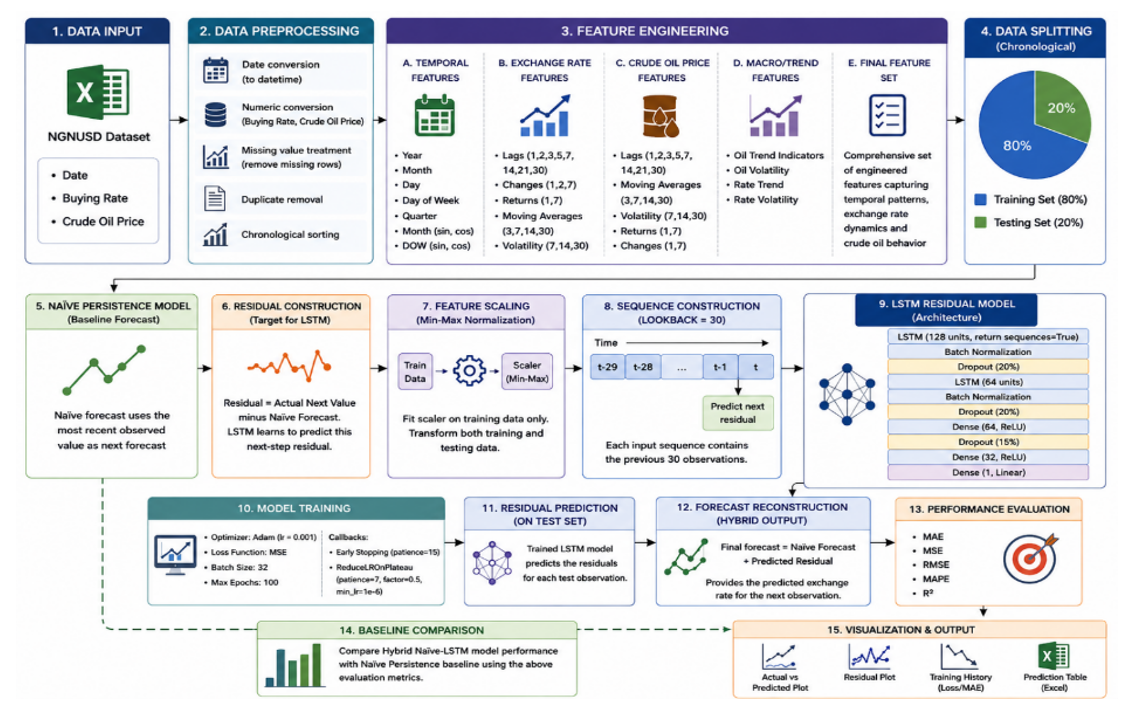
Accurate exchange-rate forecasting is important for financial planning, investment decision-making, and economic risk management, particularly in emerging economies such as Nigeria. This study evaluates a residual-based Hybrid Naïve-LSTM model for forecasting the Nigerian Naira against the United States Dollar using daily Central Bank of Nigeria (CBN) exchange-rate data from October 2009 to August 2026. Brent crude oil prices were incorporated as an exogenous variable, while feature engineering produced 49 predictors comprising exchange-rate lags, returns, moving averages, volatility measures, calendar variables, and crude-oil features. Exploratory analysis indicated strong persistence, non-stationarity, and substantial volatility in the exchange-rate series. The proposed Hybrid Naïve-LSTM model was evaluated against a standalone Naïve persistence model and an ARIMA-LSTM state-of-the-art benchmark under comparable experimental conditions. The results show that the Naïve model achieved the best overall performance, recording an MAE of 15.3367, RMSE of 34.9274, MAPE of 1.3733%, and R² of 0.9947. The proposed Hybrid Naïve-LSTM model achieved an MAE of 18.7539, RMSE of 36.2391, MAPE of 1.8465%, and R² of 0.9943. These findings demonstrate that, despite the ability of LSTM-based hybrid models to capture nonlinear residual patterns, the strong persistence of the Nigerian Naira–US Dollar exchange-rate series enabled the simple Naïve model to outperform the more complex alternatives. The study therefore highlights the importance of benchmarking complex deep-learning models against strong persistence-based baselines when forecasting highly persistent financial time series. Future research should investigate alternative deep-learning architectures with explicit regime-switching mechanisms, multi-horizon forecasting, and a broader set of macroeconomic variables.
References
Abimbola, K. A., Abiola, O. A., & Akinola, S. O. (2022). Predicting the trend of Dollar/Naira exchange rate using regression. Journal of Science and Logics in ICT Research, 8(2), 51–59.
Adekoya, A. F., Nti, I. K., & Weyori, B. A. (2021). Long short-term memory network for predicting exchange rate of the Ghanaian cedi. FinTech, 1(1), 25–43.
Angelo, M. D., Fadhiilrahman, I., & Purnama, Y. (2023). Comparative analysis of ARIMA and Prophet Algorithms in Bitcoin price forecasting. Procedia Computer Science, 227, 490–499. https://doi.org/10.1016/j.procs.2023.10.550
Cheung, Y. W., Chinn, M. D., Pascual, A. G., & Zhang, Y. (2019). Exchange rate prediction redux: New models, new data, new currencies. Journal of International Money and Finance, 95, 332–362.
Ibekwe, U., & Ajijola, L. (2022). Modelling the Naira/US Dollar currency exchange rates using Decision Tree, Ordinary Least Squares and Random Forest machine learning algorithms. UNILAG Journal of Business, 8(2), 53–74.
Ibraeva, Z. E., Bektemyssova, G., & Ahmad, A. R. (2023). Fuzzy model for time series forecasting. Scientific Journal of Astana IT University, 2023, 93–102. https://doi.org/10.37943/13eotu7482
Islam, M. S., & Hossain, E. (2021). Foreign exchange currency rate prediction using a GRU-LSTM hybrid network. Soft Computing Letters, 3, 100009. https://doi.org/10.1016/j.socl.2020.100009
Khashei, M., Bijari, M., & Hejazi, S. R. (2021). Combining seasonal ARIMA models with computational intelligence techniques for time series forecasting. Soft Computing, 16(6), 1091–1105. https://doi.org/10.1007/s00500-012-0805-9
Lawal, M. M., Abdulrauf, A., Delmut, R. D., & Tohomdet, L. K. Evaluating the Effectiveness of ARIMA and LSTM Models in Predicting USD/NGN Trends. Machine learning, 13, 14.
Magaji, B., & Garba, J. (2022). Forecasting the exchange rate of Nigerian Naira to United State Dollar using ARIMA-GARCH model. Dutse Journal of Pure and Applied Sciences, 8(3b), 87–96.
Mahmud, T., Akter, T., Anwar, S., Aziz, M. T., Hossain, M. S., & Andersson, K. (2024). Predictive modeling in Forex trading: A time series analysis approach. In 2024 IEEE Second International Conference on Inventive Computing and Informatics (ICICI) (pp. 390–397). IEEE. https://doi.org/10.1109/ICICI62254.2024.00070
Mudassir, M., Bennbaia, S., Unal, D., & Hammoudeh, M. (2020). Time-series forecasting of Bitcoin prices using high-dimensional features: A machine learning approach. Neural Computing and Applications, 32, 1–15. https://doi.org/10.1007/s00521-020-05129-6
Odion, P. O., Lawal, M. M., & Abdulrauf, A. (2025). A comparative analysis of an enhanced hybrid model for predicting Dollar against Naira exchange rate using deep learning and statistical methods. Journal of Computing Theories and Applications, 2(4), 511–522. https://doi.org/10.62411/jcta.12513
Ukabuiro, I., & Stella, A. (2023). Prediction models for Forex data exchange system. International Journal of Innovative Science and Research Technology, 8(12), 1725–1728.
Ugoh, C. I., Jammeh, L. B., Ugo, M. N., Guobadia, E. K., & Ngene, C. S. (2023). Modeling and forecasting Nigerian Naira/US Dollar and the Gambian Dalasi/US Dollar exchange rates: A comparative study. African Journal of Mathematics and Statistics Studies, 6(1), 12–26. https://doi.org/10.52589/AJMSS-XHLDL3XG
Wang, Y. (2026). Crude oil prices, exchange rates, and monetary policy in Canada. Applied Economics, 1-18.
Downloads
Published
Issue
Section
Categories
License
Copyright (c) 2026 Yusuf Musa Malgwi, Saad Aliyu Abba, Noro Gyemang Pam

This work is licensed under a Creative Commons Attribution 4.0 International License.


