
Antibiofilm Activity of Lactobacillus acidophilus Derived Bacteriocins against Biofilm-Forming Clinical Pathogens
DOI:
https://doi.org/10.33003/fjs-2026-1019-5831Keywords:
Lactobacillus acidophilus, Bacteriocin, Biofilm, Antimicrobial Peptides, Multidrug-Resistant BacteriaAbstract
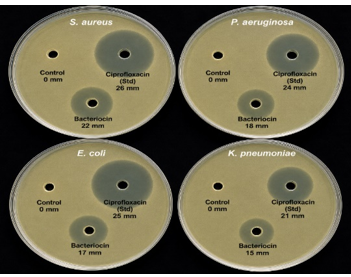
Biofilm-producing bacteria infections have been shown to be a great challenge in the clinic because of the high tolerance of the biofilm to antibiotics and host immune system, hence resulting in antimicrobial resistance. Consequently, natural antibiotics with both antibacterial and antibiofilm abilities are greatly needed. In this study, we investigated the antibacterial and antibiofilm activities of the crude bacteriocin produced by Lactobacillus acidophilus against biofilm producing pathogens such as Staphylococcus aureus, Pseudomonas aeruginosa, Escherichia coli, and Klebsiella pneumoniae. Bacteriocin were prepared from overnight cultures using procedures that involved centrifugation, neutralization, catalase treatment, and membrane filtration of cultures. The activities of bacteriocin were determined using activity units (AU/mL) with Lactobacillus plantarum as an indicator strain. Antibacterial activity was performed using agar well diffusion method and minimum inhibitory concentration (MIC), while antibiofilm activity was done using crystal violet microtiter plate. The bacteriocin has the ability to inhibit all the tested pathogens with inhibition zones of 15.0 ± 0.9 to 22.0 ± 1.2 mm. The bacteriocin has the highest activity against S. aureus while K. pneumoniae was found to be the least susceptible. The MIC values for the strains tested ranged from 25 to 100 AU/mL. Also, the bacteriocin was able to inhibit biofilm formation by 81.5 ± 2.1%, 72.3 ± 1.8%, 68.4 ± 2.0%, and 63.7 ± 1.9% against S. aureus, P. aeruginosa, E. coli, and K. pneumoniae, respectively (P < 0.05). Antibiofilm activity was found to increase dose-dependently with its maximum at 100 AU/mL.
References
Arbulu S, Kjos M. Revisiting the multifaceted roles of bacteriocins. Microb Ecol. 2024. doi:10.1007/s00248-024-02414-5.
Clinical and Laboratory Standards Institute. Performance Standards for Antimicrobial Susceptibility Testing. 33rd ed. Wayne (PA): Clinical and Laboratory Standards Institute; 2023. CLSI supplement M100.
Field D, O'Connor R, Cotter PD, Ross RP, Hill C. In vitro activities of nisin and nisin derivatives alone and in combination with antibiotics against Staphylococcus biofilms. Front Microbiol. 2016;7:508. doi:10.3389/fmicb.2016.00508.
Gaspar C, Donders GG, Palmeira-de-Oliveira R, Queiroz JA, Tomaz C, Martinez-de-Oliveira J, et al. Bacteriocin production of the probiotic Lactobacillus acidophilus KS400. AMB Express. 2018;8:153. doi:10.1186/s13568-018-0679-z.
Hall, C. W., and Mah, T.-F. (2017). Molecular mechanisms of biofilm-based antibiotic resistance and tolerance in pathogenic bacteria. FEMS Microbiol. Rev. 41, 276–301. doi: 10.1093/femsre/fux010
Høiby, N., Bjarnsholt, T., Moser, C., Bassi, G. L., Coenye, T., Donelli, G., et al. (2015). ESCMID∗ guideline for the diagnosis and treatment of biofilm infections 2014. Clin. Microbiol. Infect. 21, S1–S25. doi: 10.1016/j.cmi.2014.10.024
Humphries RM, Hindler JA, Shaffer K,Campeau SA. 2019. Evaluation of ciprofloxacin and levofloxacin disk diffusion and Etest using the 2019 Enterobacteriaceae CLSI breakpoints. JClin Microbiol 57:e01797-18. https://doi.org/10.1128/JCM.01797-18.
Ismael M, Huang M, Zhong Q. The bacteriocins produced by lactic acid bacteria and the promising applications in promoting gastrointestinal health. Foods. 2024;13(23):3887. doi:10.3390/foods13233887.
Li J, Zhang Y, Wang X, Liu H, Chen Z, Zhao L. Lactobacillus-derived components for inhibiting biofilm formation and microbial adhesion. World J Microbiol Biotechnol. 2024;40:117. doi:10.1007/s11274-024-03948-y.
Mokoena MP. Lactic acid bacteria and their bacteriocins: Classification, biosynthesis and applications against uropathogens: A mini-review. Molecules. 2017;22(8):1255. doi:10.3390/molecules22081255.
Murray, C. J. L., Ikuta, K. S., Sharara, F., Swetschinski, L., Robles Aguilar, G., Gray, A., et al. (2022). Global burden of bacterial antimicrobial resistance in 2019: a systematic analysis. Lancet 399, 629–655. doi: 10.1016/S0140-6736(21)02724-0
O'Toole GA. Microtiter dish biofilm formation method. J Vis Exp. 2011;(47):2437. doi:10.3791/2437.
Pérez-Ramos, A., Madi-Moussa, D., Coucheney, F., & Drider, D. (2021). Current knowledge of the mode of action and immunity mechanisms of LAB-bacteriocins. Microorganisms, 9(10), 2107. https://doi.org/10.3390/microorganisms9102107
Rahman MAA, Islam MA, Ahmed T, Biswas PK, Nahar S. Lactic acid bacteria biofilms and their antimicrobial potential against pathogenic microorganisms. Biofilm. 2023;5:100118. doi:10.1016/j.bioflm.2023.100118.
Reuben RC, Torres C. Bacteriocins: Potentials and prospects in health and agrifood systems. Arch Microbiol. 2024;206:233. doi:10.1007/s00203-024-03948-y.
Somsap O, Bangrak P, Bhoopong P, Lertcanawanichakul M. Antibacterial activity and purification of bacteriocin produced by Brevibacillus laterosporus SA14. Walailak J Sci Technol. 2016;13(1):55-65. doi:10.14456/WJST.2016.6.
Subramani T, George EA, Saju AE, Muralikrishnan E, De R, Siddharth AK, Ramaiah S, Anbarasu A. Biofilm-associated antibiotic tolerance in the era of multidrug resistance: quorum-sensing mechanisms and emerging therapeutic strategies. Front Cell Infect Microbiol. 2026;16:1826282. doi:10.3389/fcimb.2026.1826282.
Sugrue I, Ross RP, Hill C. Bacteriocin diversity, function, discovery and application as antimicrobials. Nat Rev Microbiol. 2024;22(9):556-571. doi:10.1038/s41579-024-01045-x.
Thuy TTD, Nguyen HT, Tran TN, Nguyen PH, Le HM. Characterization of the broad-spectrum antibacterial activity of bacteriocin-like inhibitory substance-producing probiotics isolated from fermented foods. BMC Microbiol. 2024;24:115. doi:10.1186/s12866-024-03245-0.
Vani S, Vadakkan K, Mani B. A narrative review on bacterial biofilm: Its formation, clinical aspects and inhibition strategies. Future J Pharm Sci. 2023;9:50. doi:10.1186/s43094-023-00499-9.
Downloads
Published
Issue
Section
Categories
License
Copyright (c) 2026 Sawas Younus

This work is licensed under a Creative Commons Attribution 4.0 International License.


