
Microbial Flora Associated with Different Body Parts of Nile Perch (Lates niloticus) from Kanye Dam, Kano State, Nigeria
DOI:
https://doi.org/10.33003/fjs-2026-1013-5796Keywords:
Bacterial Diversity, Food Safety, Freshwater Fish, Microbial Flora, Kanye DamAbstract
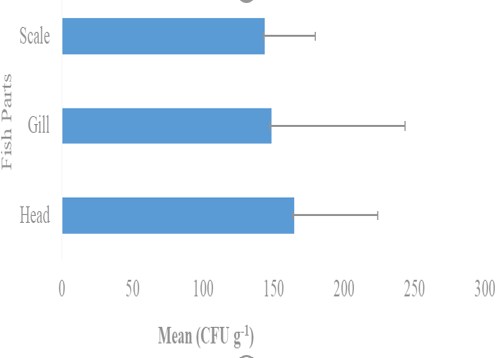
The distribution of microorganisms across body parts of fish reflects their interaction with the aquatic environment and serves as an important indicator of potential public health risks. This study examined the microbial diversity and distribution in different body parts of Nile perch (Lates niloticus) collected from Kanye Dam, using standard microbiological procedures including cultural characterization, Gram staining, biochemical identification, total viable bacterial count (TVC), total anaerobic count (TAC), total fungal count (TFC) and coliform enumeration. The head recorded the highest TVC (164.67 ± 59.38 CFU g⁻¹), while the gills exhibited the highest TFC (136.50 ± 5.26 CFU g⁻¹). Mean TAC values were highest in the head (153.83 ± 33.52 CFU g⁻¹) and scales (153.17 ± 25.46 CFU g⁻¹). Faecal coliform counts were identical (24 MPN/100 mL) across all body parts, whereas total coliform counts ranged from 12.40 to 13.33 MPN/100 mL. Cultural, Gram staining and biochemical analyses identified Enterobacter spp., Escherichia coli, Bacillus spp., Staphylococcus spp., and Shigella spp. Gram-negative bacilli predominated in all samples, with Gram-positive bacteria occurring mainly in the gills and scales. Enterobacter spp. was the most frequently isolated organism, accounting for 100% of head isolates, 75% of gill isolates and 50% of scale isolates. The presence of indicator and potentially pathogenic bacteria highlight the need for improved hygienic handling practices and thorough cooking of Nile perch to safeguard public health.
References
Akano, G. A., Olufade, I. I., Alli, Z. A., Idakwo, A. O., Nwachukwu, C. C., & Akinyemi, T. O. (2025). Microbial diversity and public health implications of bacterial and fungal contaminants in fish pond water from Southwestern Nigeria. Technology (IJOSEET), 17, 47-65.
American Public Health Association (APHA) (2017). Standard methods for the examination of water and wastewater (23rd ed.). APHA.
Amosu, A. O., Hammed, A.M., Adetayo, M. R., Babalola, A. O., Issa, A. O., Sanuth, M. A., & Sapara, G. C. (2026). Nutritional profile and dietary benefits of selected freshwater fish in Ojo Lagoon Ecosystem, Nigeria. Journal of Arid Agriculture, 27 (2), 34-45.
Asnake, W. (2018). Nile Perch (Lates niloticus): The promising white meat of the world. Journal of Nutrition & Food Sciences, 8(2), 680.
Basiita, R. K., Zenger, K. R., Mwanja, M. T., & Jerry, D. R. (2018). Gene flow and genetic structure in Nile perch, Lates niloticus, from African freshwater rivers and lakes. PLoS One, 13(7), e0200001.
Chakma, S., Barua, H., Akter, A., Afroze, S., Faisal, M., & Khan, M. N. A. (2025). Isolation and identification of pathogenic bacteria present in commercially important fish, shellfish, water, and soil samples of Kaptai Lake, Bangladesh. Environmental Microbiology Reports, 17(6), e70252.
Diaz-Mateus, M. A., Smilovitis, A., Salgar-Chaparro, S. J., & Grice, K. (2026). Microbial dynamics and metabolic activity during fish decay under aerobic and anaerobic conditions: insights into microbial fossilization. Frontiers in Microbiology, 17, 1783163.
Diner, R. E., Allard, S. M., & Gilbert, J. A. (2024). Host-associated microbes mitigate the negative impacts of aquatic pollution. Msystems, 9(10), e00868-24.
FAO (2018). The state of world fisheries and aquaculture. Rome: Food and Agriculture Organization of the United Nation.
FAO (2020). The state of food security and nutrition in the world 2020. Food and Agriculture Organization of the United Nations.
FAO and WHO (2021). Microbiological risk assessment - Guidance for food. Microbiological Risk Assessment Series No. 36. Rome. https://doi.org/10.4060/cb5006e
ICMSF. (2018). Sampling to assess control of the environment in Microorganisms in foods 7. Microbiological testing in food safety management. Second edition. Springer. pp: 265-267.
Indabawa, I. I., & Sindama, A. (2018). Physico-chemical attributes of Kanye Dam Reservoir for algal growth, in Kano North-Western Nigeria. Bima Journal of Science and Technology, 2(01), 143-150.
Lawal, K. I., Bichi, A. H., Moruf, R. O., Maradun, H. F., & Dauda, A. B. (2026). Nutritional and microbial evaluation of some frozen marine fish species sold in selected local government areas of Kano State, Nigeria. Acta Scientiarum. Animal Sciences, 48, 1-7.
Lawal-Are, A. O., Moruf, R. O., Ojetola, I. J, Obiakara-Amaechi, A. I., & Usman, B. I. (2022a). Microbial assemblage of the anatomical parts of gercacinid crab from a tropical mangrove swamp. Animal Research International, 19(1), 4333 – 4342.
Lawal-Are, A. O., Moruf, R. O., Ibrahim, O. O., & Ogunbambo, M. M. (2022b). Microbial characteristics of lagoon crab (Callinectes amnicola) as influenced by processing steps. FUW Trends in Science & Technology, 2408–5162, Journal, 7(1), 328 – 332
Lawal-Are, A. O., Moruf, R. O., & Omoyele, I. A. (2022c). Microbial spectrum and antibiotic sensitivity pattern of bacteria isolated from the Spiny Lobster, Panulirus regius (De Brito Capello, 1864). Transylvanian Review of Systematical and Ecological Research, 24 (3),11-22.
Medina‐Félix, D., Garibay‐Valdez, E., Vargas‐Albores, F., & Martínez‐Porchas, M. (2023). Fish disease and intestinal microbiota: A close and indivisible relationship. Reviews in Aquaculture, 15(2), 820-839.
Moruf, R. O. (2022c). Isolation of gut associated bacteria from Callinectes amnicola (Crustacea: Portunidae) collected from two interconnecting tropical lagoons in Nigeria. Sri Lankan Journal of Biology, 2513-2245, 7 (1), 12 – 17.
Olaifa, E. S., Osabuohien, E. S., & Issahaku, H. (2022). Enhancing fish production for food security in Nigeria. Materials Today: Proceedings, 65, 2208-2214.
Ruiz, A., Sanahuja, I., Torrecillas, S., & Gisbert, E. (2025). Anatomical site and environmental exposure differentially shape the microbiota across mucosal tissues in rainbow trout (Oncorhynchus mykiss). Scientific Reports, 15(1), 25653.
Salama, Y. and Chennaoui, M. (2024). Microbial spoilage organisms in seafood products: pathogens and quality control. Eur. J. Microbiol. Infect. Dis, 1(2), 66-89.
Sinha, R., Abu-Ali, G., Vogtmann, E., Fodor, A. A., Ren, B., Amir, A., & Huttenhower, C. (2017). Assessment of variation in microbial community amplicon sequencing by the Microbiome Quality Control (MBQC) project consortium. Nature biotechnology, 35(11), 1077-1086.
Verma, S., Verma, S., Ramakant, R., Pandey, V., & Verma, A. (2025). Comprehensive assessment of physico-chemical and biological parameters in water quality monitoring: A review of contaminants, indicators, and health impacts. International Journal of Horticulture, Agriculture and Food Science, 9(2), 611019.
Downloads
Published
Issue
Section
Categories
License
Copyright (c) 2026 Nmesoma Eunice Eze, Halimat Sadiyat Ahmad, Kadijat Humi Aliyu, Musa Abdurrauf Aliyu, R.asheed Olatunji Moruf, Olayemi Philip Olateju

This work is licensed under a Creative Commons Attribution 4.0 International License.


