
Statistical Relationship between Aerosol Optical Depth and Cloud Optical Properties over Kogi East, Nigeria
DOI:
https://doi.org/10.33003/fjs-2026-1017-5790Keywords:
Aerosol–Cloud Interaction, Aerosol Optical Depth, Cloud Optical Depth, Kogi East, MODIS AquaAbstract
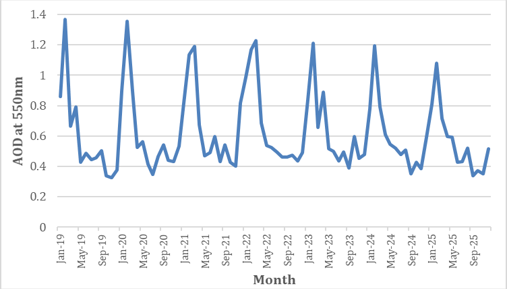
Aerosol–cloud interactions are important components of the climate system because aerosols can modify cloud optical characteristics and influence atmospheric radiation and precipitation. This study investigated the statistical relationship between aerosol optical depth (AOD) and cloud optical depth (COD) over Kogi East, Nigeria, using monthly Moderate Resolution Imaging Spectroradiometer (MODIS) Aqua observations from January 2019 to December 2025. Area-averaged monthly AOD at 550 nm from the Deep Blue land product and combined cloud optical thickness were obtained from the MODIS/Aqua MYD08_M3 Collection 6.1 product through NASA Giovanni. The matched dataset comprised 84 monthly observations. Descriptive statistics, Pearson product-moment correlation and simple linear regression were applied. AOD ranged from 0.3275 to 1.3678, with a mean of 0.6167 ± 0.2583 and a coefficient of variation of 41.89%. COD ranged from 1.9656 to 20.0880, with a mean of 8.2895 ± 4.5910 and a coefficient of variation of 55.38%. A moderate negative correlation was found between AOD and COD (r = -0.4693, p < 0.001). The fitted model was COD = 13.4322 − 8.3394AOD, with R² = 0.2202. Thus, AOD statistically accounted for about 22.02% of the observed variation in COD, while the remaining variation was associated with other atmospheric and cloud-related factors. The findings establish a quantitative baseline for aerosol–cloud studies over Kogi East, but the statistical association should not be interpreted as proof of a causal aerosol effect because meteorological conditions, aerosol type, cloud regime and satellite retrieval uncertainties can influence both variables.
References
Albrecht, B. A. (1989). Aerosols, cloud microphysics, and fractional cloudiness. Science, 245(4923), 1227–1230. https://doi.org/10.1126/science.245.4923.1227
Alfaro-Contreras, R., Zhang, J., Reid, J. S., & Christopher, S. A. (2014). Evaluating the impact of aerosol particles above cloud on cloud optical depth retrievals from MODIS. Journal of Geophysical Research: Atmospheres, 119, 5412–5427.
Bellouin, N., Quaas, J., Gryspeerdt, E., Kinne, S., Stier, P., Watson-Parris, D., Boucher, O., Carslaw, K. S., Christensen, M., Daniau, A.-L., Dufresne, J.-L., Feingold, G., Fiedler, S., Forster, P., Gettelman, A., Haywood, J. M., Lohmann, U., Malavelle, F., Mauritsen, T., ... Stevens, B. (2020). Bounding global aerosol radiative forcing of climate change. Reviews of Geophysics, 58(1), e2019RG000660. https://doi.org/10.1029/2019RG000660
Bender, F. A.-M. (2020). Aerosol forcing: Still uncertain, still relevant. AGU Advances, 1(1), e2019AV000128. https://doi.org/10.1029/2019AV000128
Chetty, N., & Yakubu, A. T. (2022). A decadal assessment of the climatology of aerosol and cloud properties over South Africa. Atmospheric Chemistry and Physics, 22(17), 11065–11083. https://doi.org/10.5194/acp-22-11065-2022
Engström, A., & Ekman, A. M. L. (2010). Impact of meteorological factors on the correlation between aerosol optical depth and cloud fraction. Geophysical Research Letters, 37(18), L18814. https://doi.org/10.1029/2010GL044361
Flamant, C., Knippertz, P., Fink, A. H., Akpo, A., Brooks, B., Chiu, J. C., Coe, H.,
Danuor, S., Evans, M., Jegede, O. O., Kalthoff, N., Konaré, A., Liousse, C., Lohou, F., Mari, C., Schlager, H., Schwarzenboeck, A., Adler, B., Amekudzi, L. K., ... Yoboué, V. (2018). The Dynamics–Aerosol–Chemistry–Cloud Interactions in West Africa field campaign: Overview and research highlights. Bulletin of the American Meteorological Society, 99(1), 83–104. https://doi.org/10.1175/BAMS-D-16-0256.1
Jia, H., Ma, X., Yu, F., & Quaas, J. (2021). Significant underestimation of radiative forcing by aerosol–cloud interactions derived from satellite-based methods. Nature Communications, 12, 3649. https://doi.org/10.1038/s41467-021-23888-1
King, M. D., Platnick, S., Menzel, W. P., Ackerman, S. A., & Hubanks, P. A. (2013). Spatial and temporal distribution of clouds observed by MODIS onboard the Terra and Aqua satellites. IEEE Transactions on Geoscience and Remote Sensing, 51(7), 3826–3852. https://doi.org/10.1109/TGRS.2012.2227333
Knippertz, P., Coe, H., Chiu, J. C., Evans, M. J., Fink, A. H., Kalthoff, N., Liousse, C., Marsham, J. H., McQuaid, J. B., Palacios-Peña, L., Schlager, H., & Taylor, J. W. (2015). The DACCIWA project: Dynamics–Aerosol–Chemistry–Cloud Interactions in West Africa. Bulletin of the American Meteorological Society, 96(9), 1451–1460.
Myhre, G., Stordal, F., Johnsrud, M., Kaufman, Y. J., Rosenfeld, D., Storelvmo, T., Kristjánsson, J. E., Sundet, J. K., & Isaksen, I. S. A. (2007). Aerosol–cloud interaction inferred from MODIS satellite data and global aerosol models. Atmospheric Chemistry and Physics, 7, 3081–3101.
Ntwali, D., & Chen, H. (2018). Diurnal spatial distributions of aerosol optical and cloud micro-macrophysics properties in Africa based on MODIS observations. Atmospheric Environment, 182, 252–262. https://doi.org/10.1016/j.atmosenv.2018.03.054
Nyasulu, M., Haque, M. M., Boiyo, R., Kumar, K. R., & Zhang, Y. (2020). Seasonal climatology and relationship between AOD and cloud properties inferred from the MODIS over Malawi, Southeast Africa. Atmospheric Pollution Research, 11(11), 1933–1952. https://doi.org/10.1016/j.apr.2020.07.023
Oreopoulos, L., Cho, N., & Lee, D. (2020). A global survey of apparent aerosol–cloud interaction signals. Journal of Geophysical Research: Atmospheres, 125, e2019JD031287. https://doi.org/10.1029/2019JD031287
Platnick, S., King, M. D., Ackerman, S. A., Menzel, W. P., Baum, B. A., Riedi, J. C., & Frey, R. A. (2003). The MODIS cloud products: Algorithms and examples from Terra. IEEE Transactions on Geoscience and Remote Sensing, 41(2), 459–473.
Remer, L. A., Kaufman, Y. J., Tanré, D., Mattoo, S., Chu, D. A., Martins, J. V., Li, R.-R., Ichoku, C., Levy, R. C., Kleidman, R. G., Eck, T. F., Vermote, E., & Holben, B. N. (2005). The MODIS aerosol algorithm, products, and validation. Journal of the Atmospheric Sciences, 62(4), 947–973. https://doi.org/10.1175/JAS3385.1
Twomey, S. (1977). The influence of pollution on the shortwave albedo of clouds. Journal of the Atmospheric Sciences, 34(7), 1149–1152. https://doi.org/10.1175/1520-0469(1977)034<1149:TIOPOT>2.0.CO;2
Downloads
Published
Issue
Section
Categories
License
Copyright (c) 2026 Abubakar Rasaq, Egbunu Friday, Aliyu Luqman Ugbede, Abubakar Hamza, Ugbede Akoh, Maji Sunday Benjamin, Ezejah Ofokaja, Onuche Usman Paul, Abubakar Abdulrazaq Ibrahim

This work is licensed under a Creative Commons Attribution 4.0 International License.


