
Organic Encapsulation: Effect of Incorporating Pod Extract (Cola nitida) in CdS as Electron Transport Layer (ETL) in Perovskite Solar Cells
DOI:
https://doi.org/10.33003/fjs-2026-10(ANB-K)-5787Keywords:
Perovskite Solar Cell, Electron Transport Layer, Cadmium Sulfide, Pod Extract encapsulation, Energy BandgapAbstract
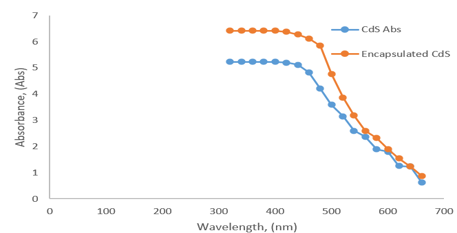
The introduction of organic perovskite solar cells has shown a remarkable development in solar energy technology. It bridges the gap posed by the hazardous and poisonous activities of the pure inorganic perovskite solar cells. This study investigates the effect of incorporating pod extract (Cola nitida) in chemical bath deposited cadmium sulfide (CdS) films as an electron transport layer (ETL) in perovskite solar cells (PSCs). The electrical properties of the encapsulated material were studied, focusing on the electrical resistivity and the measurement of the mobility of the charge carriers. The optical properties were studied using UV-VIS and near-infrared spectroscopy to characterize the material’s response to photon energy. The UV spectroscopy revealed good absorbance across the visible and ultraviolet ranges, with the encapsulated films showing about a 22.7% enhancement compared to the as-deposited film. This enhancement is attributable to the bioactive phytochemicals in Cola nitida such as tannins, flavonoids, and alkaloids, which passivate the surface defects in the film and thus increase the optical path length through modification of the electronic structure. The energy bandgaps of 2.15eV and 2.10eV were obtained for the deposited CdS and encapsulated films respectively. These values are consistent with the widely reported direct band gap of CdS nanoparticles, which usually ranges from 2.10 to 2.5 eV for bulk CdS. The reduction in band gap energy shows agreement with the expected influence of organic encapsulation on the electronic structure of semiconductor nanoparticles.
References
Ahuome, B. A., & Onimisi, M. Y. (2016). Effect of Annealing on Resistivity of Cadmium Sulphide (CdS) Thin-Film Layer, Deposited through Ammonia-Free Chemical Bath Deposition (CBD). Journal of the Nigerian Association of Mathematical Physics. Vol. 37(September 2016), pp 343-346.
Aslam, S., Farooqi, A. S., Yusri, M., Rahman, A., Azrah, S., & Samsuri, M. (2022). Titanium-Based Vacancy-Ordered Double Halide Family in Perovskite Solar Cells. 2100671, 1–13. https://doi.org/10.1002/pssa.202100671
Chaure, N.B., Bordas, S., Samantilleke, A.P., Chaure, S.N., Haigh, J. & Dharmadasa I.M. (2003). Investigation of electronic quality of chemical bath deposited cadmium sulphide layers used in thin film photovoltaic solar cells. Thin Film Solid, Science Direct, Volume 437(1–2) pg 10-17. https://doi.org/10.1016/S0040-6090(03)00671-0
Crossland, E. J. W., Noel, N., Sivaram, V., Leijtens, T., Alexander-Webber, J. A., & Snaith, H. J. (2013). Mesoporous TiO2 single crystals delivering enhanced mobility and optoelectronic device performance. Nature 495, 215–219 https://doi.org/10.1038/nature11936
Dahiru M. S, Bashir A. A. & Muhammad A. A. (2026). Performance Optimization of Double Perovskite Solar Cells Via Absorber Thickness Engineering, Charge Layer Selection, and Effects Using SCAPS- 1D Simulation. Journal of Basics and Applied Sciences Research, 4(3), 106-116. https://dx.doi.oru/10.4314/iobasr.v4i3.12s
Danladi, E., Ichoja, A., Onoja, E. D., Adepehin, D. S., Onwoke, E. E., Ekwu, O. M., & Alfred, D. O. (2023). Broad-band-enhanced and minimal hysteresis perovskite solar cells with interfacial coating of biogenic plasmonic light trapping silver nanoparticles. Materials Research Innovations, 27(7), 521-536. https://doi.org/10.1080/14328917.2023.2204585
Eli, D., Onimisi, M. Y., Garba, S., Gyuk, P. M., Jamila, T., & Boduku, H. P. (2020, March). Improved power conversion efficiency in Perovskite solar cell using silver nanoparticles modified photoanode. In IOP Conference Series: Materials Science and Engineering (Vol. 805, No. 1, p. 012005). IOP Publishing. https://doi.org/10.1088/1757-899X/805/1/012005
Green, M., Ho-Baillie, A. & Snaith, H. (2014). The emergence of perovskite solar cells. Nature Photon 8, 506–514 https://doi.org/10.1038/nphoton.2014.134
Gu, S., Chen, Y., Yuan, X., Wang, H., Chen, X., Liu, Y., Jiang, Q., Wu, Z., & Zeng, G. (2015). Facile synthesis of CeO2 nanoparticle sensitized CdS nanorod photocatalyst with improved visible-light photocatalytic degradation of rhodamine B. RSC Adv. 5(97): 79556–9564. https://doi.org/10.1039/c5ra16114b
Jain, A. S., Pawar, P. S., Sarkar, A., Junnuthula, V., & Dyawanapelly, S. (2021). Bionanofactories for green synthesis of silver nanoparticles: Toward antimicrobial applications. International Journal of Molecular Sciences, 22(21), 11993. https://doi.org/10.3390/ijms222111993
Juarez-Perez, E. J., Sanchez,R. S., Badia, L., Garcia-Belmonte, G., Kang, Y. S., Mora-Sero, I., & Bisquert, J. (2014). Photoinduced Giant Dielectric Constant in Lead Halide Perovskite Solar Cells. J. Phys. Chem. Lett. 3. 5 (13): 2390–2394. https://doi.org/10.1021/jz5011169
Jun, G. H., Jin, S. H., Lee, B., Kim, B. H., Chae, W.-S., Hong, S. H., & Jeon, S. (2013). Enhanced conduction and charge-selectivity by N-doped graphene flakes in the active layer of bulk-heterojunction organic solar cells. Energy & Environmental Science, 6(10), 3000. https://doi.org/10.1039/c3ee40963e
Kanchi, S., & Ahmed, S. (2018). Green Metal Nanoparticles: Synthesis, Characterization and their Applications. Scrivener Publishing, Wiley. ISBN: 978-1-119-41823-8
Kojima, A., Teshima, K., Shirai, Y., & Miyasaka, T. (2009). Organometal Halide Perovskites as Visible-Light Sensitizers for Photovoltaic Cells. Journal of the American Chemical Society, 131(17), 6050–6051. https://doi.org/10.1021/ja809598r
Lateef, A., Azeez, M. A., Asafa, T. B., Yekeen, T. A., Akinboro, A., Oladipo, I. C., ... & Beukes, L. S. (2016). Biogenic synthesis of silver nanoparticles using a pod extract of Cola nitida: Antibacterial and antioxidant activities and application as a paint additive. Journal of Taibah University for Science, 10(4), 551-562. https://doi.org/10.1016/j.jtusci.2015.10.010
Leijtens, T., Lim, J., Teuscher, J., Park, T., Snaith, H. J. (2013). Charge-density-dependent mobility of organic hole-transporters and mesoporous TiO₂ determined by transient mobility spectroscopy: implications for dye-sensitized and organic solar cells. Advanced Materials (Deerfield Beach, Fla.). 25(23):3227-3233. https://doi.org/10.1002/adma.201300947. PMID: 23637046.
Liu, J., Gao, C., Luo, L., Ye, Q., He, X., Ouyang, L., Guo, X., Zhuang, D., Liao, C., Mei, J., & Lau, W. (2015). Low-temperature, solution processed metal sulfide as an electron transport layer for efficient planar perovskite solar cells. J. Mater. Chem. A. 3 (22): 11750–11755. https://doi.org/10.1039/c5ta01200g
Molina-Jiménez, J. P., Horta-Piñeres, S. D., Castillo, S. J., Izquierdo, J. L., & Avila, D. A. (2025). Ultra-Thin Films of CdS Doped with Silver: Synthesis and Modification of Optical, Structural, and Morphological Properties by the Doping Concentration Effect. Coatings, 15(4), 431. https://doi.org/10.3390/coatings15040431
O'Regan, B., Grätzel, M. (1991). A low-cost, high-efficiency solar cell based on dye-sensitized colloidal TiO2 films. Nature 353, 737–740. https://doi.org/10.1038/353737a0
Onimisi, M. Y., & Musa, A. O. (2013). Optimization in the Preparation of Solar Cell Materials. Germany: Lambert Academic Publishing.
Peng, W. C., Chen, Y., & Li, X. Y. (2016). MoS2/reduced graphene oxide hybrid with CdS nanoparticles as a visible light-driven photocatalyst for the reduction of 4-nitrophenol. Journal of hazardous materials, 309, 173-179.
Qu, Z., Ma, F., Zhao, Y., Chu, X., Yu, S., & You, J. (2021). Updated Progresses in Perovskite Solar Cells. Chinese Phys. Lett. 38 (10). https://doi.org/10.1088/0256-307X/38/10/107801
Snaith, H. J., Grätzel, M. (2006). Enhanced charge mobility in a molecular whole transporter via addition of redox inactive ionic dopant: Implication to dye-sensitized solar cells. Appl. Phys. Lett. 25 vol. 89 (26): 262114. https://doi.org/10.1063/1.2424552
Stranks, S.D., Nayak, P.K., Zhang, W., Stergiopoulos, T. and Snaith, H.J. (2015), Formation of Thin Films of Organic–Inorganic Perovskites for High-Efficiency Solar Cells. Angew. Chem. Int. Ed., 54: 3240-3248. https://doi.org/10.1002/anie.201410214
Walker, B., Kim, G. H., Heo, J., Chae, G. J., Park, j., Seo, J. H., & Kim, J. H. (2015). Solution-processed CdS transistors with high electron mobility. RSC Adv. 4 (7): 3153–3157. https://doi.org/10.1039/c3ra44436h
Werner, J.H. (2004). Second and Third Generation Photovoltaics -- Dreams and Reality. In: Kramer, B. (eds) Advances in Solid State Physics. Advances in Solid State Physics, vol 44. Springer, Berlin, Heidelberg. https://doi.org/10.1007/978-3-540-39970-4_5
Xiang, W., & Tress, W. (2019). Review on Recent Progress of All-Inorganic Metal Halide Perovskites and Solar Cells. Adv. Mater. 31, 1902851. https://doi.org/10.1002/adma.201902851
Yang, X., Xu, C., & Giles, N. C. (2008). Intrinsic electron mobilities in CdSe, CdS, ZnO, and ZnS and their use in analysis of temperature-dependent Hall measurements. J. Appl. Phys. Vol. 104 (7): 073727. https://doi.org/10.1063/1.2996032
Yekeen, T. A., Azeez, M. A., Lateef, A., Asafa, T. B., Oladipo, I. C., Badmus, J. A., & Ajibola, A. A. (2017). Cytogenotoxicity potentials of cocoa pod and bean-mediated green synthesized silver nanoparticles on Allium cepa cells. Caryologia, 70(4), 366-377. https://doi.org/10.1080/00087114.2017.1370260
Zhang, W. E. I., Saliba, M., Stranks, S. D., Sun, Y., Shi, X., Wiesner, U., & Snaith, H. J. (2013). Enhancement of perovskite-based solar cells employing core–shell metal nanoparticles. Nano letters, 13(9), 4505-4510. https://doi.org/10.1021/nl4024287
Downloads
Published
Issue
Section
Categories
License
Copyright (c) 2026 Bashir Ahuome Abubakar, Daramola T. Busayo, Adamu M. Aminu, Samaila Muhammad, Shaibu Isah

This work is licensed under a Creative Commons Attribution 4.0 International License.


