
Development of Lubricant Grease from Plastic Wastes for Possible Indusrial Application
DOI:
https://doi.org/10.33003/fjs-2026-1020-5783Keywords:
Plastics, Polyethylene, Pyro-wax, RecyclingAbstract
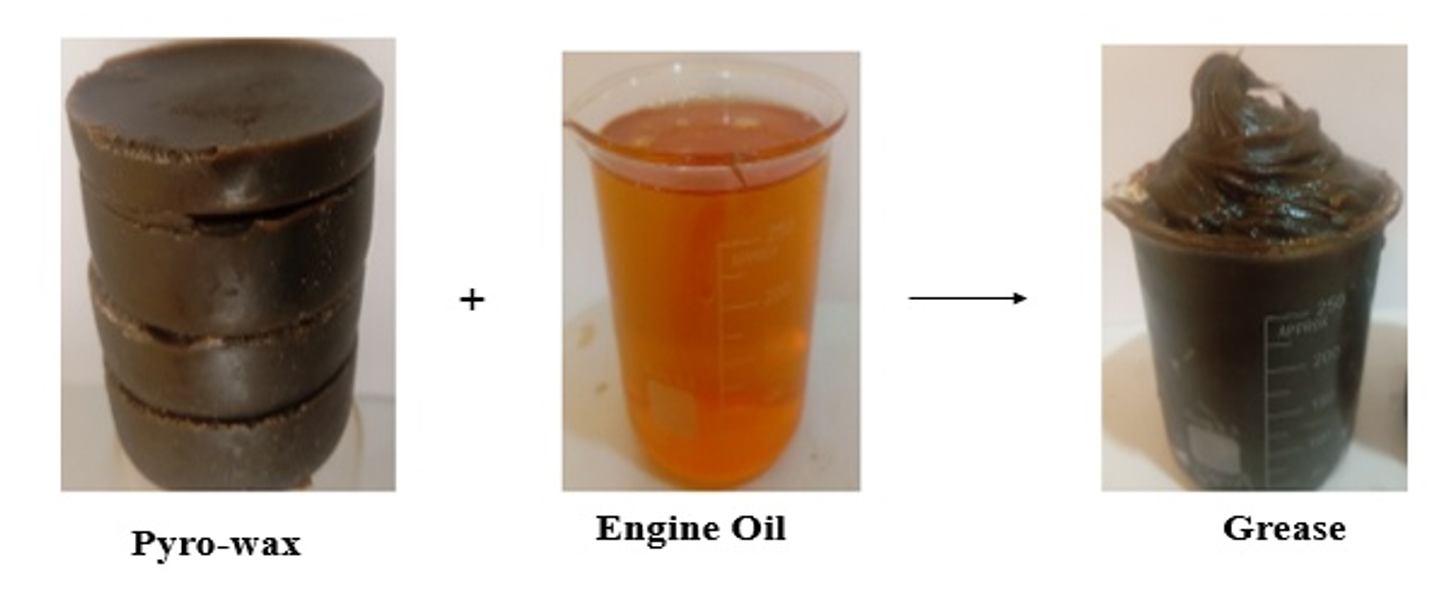
The increasing accumulation of polyethylene plastic waste poses a significant threat to the environment due to its non-biodegradable nature and widespread use in packaging and consumer products. With global concerns over plastic pollution and the urgent need for sustainable waste management solutions, this research proposes the formulation of lubricant grease from polyethylene waste. This made a low-value polyethylene plastic waste into high-value industrial product (lubricant). This involves subjecting shredded polyethylene waste via pyrolysis, producing low molecular weight hydrocarbon product pyro-wax by thermal decomposition, which was used as thickeners replacing metal soap in a conventional grease where 30% weight pyro-wax give a grease NLGI 4 standard value on consistency test 180mm penetration length. Other parameters analyze includes dropping point 118 oC, Oil separation 0.041%, Oil bleeding 0.013%, percentage sample wash-off 0.26%,Oxidation stability 1kPa after 1000hrs and corrosion free all performed using American Society for Testing and Materials (ASTM) standard and the result were within accepted limit of the ASTM standard Grease for bearings lubrication. The significance of this work demonstrates that polyethylene waste can be recycled into a functional lubricant product; these outcomes not only contribute to waste valorization efforts but also encourage innovation in the recycling and up-cycling sector, fostering greener production. It also contributes to circular economy efforts by transforming nuisance into useful engineering materials and also promoting a more sustainable industrial future.
References
Abdulbari, H. A., Abid, R. T. and Mohammad, A. H. A. (2008). Fume silica base grease. Journal of Applied Sciences, 8(4), 687-691. https://doi.org/10.3923/jas.2008.687.691
Aforolagba-Balogun O. T. and Towoju O. A. (2025). Characterization of Fuel Produced from Nylon (Polyamide) and Polyethylene Terephthalate (PET) Wastes with Pyrolysis. FUDMA Journal of Engineering and Technology. 1(2); 367-376. https://sites.google.com/fudutsinma.edu.ng/fjet
ASTM D 128-94a, (1996). Annual Book of ASTM standards/American Society for Testing and Materials.
ASTM D1742 - 06 Standard Test Method for Oil Separation from Lubricating Grease during Storage, ASTM Standard.
ASTM D217-02; (2002). Standard Test Methods for Cone Penetration of Lubricating Grease.ASTM International: West Conshohocken, PA, USA.
ASTM D2265 - 15 Standard Test Method for Dropping Point of Lubricating Grease Over Wide Temperature Range, ASTM Stand. (n.d.).
ASTM D4048-16e1. (2018). Standard Test method for detection of copper corrosion. ASTM International. http://www.astm.org/
ASTM D4049 - 06 Standard Test Method for Determining the Resistance of Lubricating Grease to Water Spray, ASTM Stand. (n.d.).
Bhat, S. A., andCharoo, M. S. (2019). Effect of additives on the tribological properties of various greases-A review. Materials Today: Proceedings, 18(7), 4416-4420. https://doi.org/10.1016/j.matpr.2019.07.410
Bhushan, B. (2013). Introduction to Tribology. Tribology in Practice Series, Wiley, 2013.
Blau, J.P. (2008). Friction Science and Technology: From Concepts to Applications, Second Edition. Mechanical Engineering, CRC Press.
Canter, N. (2012). Grease additives: Important contributors not to be overlooked. Tribology and Lubrication Technology, 68(12), Article 28.
Diphare, M. J., Pilusa, J., Muzenda, E. and Mollagee, M. (2013). “A review of waste lubricating grease management,” in 2nd International Conference on Environment, Agriculture and Food Sciences, Pp. 131–134.
Fern´andez-Silva, S.D.,Garc´ıa-Morales, M., Ruffel, C. and Delgado, M.A. (2021). “Influence of the Nanoclay Concentration and Oil Viscosity on the Rheological and Tribological Properties of Nanoclay-Based Eco-lubricants,” Lubricants, vol. 9, Pp. 1–15.
Gallego, R., Arteaga, J., Valencia, C., D´ıaz, M.J. and Franco, J.M. (2015). “Gel-Like Dispersions of HMDI-Cross-Linked Ligno cellulosic Materials in Castor Oil: Toward Completely Renewable Lubricating Grease Formulations,” ACS Sustainable Chemistry and Engineering, vol. 3, Pp. 2130–2141.
Gorbacheva, S.N., Yarmush, Y.M. and Ilyin, S.O. (2020). “Rheology and tribology of ester-based greases with microcrystalline cellulose and organo modified montmorillonite,” Tribology International, vol. 148, Pp. 106318.
Idisi, B. E. and Ogumeyo, S. A. (2024). A Linear Programming Approach to Optimizing Environmental Resource Management in Urban Areas. FUDMA Journal of Science FJS. DOI: https://doi.org/10.33003/f js -2024 -0806-2770.
Jameel, A. T., Muyubi, S.A., Karim, M.I.A. and Alam, M.Z. (2011). “Removal of oil and grease as emerging pollutants of concern (EPC) in wastewater stream,” IIUM Engineering Journal, vol. 12, no. 4, 2011.
Kaperick, J. P. (2013). Grease thickeners. In Q. J. Wang and Y. W. Chung (Eds.) Encyclopedia of Tribology (Pp. 1562-1567). Springer.
Kozdrach, R. (2020). “The influence of montmorillonite content on change the physicochemical properties of lubricating greases produced from vegetable base oil,” Oil-Gas, vol. R. 76, Pp. 270–278.
Lugt, P. M. (2013), Grease Lubrication in Rolling Bearings, chapter 2, Wiley and Sons Ltd, Chichester, United Kingdom
Mart´ın-Alfonso, J. E., L´opez-Beltr´an, F., Valencia, C. and Franco, J.M. (2018). “Effect of an alkali treatment on the development of cellulose pulp-based gel-like dispersions in vegetable oil for use as lubricants,” Tribology International, vol. 123, Pp. 329–336.
Mohd Najib Razali, M.,Aizudin A., Aziz, W. N., Athirah W. M., Hamdan, N., Adilah M. D. S., and Rosli M. Y. (2017). Synthesis of Grease from Waste Oils and Red Gypsum. Australian Journal of Basic and Applied Science, 11(3): 154-159.
Morrison, F.A. (2001). Understanding rheology. Oxford University Press.
Mortier R. M., Malcolm F. F. and Stefan T. O. (2010). Chemistry and Technology of Lubricants. Third Edition. Springer Dordrecht Heidelberg London New York. https://doi.org/10.1023/b105569 ISBN 978-1-4020-8661-8S.
Nadkarni, R. A. (2007). Guide to ASTM test methods for the analysis of petroleum products and lubricants. 2nd ed. ASTM manual series; no. mnl 44-2nd Includes bibliographical references and index. ISBN 978-0-8031-4274-9
Nowak, P., Kucharska, K. and Kami´nski, M. (2019). “Ecological and Health Effects of Lubricant Oils Emittedinto the Environment,” International Journal of Environmental Research and Public Health Vol.16, Page 3002, vol. 16, Pp. 3002.
Nur Amira F. B., Mohd A. A., Muhammad A. H. and Mohd Azmir A. (2024). Formulation of Lubricating Grease from Waste Oil: A Review Pertanika Journal of Science and Technology 32 (5): 2193 – 2211.
Osemeahon, S. A., Akinterinwa, A., Mohammad, Z.M., Shagal, M.H., Kareem, S.A., Reuben, U., Onyebuchi, P. U., Adelagun, O. R., Alsayah, A.M., Aminu, A. and Dimas, B. (2025). Formulation of binder-extender compositeresin from recycled plastic wastes for the production of emulsion paint. Journal of Reinforced Plastics and Composites 0(0)1–13
Ranskiy, A., Sandul, O., Gordienko, O., Didenko, N. and Titov, T. (2024). Development of new C, S, N-containing plas¬tic lubricants based on products from industrial waste integrated processing. Eastern-European Journal of Enterprise Technolo¬gies, 1 (6 (127)), 13–21. doi: https://doi.org/10.15587/1729-4061.
Razali, M. N., Aziz, M. A. A., Jamin, N. F. M. and Salehan, N. A. M. (2018). Modification of bitumen using polyacrylic wig waste. AIP Conference Proceedings, 1930(1), Article 020051. https://doi.org/10.1063/1.5022945
Rubio-Valle, J. F., Valencia, C., S´anchez, M., Mart´ın-Alfonso, J. E. and Franco, J.M. (2023). “Oil structuring properties of electrospun Kraft lignin/cellulose acetate nano fibers for lubricating applications: influence of lignin source and lignin/cellulose acetate ratio,” Cellulose, vol. 30, Pp. 1553–1566.
Saatchi, A. (2019). The Effect of grease composition on fretting wear. A Dissertation Presented to The Graduate Faculty of The University of Akron.
Silverstein, R. and Rudnick, L.R.(2017).Additives for GreaseApplications. Chemistry and Application. Pp 585-606.
Soltannia, B., Martin-Alarcon, L., Uhryn, J., Govedarica, A., Egberts, P. and Trifkovic, M. (2023). “Enhancedrheological and tribological properties of nanoenhanced greases by tuning interparticle contacts,” Journal of Colloid and Interface Science, vol. 645, Pp. 560–569.
Uhryn, J. J. L. (2024). Investigating tempo-oxidized cellulose nanofiber lubricating greases usingmicroscopy, rheology, and tribology (Master's thesis, University of Calgary, Calgary, Canada). Retrieved from https://prism.ucalgary.ca.
Yousef, S., Eimontas, J., Zakarauskas, K. and Striugas, N., (2021). Microcrystalline paraffin wax, biogas, carbon particles and aluminium recovery from metallised food packaging plastics using pyrolysis, mechanical and chemical treatments. Journal of Cleaner Production, 290, Pp.125878.
Downloads
Published
Issue
Section
Categories
License
Copyright (c) 2026 Sunday Osemeahon, Saminu Mohammed Abdulmalik, Gambo Saljaba

This work is licensed under a Creative Commons Attribution 4.0 International License.


