Point Queue Analysis of Customers Services in South - Western Nigeria
DOI:
https://doi.org/10.33003/fjs-2026-1020-5767Keywords:
Point Queue Analysis, Queuing Theory, Customer Waiting Time, M/M/c Model, Banking Operations, Service EfficiencyAbstract
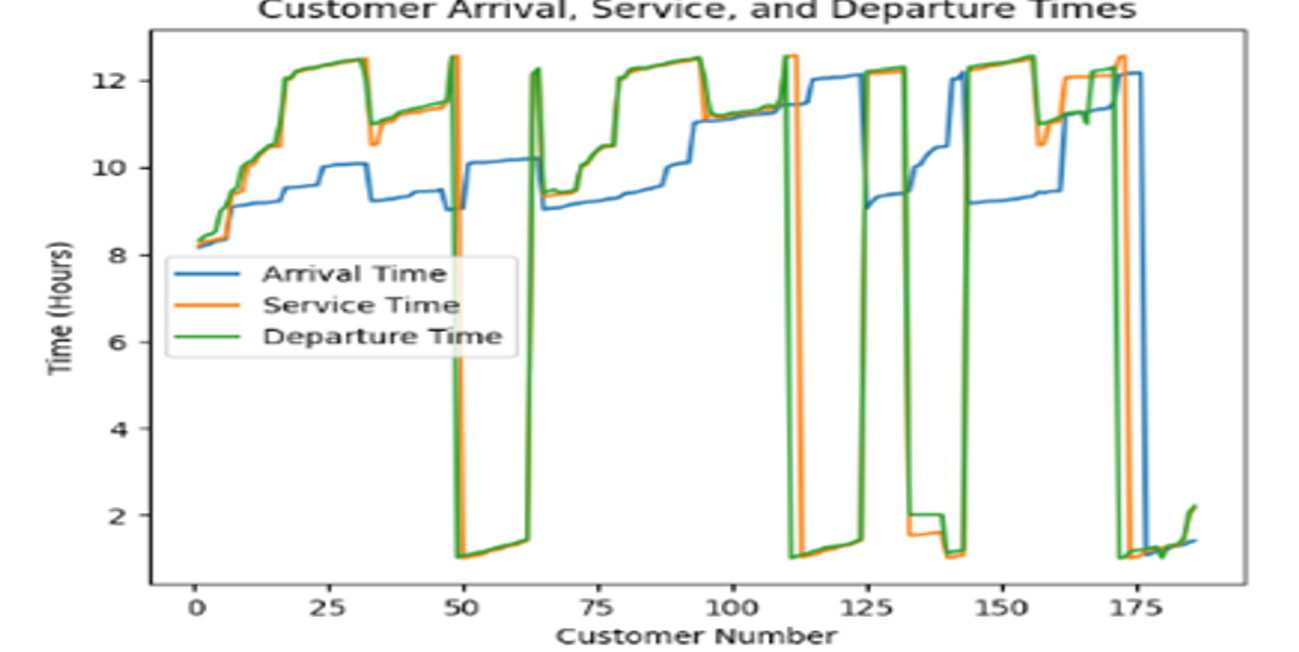
Long wait times and congestion are still problems in Nigerian banking rooms, despite improvements in digital banking services. With a focus on M/M/1 and M/M/c queuing models, this study used point queue analysis to assess the effectiveness of customer service delivery in South-Western Nigeria. Over the course of five weeks, organized observation was used to gather primary data on customer attendance, service, departure, and waiting times. 177 valid observations were examined using statistical and queuing methods following data cleaning. The mean service time was 45.271 minutes, indicating a service rate of 1.325 clients per hour per server, while the mean inter-arrival time was 10.243 minutes, indicating an arrival rate of 5.858 customers per hour. The mean system time was 60.17 minutes, but the empirical mean waiting time was 14.90 minutes. The current four-server system has a utilization rate of 1.105 under the M/M/c model, indicating an unstable system since demand outpaced service capacity. The system was stabilized and utilization was lowered to 0.884 when the number of servers was increased to five, but the anticipated waiting time was still rather high. With six servers, the average waiting time decreased to approximately 11 minutes and system time to about 57 minutes. The results further showed mean waiting times of 81.47, 8.66 and 1.92 minutes for four, five and six servers, respectively. The study concludes that the existing four-server configuration is inadequate, while increasing staffing and reducing service-time variability can substantially improve service efficiency and customer satisfaction.
References
Adams, J. S. (2015). Inequity in social exchange. In L. Berkowitz (Ed.), Advances in Experimental Social Psychology (Vol. 2, pp. 267–299). Academic Press.
Adetunji, A., and Adegoke, T. (2021). Performance appraisal practices and employee motivation in State - owned institutions in Nigeria. Journal of Public Administration and Management Research, 13(2), 45–57.
Afolalu, A. S. and Babaremu, K., (2021). Overview Impact of Application of Queuing Theory Model on Productivity Performance In A Banking Sector. Journal of Physics, [online] 1378(3). Available at: https://iopscience.iop.org/article/10.1088/17426596/1378/3/032033/meta [Accessed 5 March 2022]
Aguinis, H. (2019). Performance management for dummies. John Wiley & Sons, Inc., Hoboken, NJ, pages: 368.
Ahmed, M., Bello, S., and Yusuf, R. (2023). Continuous appraisal and employee motivation in Nigerian civil service organizations. African Journal of Human Resource Management, 15(1), 102–117.
Al-Kandari, N., Al-Sharrah, G., and Al-Enezi, F. (2020). Customer impatience in queuing systems: A survey of balking and reneging models. Journal of Applied Mathematics and Computation, 365(3), 124–138.
Armstrong, M., and Taylor, S. (2020). Armstrong’s handbook of human resource management practice (15th ed.). Kogan Page.
Bolch, S. A., et al. (2018). Survey dataset on analysis of queues in selected service points. Data in Brief, 19, 124–129.
Chukwu, P., and Ibrahim, A. (2024). Digitalized performance appraisal systems and staff motivation in Nigerian public institutions. International Journal of Management and Applied Research, 9(1), 67–82.
Collins, A. J. (2023). Past challenges and the future of discrete event simulation. Simulation Review Journal, 45(2), 221–238.
Erlang’s, A.K. (2021),”The theory of Probabilities and Telephone conversations” (Nyttidsskrift for Mathematic,B,20,p.33.).
Gross, D., and Shortle, J. F. (2018). Fundamentals of queuing theory (5th ed.). Wiley Series in Probability and Statistics pages 576.
Herzberg, F. (2016). Work and the nature of man. Cleveland: World Publishing Company, Cleveland/New York pages 203 – 223.
Kyritsis, A. I. and M. Deriaz, (2019). "A Machine Learning Approach to Waiting Time Prediction in Queuing Scenarios," 2019 Second International Conference on Artificial Intelligence for Industries (AI4I), 2019, pp. 17-21, https://doi.org/10.1109/AI4I46381.2019.00013
Kyritsis, A. I. and Deriaz, M. (2020). "A Machine Learning Approach to Waiting Time Prediction in Queueing Scenarios," 2021 Second International Conference on Artificial Intelligence for Industries (AI4I), 2021, pp. 17-21, https://doi.org/10.1109/AI4I46381.2019.00013 [4] C.
Marin, A., and Rossi, S. (2020). Power control in saturated fork-join queuing systems. Performance Evaluation, 116, 101–118.
Medhi, J. (2017). Stochastic models in queuing theory (2nd Edition). Academic Press, pages 450 – 504.
Mogilner, H. E. Hershfield, and Aaker, J. (2022). “Rethinking time: Implications for well-being,” Consumer Psychology Review, vol. 1, no. 1, pp. 41–53, 2018.
Noe, R. A., Hollenbeck, J. R., Gerhart, B., and Wright, P. M. (2020). Fundamentals of human resource management (9th ed.). McGraw-Hill Education.
Okeke, F., and Okafor, C. (2020). Performance appraisal and employee motivation in Nigerian public service: An empirical investigation. Nigerian Journal of Management Studies, 12(1), 23–39.
Olawale, O. O. et al (2026). Cloud Security Alliance. Cloud Controls Matrix and CAIQ v4.1 Vol.10 No.17 (2026): FUDMA Journal of Science.
Osei, B., and Mensah, D. (2022). Linking performance appraisal and employee motivation in Ghanaian public institutions. Journal of African Business, 23(4), 589–606.
Uddin, N., (2016). Automated Queue Management System. Global Journal of Management and Business Research: A Administration and Management, [online] 16(1).
Vroom, A. S., (2017). Overview Impact of Application of Queuing Theory Model on Productivity Performance In A Banking Sector. Journal of Physics, [online] 1378(3).
Weiss, E., (2018). Queue management: Elimination, expectation, and enhancement. Business Horizons, [online] 61(5).
Downloads
Published
Issue
Section
Categories
License
Copyright (c) 2026 Emmanuel Kayode Shobanke, Olanrewaju Olumide Adekola

This work is licensed under a Creative Commons Attribution 4.0 International License.