
Application of 2-D Electrical Resistivity Tomography and Radiometric Techniques in Assessing Groundwater Vulnerability and Soil Contamination in Jos Mining Area, Nigeria
DOI:
https://doi.org/10.33003/fjs-2026-1013-5758Keywords:
Geoelectrical, Groundwater, Vulnerability, Electrical Resistivity Tomography, Vertical Electrical Sounding, Radiometric, Radionuclides, Mining, Contamination, AquiferAbstract
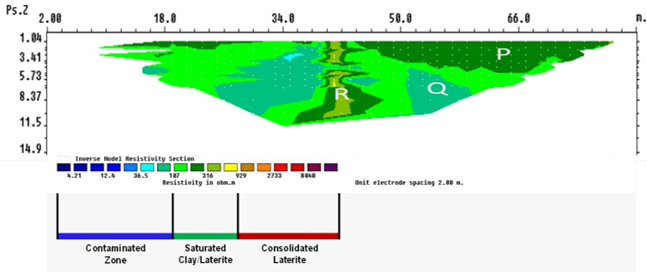
Groundwater resources within mining environments are increasingly threatened by contaminant infiltration and radionuclide migration resulting from intensive mineral exploitation. This study integrates Vertical Electrical Sounding (VES), Two-Dimensional Electrical Resistivity Tomography (ERT), and radiometric techniques to assess groundwater vulnerability and soil contamination in the Rayfield mining area of Jos Plateau, North-Central Nigeria. Geoelectrical investigations were conducted to delineate subsurface lithology, identify aquifer units, and evaluate groundwater vulnerability, while radiometric analyses were performed to determine the distribution and potential hazards of naturally occurring radionuclides. The VES results revealed a seven-layer geoelectric succession characterized by an HQ-type curve, with resistivity values ranging from 20.5 to 509 Ωm. A thick fractured basement aquifer with a resistivity of 271 Ωm and thickness of approximately 36.2 m constitutes the principal groundwater reservoir. ERT imaging delineated three distinct subsurface zones comprising a conductive contaminated zone, saturated weathered materials, and consolidated lateritic-basement formations. A prominent low-resistivity anomaly (<36.5 Ωm) was interpreted as a contaminant plume associated with mining-derived leachates and radionuclide-enriched pore fluids, indicating active contaminant migration through weathered and fractured pathways. Radiometric assessment showed mean values of 88.91 Bq kg⁻¹, 279.4 μSv y⁻¹, 0.24, 0.33, and 0.17 × 10⁻³ for Raeq, AGED, Hex, Hin, and ELCR, respectively, all below internationally recommended limits. However, localized radionuclide enrichment was observed at specific lithological horizons. The integrated interpretation indicates moderate to high groundwater vulnerability despite favourable groundwater potential. The study demonstrates that combining geoelectrical and radiometric methods provides an effective framework for identifying contaminant migration pathways, evaluating environmental risks,...
References
Agbalagba, E. O., & Onoja, R. A. (2011). Evaluation of natural radioactivity in soil, sediment and water around mineralized areas and estimation of associated radiological hazards. Environmental Earth Sciences, 63(5), 1029–1038.
Agbalagba, E. O., Nenuwe, O. N., & Owoade, L. R. (2019). Geophysical survey of groundwater potential and radioactivity assessment of soil depth lithology for drinking water quality determination. Environmental Earth Sciences, 78(24), 1–15.
Akintorinwa, O. J., Atitebi, M. O., & Akinlalu, A. A. (2020). Hydrogeophysical and aquifer vulnerability zonation of a typical basement complex terrain: A case study of Odode Idanre,southwestern Nigeria.Heliyon, 6, e04549. https://doi.org/10.1016/j.heliyon.2020.e04549
Alabi, A. A., Bello, O., Ogungbe, A. S., & Oyerinde, H. O. (2010). Determination of groundwater potential using geoelectric methods in Lagos State University, Ojo. Report and Opinion, 2(5), 68–75.
Ashraf, E. M., El-Kamel, A. H., & Abbady, A. G. E. (2010). Natural radioactivity in building materials. Radiation ProtectionDosimetry,138(3), 241–247.
Avwiri, G. O., Enyinna, P. I., & Agbalagba, E. O. (2012). Assessment of radiological hazards in soil around oil and gas facilities. Scientia Africana, 11(2), 1–12.
Avwiri, G. O., Esi, E. O., & Ononugbo, C. P. (2014). Gonadal dose and radiological health risk assessment of soil samples. Journal of Environmental Protection, 5, 123–131.
Henriet, J. P. (1976). Direct applications of the Dar Zarrouk parameters in groundwater surveys. Geophysical Prospecting, 24(2), 344–353.
International Atomic Energy Agency (IAEA). (2007). Radiation protection and naturally occurring radioactive material (NORM) residues from industrial processes. Vienna, Austria: IAEA.
International Commission on Radiological Protection (ICRP). (2012). Compendium of dose coefficients based on ICRP Publication 60. Oxford, UK: Elsevier.
Khan, A. Y., Ullah, W., Niaz, A., Bibi, T., Imtiaz, M. M., Fiaz, R., Gul, S., Hameed, K., & Islam, F. (2024). Integrated geophysical and geospatial techniques for surface and groundwater modeling. Scientific Reports, 14, 25514. https://doi.org/10.1038/s41598-024-76262-8
MacDonald, A. M., Davies, J., Calow, R. C., & Chilton, P. J. (2002). Developing groundwater: A guide for rural water supply. Rugby, UK: ITDG Publishing.
Oguama, B. E. (2019). Geophysical investigation of groundwater potential and aquifer vulnerability in Nigeria. International Journal of Geophysics, 2019, 1–12. Organisation for Economic Co-operation and Development (OECD). (1979). Exposure to radiation from the natural radioactivity in building materials. Paris, France: OECD.
Ravisankar, R., et al. (2014). Natural radioactivity and radiological hazard assessment in soil samples. Applied Radiation and Isotopes, 87, 59–66.
Taskin, H., Karavus, M., Ay, P., Topuzoglu, A., Hidiroglu, S., & Karahan, G. (2009). Radionuclide concentrations in soil and lifetime cancer risk due to gamma radioactivity in Kirklareli, Turkey. Journal of Environmental Radioactivity, 100(1), 49–53.
United Nations Scientific Committee on the Effects of Atomic Radiation (UNSCEAR). (2000). Sources and effects of ionizing radiation. New York, NY: United Nations.
United Nations Scientific Committee on the Effects of Atomic Radiation (UNSCEAR). (2008). Sources and effects of ionizing radiation: UNSCEAR 2008 report to the General Assembly with scientific annexes. New York, NY: United Nations.
Veiga, R., Sanches, N., Anjos, R. M., Macario, K., Bastos, J., Iguatemy, M., Aguiar, J. G., Santos, A. M., Mosquera, B., Carvalho, C., Baptista Filho, M., & Umisedo, N. K. (2006). Measurement of natural radioactivity in Brazilian beach sands. Radiation Measurements, 41(2), 189–196.
World Health Organization (WHO). (2011). Guidelines for drinking-water quality (4th ed.). Geneva, Switzerland: World Health Organization
Downloads
Published
Issue
Section
Categories
License
Copyright (c) 2026 Timothy Terngu Bem, Yemi S. Onifade, E. O. Agbalagba

This work is licensed under a Creative Commons Attribution 4.0 International License.


