
Phytochemical and Nutritional Evaluation of Shea Tree Organs
DOI:
https://doi.org/10.33003/fjs-2026-1013-5749Keywords:
Vitellaria paradoxa, Nutritional Composition, Sub-Saharan AfricaAbstract
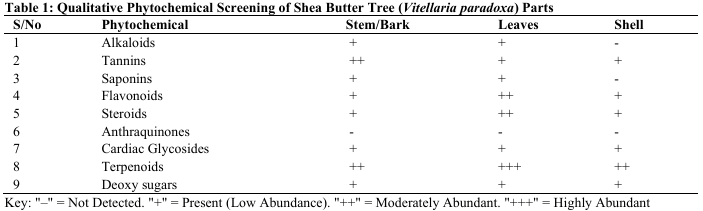
Vitellaria paradoxa (shea tree) is an economically important species in sub-Saharan Africa, but its vegetative parts are less characterized than the commercially valuable shea butter. The qualitative phytochemical profile, proximate composition and physicochemical properties of stem bark, leaves, kernel shell and traditionally processed shea butter were comparatively evaluated. Plant materials were gathered, identified, air-dried and analyzed according to standard AOAC procedures. Qualitative phytochemical screening showed the presence of alkaloids, tannins, saponins, flavonoids, steroids, terpenoids, cardiac glycosides and deoxy sugars in most organs, but not anthraquinones. The leaves had the highest phytochemical intensity, especially terpenoids (+++), while the shell had the lowest diversity. The results of proximate analysis showed that there was a significant difference between the different parts of the plant, with stem bark having the highest ash content (25.10%), shell having the highest crude fibre (54.61%), and leaves having the highest carbohydrate (48.33%), protein (6.41%) and lipid (2.59%) content. Physicochemical evaluation revealed that processing decreased acid value (18.23 to 8.43 mg KOH/g), free fatty acid content (9.12% to 4.22%) and slightly increased peroxide value (4.29 to 6.11 meq O₂/kg). The iodine value was not affected, suggesting that the fatty acid unsaturation was not affected. The results showed that there is a considerable variation in the phytochemical and nutritional composition of the different organs and that the traditional clarification process enhances the hydrolytic quality of shea butter. The present study offers scientific evidence for the medicinal and nutritional applications of various organs of V. paradoxa and emphasizes their potential for...
References
Abubakar, A., Abdulmumin, T., Abdulmumin, Y., Murtala, M., Muhammad, A., Sy, I., Bichi, S., Dalhatu, M., Sarki, S., Shehu, A., Sheshe, S., & Abdullahi, A. (2022). Nutritional and bio-physicochemical characterization of Vitellaria paradoxa butter prepared and sold in Kano, Nigeria. Journal of Pharmacognosy and Phytochemistry, 11(4), 170–175. https://doi.org/10.22271/phyto.2022.v11.i4b.14458
Adekunle, O. A., Ibrahim, S. A., & Lawal, T. M. (2021). Proximate composition of selected underutilized plant parts used in traditional diets. Journal of Food Composition and Analysis, 96, 103690.
Bello, K. O., & Adeyemi, A. R. (2022). Application of univariate and multivariate statistics in food quality evaluation. Food Research International, 152, 110913.
Danquah, C. K., Tetteh, E. K., & Obeng, B. (2023). Standardization of collection and processing procedures for medicinal plant materials in Ghana. Journal of Herbal Medicine, 35, 100592.
Ezeonu, C. S., & Ejikeme, C. M. (2019). Qualitative and quantitative determination of phytochemical contents of indigenous Nigerian softwoods. New Journal of Science, 2019, 1–9.
Hasnat, H., Shompa, S. A., Islam, M. M., Alam, S., Richi, F. T., Emon, N. U., Ashrafi, S., Ahmed, N. U., Chowdhury, M. N. R., Fatema, N., Hossain, M. S., Ghosh, A., & Ahmed, F. (2024). Flavonoids: A treasure house of prospective pharmacological potentials. Heliyon, 10(6), e27533. https://doi.org/10.1016/j.heliyon.2024.e27533
Honfo, F. G., Akissoe, N., Linnemann, A. R., Soumanou, M., & Van Boekel, M. A. J. S. (2020). Nutritional composition of shea products and chemical properties of shea butter. Critical Reviews in Food Science and Nutrition, 54(5), 673–686.
Kolawole, M. T., Adams, M. D., Ibrahim, A. T., Ogundolie, F. A., Olajugbagbe, T. E., & Titilayo, G. I. (2025). Qualitative parameters and deterioration kinetics of palm oil, shea butter and their blend use for frying cheese. BMC Biotechnology, 25(1), 139. https://doi.org/10.1186/s12896-025-01068-z
Lawal, A. O., Sanni, T. A., & Omeiza, H. U. (2023). Nutritional evaluation of lesser-known leafy vegetables consumed in rural communities. International Journal of Food Properties, 26(1), 124–138.
Lawrence, A. A., Oliver, A., & Abdul-Wahab, M. I. (2023). Antimicrobial activities of the extract of shea tree (Vitellaria paradoxa Gaertn. F.) leaf and bark on some selected clinical pathogens. Journal of Medicinal Plants Research, 17(12), 338–344. https://doi.org/10.5897/JMPR2023.7329
Mensah, R. A., Aidoo, R., & Konlan, K. D. (2020). Comparative physicochemical properties of shea butter obtained by traditional and improved processing methods. Journal of Food Science and Technology, 57(11), 3870–3878.
Mohammed, I. H., Halilu, M. E., Atinga, V., Sabo, I., Aliyu, W. A., Yusuf, A. A., Suleiman, A. U., Zainab, M., Garba, I., & Avosuahi, O. R. (2024). Comparative phytochemistry of Vitellaria paradoxa: Towards establishing a chemotaxonomic marker. Malaysian Journal of Pharmaceutical Sciences, 22(1), 61–76. https://doi.org/10.21315/mjps2024.22.1.4
Mohammed, S. B., Adamu, H. M., & Yusuf, A. M. (2021). Phytochemical screening and antioxidant activity of selected Nigerian medicinal plants. BMC Complementary Medicine and Therapies, 21, 210.
Nestor, T., Bertilla, K., & Ronald, B. (2024). Evaluation of phytochemicals, antimicrobial activity and antioxidant potential of methanolic extract of Vitellaria paradoxa nut. World Journal of Biology Pharmacy and Health Sciences, 20(3), 630–641. https://doi.org/10.30574/wjbphs.2024.20.3.1083
Nikiema, P. A., Blecker, C., Danthine, S., Sindic, M., Wathelet, B., Paquot, M., & Lognay, G. (2021). Physicochemical characteristics and quality of shea butter (Vitellaria paradoxa) produced in Burkina Faso. International Journal of Biological and Chemical Sciences, 15(2), 412–425.
Nkoulou, E. T., Mbeng, W. J., & Ngah, A. S. (2024). Metabolic variations in Vitellaria paradoxa: Ecological and physiological implications. African Journal of Plant Science, 18(3), 201–215.
Nuhu, Y., Haruna, H., Namadina, M. M., Yakasai, B. D., & Adamu, M. M. (2021). Pharmacognostic, antioxidant and acute toxicity studies of Vitellaria paradoxa. Bayero Journal of Pure and Applied Sciences, 14(1), 219–226. https://doi.org/10.4314/bajopas.v14i1.32
Ojo, O., Kengne, M. H. K., Fotsing, M. C., Mmutlane, E. M., & Ndinteh, D. T. (2021). Traditional uses, phytochemistry, pharmacology and other potential applications of Vitellaria paradoxa Gaertn. (Sapotaceae): A review. Arabian Journal of Chemistry, 14(7), 103213. https://doi.org/10.1016/j.arabjc.2021.103213
Olamide, A. R., Faleye, F. J., & Oladiran, A. T. (2022). Standard phytochemical screening procedures and their applications in African medicinal plant research. Journal of Applied Biosciences, 176, 18495–18507.
Saady, N. M. C., Hernández, A. V., Flores Servin, K. L., Rodriguez, J. Z., Haque, M. A., Owusu, M. K., Zendehboudi, S., Bazan, C., & Ruiz Espinoza, J. E. (2026). Valorization of agro-food plant wastes: Bioactive compound profiles and biotechnological potential of twenty crops. Recycling, 11(1), 7. https://doi.org/10.3390/recycling11010007
Sale, A. I., Namadina, M. M., Abubakar, F. B., Sani, M. H., Zakari, S. A., & Suleiman, J. (2023). Phytochemical and antibacterial activities of Vitellaria paradoxa and Sclerocarya birrea stem bark and leaves. Dutse Journal of Pure and Applied Sciences, 9(2a), 254–265. https://doi.org/10.4314/dujopas.v9i2a.25
Sirignano, C., Nadembega, P., Poli, F., Romano, B., Lucariello, G., Rigano, D., & Taglialatela-Scafati, O. (2021). Triterpenoids from Vitellaria paradoxa stem barks reduce nitrite levels in LPS-stimulated macrophages. Plants, 10(5), 1006. https://doi.org/10.3390/plants10051006
Sulaiman, M. S., & Abubakar, M. G. (2022). Semi-quantitative phytochemical profiling of selected Sahelian medicinal plants. Journal of Ethnopharmacology, 285, 114900.
Tchobo, F. P., N'Guessan, Y. D., & Soumanou, M. M. (2022). Technological improvements in the extraction and refining of shea butter: A review. European Journal of Lipid Science and Technology, 124(7), 2100278.
Usman, A. A., Akintayo, E. T., & Salihu, S. O. (2021). Use of ANOVA and multiple range tests in evaluating functional properties of composite flours. Journal of Cereal Science, 99, 103206.
Yusuf, A. M., Ibrahim, H. A., & Musa, A. Y. (2020). Influence of drying and grinding conditions on the quality of herbal plant materials. Journal of Applied Research on Medicinal and Aromatic Plants, 16, 100236.
Downloads
Published
Issue
Section
Categories
License
Copyright (c) 2026 Uduakobong Ime Idio, Nkechinyere Nneka Egwim, Anna Florence Samuel, Bukunmi Damilola Olusegun-Awosika, Onyeyirichi Esew, Okpokwu Alexander Ogabidu, Ayotunde Sunday Abe, Francis Iyeh, Evelyn Hope Odeke

This work is licensed under a Creative Commons Attribution 4.0 International License.